


The Screwworm’s Last Waltz Across Texas
The screwworm routinely screwed with the Texas economy prior to 1959, with Southwestern producers losing $50 to $100 million a year. The pest is a fly that lays its eggs in open wounds and body openings such as the eyes, ears, nose, mouth, or genitals. The egg hatches into a parasitic maggot that feeds on living tissue or flesh. Livestock is particularly vulnerable to this organism.
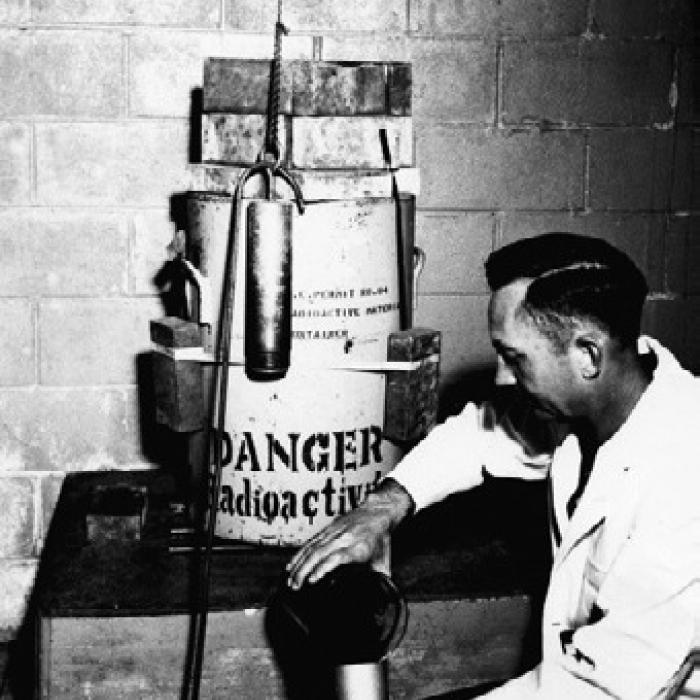
Early work by the federal government and Florida to halt the pest using sterile flies was successful, so the program was extended to the Southwest eradication area (Texas, New Mexico, Arkansas, Louisiana, and Oklahoma) in 1962. The program was based on the fact that female flies mate only once. By releasing an overwhelming number of male flies that have been made sterile by irradiation, the fly population implodes. To aid the effort, ranchers formed the nonprofit Southwest Animal Health Research Foundation in 1961. This group raised over $1.8 million by the end of 1962 for the construction of sterile fly-production facilities. State and federal appropriations followed. A successful meeting regarding support of the fundraising drive was held in Cistern on January 12, 1962. Those planning to donate were urged to make their contribution by February 1.
Fayette County’s fundraising efforts, however, were less than stellar. By the requested date, the county had collected only $4,604.80 toward its $23,000 goal. County Agent Clinton Bippert was not hopeful that the goal would be reached. The amount to be raised was based on asking residents to contribute 50 cents per head of cattle and 10 cents per head of hogs, sheep, and goats they owned. Bippert noted that small farmers with small herds were not in the giving mood.
The flies were stubborn, however. The one plant operating in Kerrville could not keep up with demand, so another was built in Mission. By the summer of 1962, the Mission location was producing over 40 million sterile flies a week.
Because the flies can cover distances of up to 180 miles, the program was later extended into Mexico through a joint eradication program.
By September, 1963, the pests were still tormenting Fayette County. The county agent asked that livestock owners spray their animals with Co-Ral or another suitable spray as soon as possible in the event there was more than one fly in the area. He asked that any wound worms be reported immediately. Also, he advised that the area’s fly drop would be intensified.
The screwworm was eradicated in the United States in 1966 and pushed south to the border between Panama and Colombia by 2000. Since 2023, it has steadily spread northward from South America, through every country in Central America and into Mexico.
As of June 3, 2026, the United States Department of Agriculture’s Animal and Plant Health Inspection Service confirmed that the pest’s larvae had been detected in a three-week-old calf’s umbilical area in Zavala County. Since that time, additional cases have been confirmed.
As they say, history repeats itself.
Sources: Bridges, George W. The Flatonia Argus (Flatonia, Tex.), Vol. 87, No. 3, Ed. 1 Thursday, January 18, 1962, newspaper, January 18, 1962; Flatonia, Texas. (https://texashistory.unt. edu/ark:/67531/metapth985291/m1/1/?q=screw%20worm: accessed June 13, 2026), University of North Texas Libraries, The Portal to Texas History, https://texashistory.unt.edu; crediting Fayette Public Library, Museum and Archives.
CDC New World Screwworm. (https://www.cdc.gov/newworld- screwworm/about/index.html: accessed June 13, 2026).
Fuchs, Durwood L. The La Grange Journal (La Grange, Tex.), Vol. 83, No. 7, Ed. 1 Thursday, February 15, 1962, newspaper, February 15, 1962; La Grange, Texas. (https://texashistory. unt.edu/ark:/67531/metapth1113010/m1/2/?q=screw%20 worm: accessed June 13, 2026), University of North Texas Libraries, The Portal to Texas History, https://texashistory.unt.edu; crediting Fayette Public Library, Museum and Archives.
New World Screwworm Ready Reference Guide-Historical Economic Impact. January 2025. (https://www.aphis.usda.gov/ sites/default/files/nws-historical-economic-impact.pdf: accessed June 13, 2026).
Roberts, Dottie M. The La Grange Journal (La Grange, Tex.), Vol. 84, No. 37, Ed. 1 Thursday, September 12, 1963, newspaper, September 12, 1963; La Grange, Texas. (https://texashistory.unt. edu/ark:/67531/metapth1255456/m1/7/?q=screw%20worm: accessed June 13, 2026), University of North Texas Libraries, The Portal to Texas History, https://texashistory.unt.edu; crediting Fayette Public Library, Museum and Archives.
Sulak, L. J. The Fayette County Record (La Grange, Tex.), Vol. 40, No. 28, Ed. 1 Tuesday, February 6, 1962, newspaper, February 6, 1962; La Grange, Texas. (https://texashistory.unt. edu/ark:/67531/metapth986648/m1/2/?q=screw%20worm: accessed June 13, 2026), University of North Texas Libraries, The Portal to Texas History, https://texashistory.unt.edu; crediting Fayette Public Library, Museum and Archives.
USDA Confirms Presence of New World Screwworm in the United States. (https://www.aphis.usda.gov/news/agency-announcements/ usda-confirms-presence-new-world-screwwormunited- states) accessed June 13, 2026). USDA National Agricultural Library, 1958-1919 (https:// www.nal.usda.gov/exhibits/speccoll/exhibits/show/stopscrewworms--selections-fr/1958-1969: Accessed Jun 13, 2026).
Footprints Of Fayette
Fayette County is one of the most historic counties in Texas. In this weekly feature from the County Historical Commission, a rotating group of writers looks back at local history.