


Revisiting Roselles in My Garden

Iplanted some roselle seed the other day. I grew this plant in 2023 for the first time and saved some seeds. I was worried they would be slow to germinate with the cool weather recently, and the fact that these seeds are a few years old. But to my surprise, they sprouted in just a couple of days.
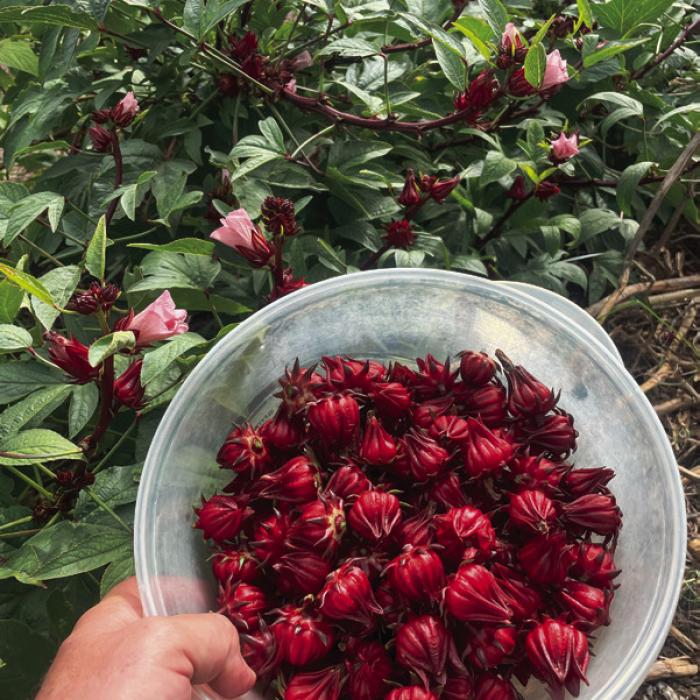
Roselle is a beautiful bushy plant in the hibiscus family. It’s distantly related to cotton and okra. The plants grow into a large bush, about three feet tall by three feet wide or larger, with red stems and dark green foliage. At maturity, lots of attractive pink hibiscus-like flowers begin budding from the stems, followed by crimson- colored “fruits,” which are technically called calyxes.
Inside each calyx is a green seed pod, which is the actual fruit. They can be boiled to produce pectin for jams and jellies. But the real stars of the show are the fleshy crimson petals of the outer covering or calyx. These can be steeped in hot water to make tea or boiled to extract their juice. They taste like cranberries. For that reason, they’re sometimes called “Florida Cranberry.” They’re a slow-growing plant, and the harvest comes in the fall, usually before Thanksgiving. This provides southern gardeners with a great substitute for making cranberry sauce at Thanksgiving, since it is much too warm in the south to grow actual cranberries.
I prefer using it to make drinks. Roselle juice makes an excellent cocktail. The calyx petals dry easily in a dehydrator for long-term storage.
Roselleisquitewellknown outside of the United States in the tropics and subtropic parts of the world. Throughout Latin America, where the plant is often called “Jamaican sorrel” or just “sorrel.” it is used to make a popular summertime drink called agua de Jamaica. It is used similarly throughout Africa and southeast Asia.
But here in the U.S., this plant is relatively unknown outside of the south. Its long growing season and love for the heat limits its growth to the southern parts of the country. I never knew about roselle before seeing it in a seed catalog from Southern Exposure Seed Company.
When I grew it the first time in 2023, I didn’t realize that the leaves were edible. In parts of Africa and Asia, the leaves are a common ingredient in soups and stir-fries. I’ll definitely have to try that this year. I saw one recipe in which the calyxes are cooked in a sweet and sour chicken dish.
In my limited experience, the plants seem to be resistant to disease and our common pests. Once established, it’s fairly drought-tolerant. There’s no reason to relegate roselle to the kitchen garden. It’s a lovely ornamental plant. Consider using it in your landscape as an annual with an explosion of color in the fall.
By the way, I grew way more tomatoes than I need this spring. So here’s an opportunity to grow some of my plants. This Saturday, April 25, I’m going to hold a popup plant sale next to the Fayette County Record Office at 127 S. Washington St. in La Grange. I’ll be there from 10 a.m. to noon. I have two heirloom indeterminate varieties available: Hungarian Heart, a large red heart-shaped tomato; and Afghan Orange, a medium-sized orange tomato that is supposedly very prolific. I’ll also have a few unique peppers. They’re all in 4-inch pots or bigger and I’m selling them for $5 each. I hope to see you there.