


Rev. Carl Baer, German Missionary to Fayette County
Part II
Although he had been hired by the new Evangelical Lutheran Zions Congregation at Waldeck in early 1900, it wasn’t until November 1905 that Carl Baer purchased fifty acres in the rural Walhalla community of Fayette County for $550 in cash. This property in the Vanderwerth League is located along FM 1291 and is still owned by one of the Baers’ great-granddaughters and her husband. The Baer home still stands but is uninhabitable. The Baers were wellknown for their love of music. Carl would conduct services and then move over to the organ and lead the singing of hymns. They both sang beautifully and numerous obituaries and wedding announcements mention their heartfelt duets. During the many years the Baers lived at Walhalla, a pump organ sat near the front door in the hallway of their home. Stories are told of the couple entertaining their assembled neighbors from this doorway.
Baer’s grandchildren had fond memories of sleeping in the Baer’s attic bedroom. From the window you could look out at Minna Baer’s beautiful flowers, the old cistern below and the outhouse a few yards behind the house. They spoke of Polly, the parrot who lived with the Baers for almost half a century, Dixie the beautiful white dog, and their many cats.
The Baers welcomed their first child, Elizabeth “Lissie” on July 9, 1896, while they were living in Giddings. Lissie taught school at Walhalla from at least 1914-1915. She married a career teacher, Fred Mueller, on January 1, 1918. Fred was born in Fayette County’s Bell Settlement in 1883 as one of Friedrich and Lina (Peters) Mueller’s twelve children.
A second daughter, Minna Leonide “Minnie,” was born on September 23, 1903 at Walhalla and baptized on October 18th at Rutersville by her father. Like her older sister, she attended the Waldeck School. Minnie taught at the Nassau School near Winedale during the 1918-1919 school year and at the Mecklenberg School from 1920-1921. On June 7, 1921, she married Alvin F. Kraatz (later shortened to Kratz) who also grew up in Fayette County.
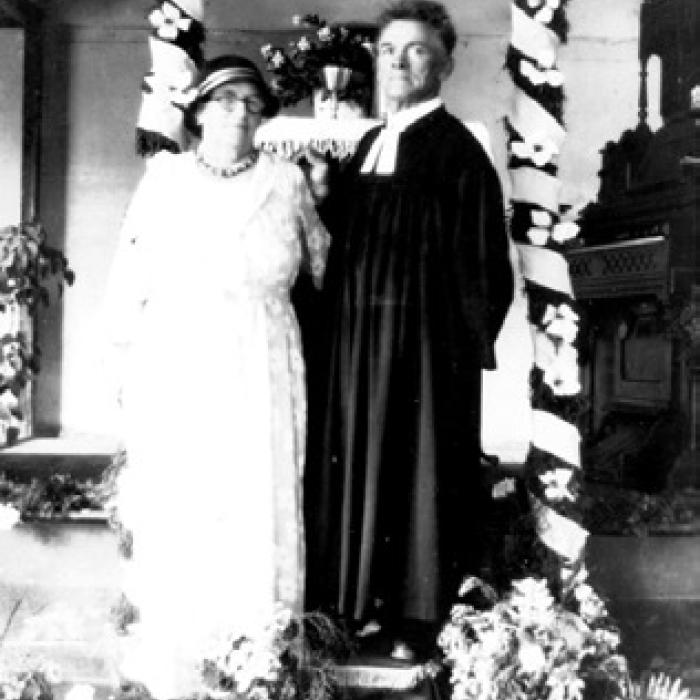
From studying his many photographs, we know that Carl Baer was small in stature and estimate that he was only about 5’4” tall. He was often pictured standing on top of a box draped in fabric. Pastor Baer was described as being “loved by all for his mild manner and gentle, though strict Christian character and was highly regarded as a true God-fearing man.” However, evidently his temper got the better of him on at least one occasion. The June 6, 1901 issue of the La Grange Journal reported that “Rev. Carl Baer was tried in the justice’s court at Round Top Monday for using abusive language, found guilty and fined five dollars and costs; in all amounting to about forty-five dollars.”
We have heard from several local people that their families referred to him as “Preacher Baer.” Because he served at Waldeck for so many years, it was not unusual for him to have baptized, confirmed and married several generations of families.
Because the Lutheran churches in our area were organized by German immigrants and German pastors, German was spoken during church services and church records were written in German script well into the twentieth century. Rev. Baer still held one German service per month at Waldeck as late as 1940, but the United States’ entry into World War II made it complicated to continue that tradition.
Baer’s congregation met in the Waldeck schoolhouse until 1926, when a schism occurred among the members. The Methodist congregation at Long Prairie had declined and eventually dissolved once the Lutherans had organized. After the split, the group that Rev. Baer led bought the old Methodist church building in November 1926. The second group, led by Rev. Brunotte of Carmine, continued to meet in the schoolhouse. When Carl Baer retired in 1944, the two factions reunited and since that time have met at the current location in the former Methodist church.
Minna’s health began to fail in the year following Baer’s retirement and their daughters made plans to move the couple to Minnie’s home in New Braunfels. However, Carl refused to leave his home. On the day an ambulance was sent to move Minna, Carl collapsed. Instead, the ambulance took Carl to the hospital in La Grange where he died about two weeks later on October 4, 1945. He was 77 years old. Minna did spend her remaining years in New Braunfels. She passed away there on January 7, 1951. Both of the Baers are buried in the Waldeck Cemetery.
Unfortunately, most of Rev. Baer’s church records were lost when he destroyed boxes of papers in his last years. He had explained to his daughter, Minnie, that his records were not needed because the members had their certificates—the elaborate baptism, confirmation, and wedding certificates that were popular during those early years.
Using old newspapers, documents, and even photographs, the staff of the Fayette Heritage Museum and Archives is attempting to reconstruct lists of baptisms, confirmations, weddings, and burials at which he officiated. Visitors have brought in family certificates and helped identify some of the many early 1900s photos of people he served. An exhibit based on Rev. Carl Baer is on display until later this spring.
Sources: Waldeck Lutheran Church and Her People, published October 1989the “Carl Baer” and “Waldeck Evangelical Lutheran Church,” Fayette County, Texas Heritage, Curtis Media, 1996.
Wolff, Carl. Mission to Frontier Texas, Volume I, Southwestern Synod of the Texas Evangelical Lutheran Church, 2002.
Carl Baer collection at Fayette Heritage Museum and Archives, 855 S. Jefferson, La Grange, TX
Footprints Of Fayette
Fayette County is one of the most historic counties in Texas. In this weekly feature from the County Historical Commission, a rotating group of writers looks back at local history.