


Life in Early Fayette County
Footprints Of Fayette
Fayette County is one of the most historic counties in Texas. In this weekly feature from the County Historical Commission, a rotating group of writers looks back at local history.
The following excerpts about life in early Fayette County were taken from the “Sketch of Fayette County”, compiled by Laura J. Irvine in 1880 for The American Sketch Book, an Historical and Home Monthly.
“John Duff, or Waco Brown, was captured by the Waco Indians in August, 1825, and by them kept for fifteen months, in their favorite region, of which the present town site of Waco was one of the chief villages. He, by his stay among the Indians, acquired a vast amount of information about the Waco and other tribes, which proved to be of great value to General Austin and the early settlers.” “J.G. Robison was the first to represent this district in the First Congress that convened at Columbia, on the Brazos, in the latter part of 1836, and in February, 1837. He had just returned home, when he and his brother, Walter Robison, were on their way to see a gentleman on business, who were both killed by the Indians on Commings (Cummins) Creek. The same day Mr. and Mrs. Gocher were killed by the same party of Indians on Rabb’s Creek, and three of their children carried off captives, one girl and two boys; they were afterward redeemed by Mr. Spalding, who married the young lady.”
“John G. Robison had in the first session of the First Congress, nominated Andrew Rabb for chief justice of Mina (Bastrop), it being the year previous to the formation of Fayette. He was afterwards a representative in the Second Congress, and upon his resignation he was elected by that body, chief justice of Fayette.”
“The first court held in Fayette County was in the town of La Grange, in a little log cabin.”
“Mr. John E. Lewis, Sr., a veteran of the war for independence, moved to Fayette County in 1833, participated in the Battle of San Jacinto, and he together with J.H. Moore, had the pleasure of guarding the captured Santa Anna. He was the first justice of the peace commissioned in the county (in that day the justice of the peace was also county commissioner) ...”
“John Breeding, one of the old settlers of Fayette County, came to Texas in 1832 ... He was the first sheriff of Fayette County under the Republic ... He died in October, 1869.”
In 1880, “Fayette County has four Texas veterans still living that fought in the Battle of San Jacinto in 1836: Col. Monroe Hill, of Fayetteville; I.H. Hill, of Round Top; Col. Joel W. Robison, of Warrenton; and John E. Lewis, of La Grange.”
“The first cotton crop raised in this county was in 1834 on the farms of Jessie Burnham and Jack Crier.”
“In 1838, Rev. John John Haynie is said to have preached the first sermon in the county.”
“In 1842, the Indians killed one of old Mr. Earthman’s sons and ran another son until he went blind from over-heat and so remained the rest of his life.”
“The last Indian raid in this county was in 1843. Mr. John Lewis says that the Tonkaway tribe would occasionally camp on O’quinn branch ...”
“The first whisky sold in La Grange was brought by a man who went to Houston and sold his horse for a barrel and brought it back on a Truck wagon’ with oxen attached.”
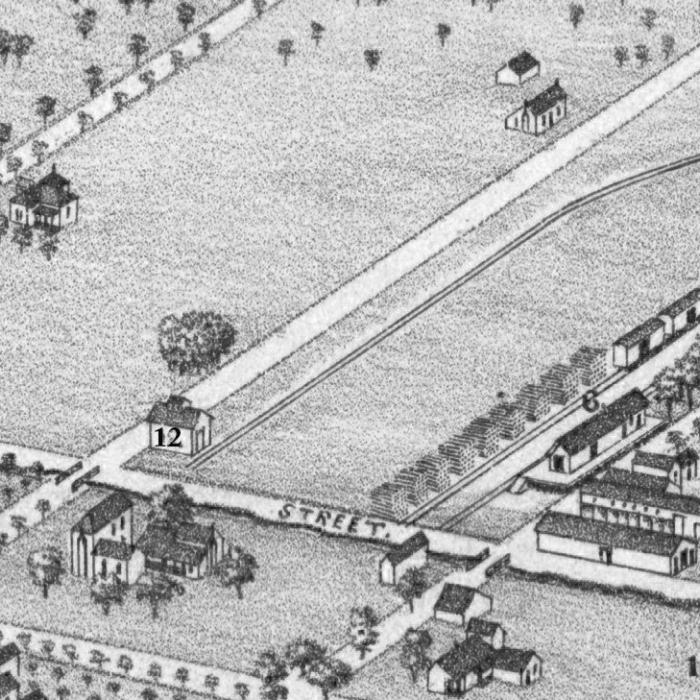
“The Galveston, Houston and San Antonio (rail)road have a branch running from Columbus to La Grange, thirty-one miles. Cars commenced running to that place on the first of January, last 1880.”
“Bradshaw and White have erected a large warehouse at the depot ... Mr. Shumacher has built at the depot a splendid ice house ...”
“The benevolent orders in the city comprise Freemasonry and the Independent Order of Odd Fellows.”
“La Grange has three hotels. The most popular is the “Farquhar House,” W.E. Farquhar, proprietor. It is a two-story building and very convenient for business men.”
“The La Grange ‘Journal’ has lately been purchased by Messrs. Bradshaw, Holloway and Bryan, and is edited by the able editor, Lewis R. Bryan. The ‘Journal’ is a weekly ...”
“The ‘Slovan’ is published in La Grange, and is the only Bohemian paper published in the state. It is a splendid forty column paper, well supported.”