


Footprints of Fayette County: Raisin’ Cane
Footprints Of Fayette
Fayette County is one of the most historic counties in Texas. In this weekly feature from the County Historical Commission, a rotating group of writers looks back at local history.
In 2011, Carolyn Heinsohn wrote a Footprints article titled “Making Molasses.” The article reached out to me in three areas: local history, growing things, and practicing self-reliance. Over a decade later, I finally get to do a follow-up on the subject. Combining history and some historic re-enactment, this is my take.
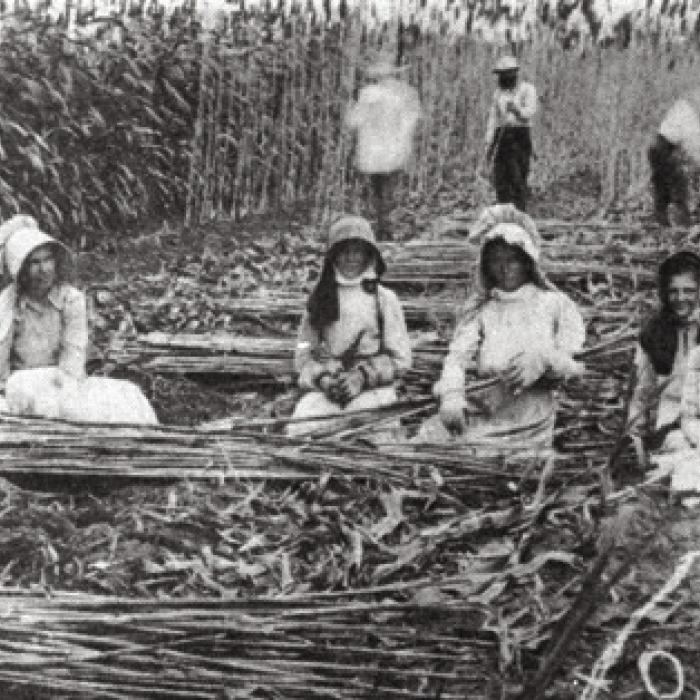
Molasses, along with most raw or refined sugar, is a product of sugar cane. Sweet sorghum syrup is made from sweet sorghum cane. It is a tall grass, high in sugar content, more drought tolerant and has a seed head at the top. Both sugar cane and sweet sorghum were grown on local farms a century ago. Both molasses and sweet sorghum syrup (sorgo) are a perfect mate to biscuits and cornbread. Both make wonderful cookies and both have been distilled into rum. Sorghum was grown as a grain crop in ancient Egypt, spreading across North Africa, Asia and India. Coming to America in the 1800s, it was a good fit for the South and our Mid-West. The hard years during and following the Civil War created shortages for many food items, including sugar. Up steps self-reliance, that thing that my Grandparents called the “make do” attitude. In the late 1800s the influence of German and Czech immigrants reinforced that attitude. Sweet sorghum syrup and molasses became the sweeteners of choice, if not necessity. By the end of WWII improved commerce and shifting trends in our society made it easier to just go to the grocery store. The height of sorghum syrup production in Texas was probably from 1870 to 1940. In my research I have found that most of our local cotton gins had a cane press and cooking equipment to rent or just “loan out.” Going to the gin was often a family outing, not just another workday.
Last year, along with the great folks over at Granny’s Garden, we enjoyed the full sweet sorghum experience. In early June, I planted two rows of Mennonite Sweet Sorghum (heirloom seed) in my garden. With a 110-day maturity cycle, it grew fast in the black-land prairie soil. At the end of September, we cut down the seven-foot stalks, removed the seed heads and leaves, and hauled them to the cane press/cooking shed in the country. Unfortunately, the little mule that drove the cane press had retired some 65 years ago. Our choice for pressing was a small, hand cranked, sugar cane mill that worked great. Our production for the day was about two gallons of a beautiful “light pea green” juice, surprisingly sweet to the taste.
The cooking off or evaporating of water is by far the most complex part of the whole process. While a wood fire would have been the preferred choice, we pulled it off with a gas camp stove and an electric warming pan. The detailed recipe for cooking? Not to worry, the internet is full of “wanna-be” YouTube homesteaders who think they know what they are doing. I think it’s really making videos. At the end of the day our final product was almost two pints of pure sweet sorghum syrup, not some unknown sugary substance out of a plastic container. We never did get to the desired color—that elusive dark amber. But It tasted great on Sylvia’s homemade biscuits the next morning, sort of took me back to my childhood. Was this little experiment in history perfect? No, life never is. But we had the opportunity to learn and re-create a few precious moments in time from the daily lives of our grandparents and great grandparents. What’s next?
The Backstory: I remember syrup cooking days from the late 1950s—you know, those “classic” car years. Joe and “Miss Rosie” Ryza, in their 60s, lived in the first house on Rabb’s Prairie Road. He farmed several plots of black-land prairie and sand bottoms along Jordan Creek. With cotton all around him he chose to grow corn, blackberries, peaches, yellow plums, and sweet sorghum cane. Syrup making day was one of shared work and socializing, still a common neighborhood event in the 1950s.
The center of the operation was the mule powered cane mill (press) that sat between the house and the equipment shed. With a sharp “whoa” or “walk” command that trusty little mule kept the mill turning. Next to the mill would be a group of youngsters, including myself, busy stripping the leaves from the cut cane stalks. It was a long day, with cutting starting at day-break, and the cooking going late into the night. Four to five men, one being my dad, would cut and haul the cane from the field to the mill. Another four to five men would manage the operation of the mill/press, while a larger crew of 12 to 20, mostly women, would oversee the wood fired evaporation trays/pots and bottling operation. Everyone had a job, with another team of five keeping us supplied with fried chicken and sweet tea. The compensation for the day? Each family went home with a full gallon of syrup. Later that night my dad would set our jar of sweet sorghum syrup on the kitchen table and proudly say, “We made that.” I think he would have used the term “we were self- reliant today,” but it was not in common use at the time. I am forever grateful for having been a part of these events.