


Ellinger Declares a Victory Over Its Arsenic Water Woes
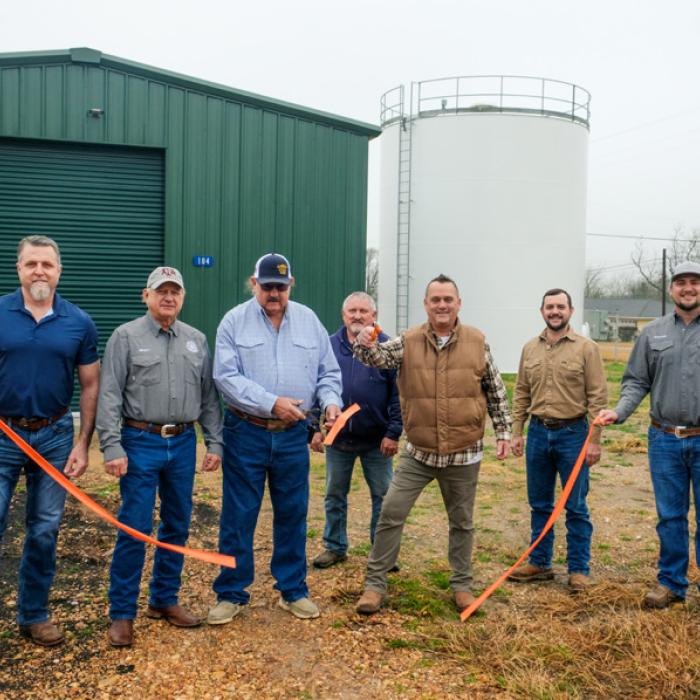
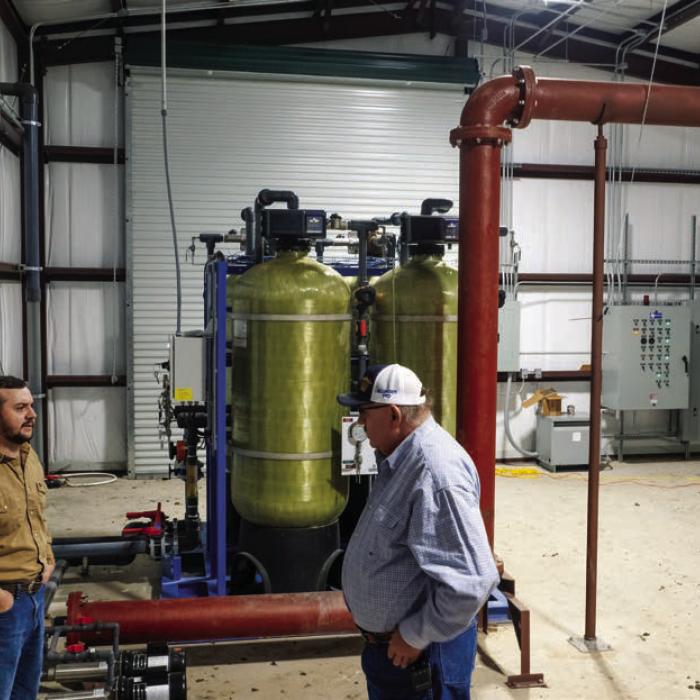
Representatives from Ellinger Sewer and Water Corporation (ESWC) and the City of Ellinger held a ribbon cutting ceremony at the new water treatment facility and storage tank. Pictured (from left) are ESWC Board Member Kevin Coufal, Ellinger Mayor Matt Mikulenka, ESWC President Greg Hunger, Water System Operator Wayne Kocian, ESWC Treasurer Michael Schlabach, Ross Weishuhn of Weishuhn Engineering and Ellinger City Commissioner Cullen Weishuhn. Not pictured were ESWC Directors Bradley Dunk, Paula Urban and Jeffery James, along with James and Barbara Weishuhn of Weishuhn Engineering. Photos by Andy Behlen Ross Weishuhn of Weishuhn Engineering (center) discusses the arsenic treatment system with system operator Wayne Kocian (left) and ESWC President Greg Hunger (right). The town’s drinking water flows through four filtration chambers, pictured above, that are filled with activated charcoal, sand and other materials that separate arsenic from the water.
Ellinger’s long fight against arsenic in its water may have finally come to an end.
Ellinger Sewer and Water Corporation (ESWC) recently completed $1,428,000 in upgrades including an arsenic treatment facility and water storage tank.
The town’s arsenic problems started more than 20 years ago. The groundwater in the Ellinger area naturally has higher levels of the toxic mineral. When the state imposed stricter arsenic controls in the early 2000s, ESWC found itself subject to onerous fines.
As a private non-profit, ESWC couldn’t qualify for the types of state and federal grants that pay for public drinking water improvements.
“We could get loans, but we could never get grants,” said ESWC President Greg Hunger.
Ellinger residents already paid high rates for water and sewer services. And its aging wells couldn’t keep up with growth. The town needed a new source of water.
As the fines racked up, ESWC faced a nearly impossible financial hurdle. The town tried to incorporate in 2015, but that effort failed. Then in 2020, residents relaunched an incorporation effort with a focus on improving the town’s water service. Residents approved it by a vote of 76-44.
Right away, the new City government teamed up with ESWC to solve the arsenic problem. The town applied for funding on behalf of the water utility. At one point, the County considered building a pipeline to connect several water systems, including ESWC, which could have alleviated the arsenic issue. But that project never came to fruition. Instead, ESWC drilled a new water well. It, too, had high levels of arsenic. So in 2022, thanks to a big injection of cash from the Texas Water Development Board, ESWC broke ground on a storage tank and arsenic removal facility. ESWC hired Weishuhn Engineering to design the pro- ject. It is now complete.
ESWC held a ribbon cutting ceremony last Tuesday.
“This is going to Make Ellinger Great Again,” said EWSC Treasurer Michael Schlabach.
He’s not joking. The town is poised for growth with it’s location on the busy SH 71 between Houston and Austin. In 2021, developers wanted to build a 38-unit apartment complex in Ellinger. But those plans had to be scaled back due to the town’s limited water supply. The future is much brighter today. Ellinger continues to grow its infrastructure. Right now, workers are in town installing the town’s first-ever system of fire hydrants. Schlabach said the progress Ellinger has made in the last three years wouldn’t be possible without the close working relationship between the City of Ellinger, ESWC and Weishuhn Engineering.
He also praised State Senator Lois Kolkhorst and State Rep. Stan Kitzman, who represents Fayette County in the State Legislature. Schlabach said the two of them, especially Rep. Kitzman, were instrumental in pushing Ellinger’s water projects through the various permitting processes and bureaucratic hurdles imposed by the state.
“Thanks to Sen. Kolkhorst and Rep. Kitzman, these things are happening in Fayette County,” Schlabach said.
The City of Ellinger also applied for federal mitigation funds through the Texas General Land Office to pay for street and drainage improvements along with a backup generator to power the town’s water system during electrical outages. The town learned Tuesday morning, Jan. 28, that it was awarded $1,588,300 for those projects. The news came just hours before the federal spending freeze implemented by the new Trump administration.