

City of LG Votes To Create New Tax Reinvestment Zone
Here’s Why That Could Mean Big Changes:
The La Grange City Council voted Monday night to create a Tax Increment Reinvestment Zone (TIRZ).
The move will allow the City to engage in Tax Increment Financing (TIF), a property tax funding mechanism for infrastructure projects that can be used to attract developers within the TIRZ. The TIF is not a new tax on development. Instead, it redirects a portion of the tax generated from new development within the TIRZ.
Developers can apply for those funds to pay for infrastructure improvements like roads, water and sewer lines, drainage and landscaping.
The Council voted Monday to hire the consulting firm Pettit & Ayala of Fort Worth to establish the program. Their fee is $40,000. The City will be able to reimburse itself for this cost with funds generated from the TIRZ. Partners David Pettit and Natalie Ayala gave a presentation about the program to the Council Monday night, March 10.
“A lot of times a developer will come in here and say, ‘At my price point, I just can’t make this happen because I can’t pay for the roads, water, sewer, and drainage,’” Pettit said. “What the TIF is essentially doing is creating a zone. You’re currently getting nothing on it. And you put a portion of it back. The developer takes the risk, and they’re getting paid back over time.”
Unlike other economic development incentives, the City can require developers using TIF funds to design their projects in certain ways. For example, if a developer applied to TIF funding to build the roads in a new residential subdivision, the City could require all new homes to have a masonry exterior. In addition, the City could require lot sizes larger than the minimum standards specified in the code of ordinances.
Ayala said cities can also use TIF money to fund their own projects within the TIRZ. One such project could be the downtown plaza that the City wants to build on the old Fayette Electric Coop property just north of the Courthouse Square.
“We had talked to (City Manager Jack Thompson) about a downtown plaza that I think there’s a lot of interest in, street improvements to include Main Street – the public improvements, low-hanging fruit – these are easier sells for the TIRZ board and City Council to sign off on,” Ayala said.
She said the City could use TIF money for railroad crossing improvements, landscaping public art, streetscape improvements, in addition to private development “to incentivize higher quality than what is currently required by the subdivision ordinance.”
Councilman Ken Taylor asked whether setting up a TIRZ would require additional work for the Fayette County Appraisal District (Fayette CAD). Pettit said it shouldn’t require much additional work. The City would provide Fayette CAD with maps of the reinvestment zone, and then Fayette CAD would provide a report to the City each year with the new values for those properties. All the other accounting would take place within City Hall. The City will identify a “base year,” which in this case will likely be 2025. One hundred percent of the base year property tax revenue within the TIRZ will continue to go into the general fund.
But in subsequent years, the City can direct some percentage of the revenue from the increase in property value to the TIF fund. Pettit & Ayala Thompson said that earlier in his career, he was a competitor to Pettit & Ayala. Thompson said he recommended them to the Council based on his respect for their work. In addition, Thompson said he has seen how TIF funding can speed up development not only within a reinvestment zone, but throughout the whole community.
“Often times, too, a lot of what you’ll see is value outside the TIF will grow at an exponentially faster rate than it would have otherwise,” Thompson said.
Pettit and Ayala gave several examples of fast-growing cities that have established these programs, including Elgin, Georgetown (which used it to revitalize their downtown) and Celina (one of the fastestgrowing cities in the nation, which went from population 6,028 in 2010 to 43,317, according to 2023 census data).
Councilwoman Kathy Weishuhn asked about the downsides to forming a TIRZ: “Why not do it?” she asked.
Pettit said one main downside would be granting TIF funds to a developer who would have built a project anyway. He said a natural disaster could also complicate the City’s TIF fund if it wiped out large amounts of property value.
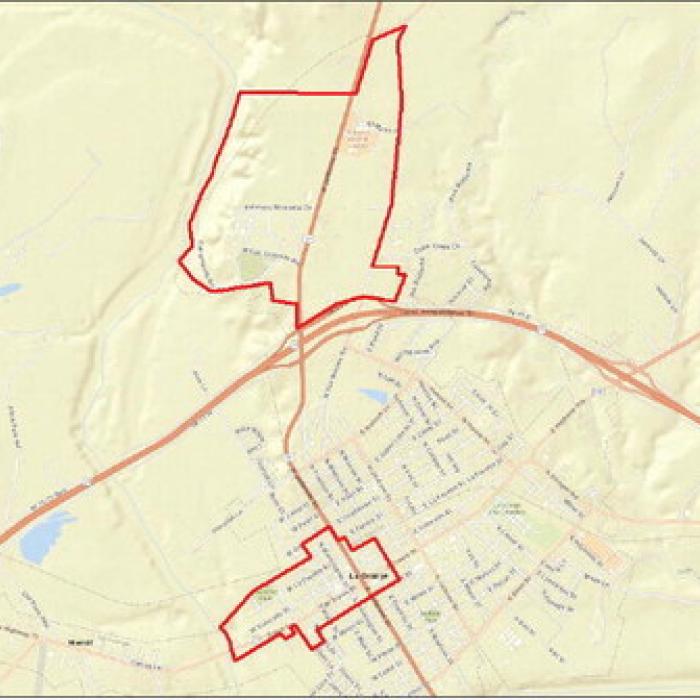
The City will need to pass an ordinance establishing the TIRZ, its boundary, a term (typically 20 years), an advisory board and a preliminary project and financing plan. Pettit & Ayala, in conjunction with City staff, proposed a boundary that includes two non-contiguous parts of the City.
One portion of the zone stretches along US 77 north of SH 71 Bypass that includes the former St. Mark’s Medi-cal Center, the property north of the hospital to FM 2145, the Fayette County Fairgrounds and a large swath of land along the Colorado River north of the Fairgrounds. The other portion of the zone takes in the downtown area, including the old Fayette Electric property.
Thompson said he was aware of one developer who wants to build a subdivision in the northern portion of the zone.