


Adventures in Charcuterie: My First Time Making Summer Sausage
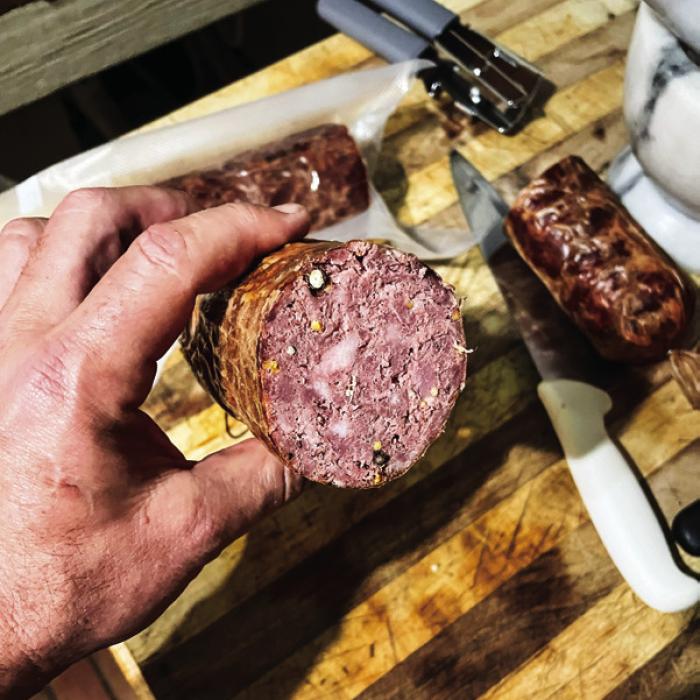

We’re blessed to live in one of the greatest sausagemaking regions of the United States. German and Czech immigrants brought this craft with them when they settled this area generations ago.
Smoking and curing meats was much more important in those days before refrigeration became widely available. In Fayette County, the first rural residents got electricity in the late 1930s. Refrigerators didn’t become common until the 1950s.
Texas, of course, is beef country. But everyone raised hogs. They’re much more manageable for the home butcher. Without refrigeration, a typical family could not consume a fattened calf before the meat went bad. And beef doesn’t really preserve as well as pork.
Bacon and hams made from pork remained a staple, along with sausages, sometimes made from a combination of pork and beef or venison.
Given all this, I’ve always been intrigued by the art of preserving meats at home. I get an itch to make some sausage this time of year. It is the time of year for home butchering, after all. When you try to work with meat in warm weather, it can spoil quickly and the fat tends to melt.
Plus, it’s deer season. Right now, we have two whole deer in our freezer. We always make some into smoked sausage links. But this year I wanted to try something new with our venison meat – summer sausage.
The word “sausage” comes to us by way of French from the Latin word “salsus,” meaning “salted.” It’s a fitting name, because salt is the most important ingredient. I’m talking about regular old table salt. How much salt? I’ve learned that for any sausage recipe, the correct amount of salt is around two percent of the weight of the meat and fat.
This brings us to the next ingredients: freshly ground meat and fat. This means you need a meat grinder. You cannot really make sausage without fat. It carries flavor and gives texture to the finished product. Without fat, sausage would be dry, crumbly meat. The meat could be pork, beef, venison, lamb or even chicken. It doesn’t really matter. It just needs the right amount of fat. How much fat does sausage need? Depending on the recipe, somewhere around 20%. What kind of fat? I think pork fat tastes the best. But sausage can also be made with beef fat.
To make sausage in its simplest form, all you need is some meat, fat and salt (plus a scale). Mix these three ingredients according to the ratios above until it becomes a sticky ball, and you’ll make a delicious pan sausage. Add a few spices like sage and black pepper to make it into breakfast sausage. Or fennel seed and garlic for Italian sausage. Or chili peppers and paprika for chorizo. These are all fresh sausages that can be stored a few days in the refrigerator or frozen for months.
To preserve sausage for longer storage, you need pink curing salt. There are two types: Prague Powder No. 1 (also known as Instacure No. 1) and Prague Powder No. 2 (aka Instacure No. 2). No. 2 curing salt is used in products like salami that are dried for several weeks or months. For the home sausage maker, No. 1 curing salt is all you’ll probably ever use. It’s also more widely available. The pink curing salt sold at H-E-B is the No. 1 variety. You can use it to make bacon, pastrami, and almost every type of smoked sausage. To cure sausage, you need very little curing salt, only 0.25% of the weight of the meat and fat. That amounts to just 5.67 grams in a five lb. batch. For small batches of sausage, you need a fairly precise scale to measure such as small amount.
We now have meat, fat, salt and curing salt. Combine these four ingredients, add a little garlic and black pepper, mix until sticky, stuff it into pig intestines, then smoke at low temperatures for several hours. After four or five hours, gradually raise the smoke temperature until the inside of the sausage gets to 160 degrees F. The result will be a simple, delicious smoked sausage. Spices and herbs such as mace and marjoram often appear in traditional German and Czech-style sausages. After smoking, these sausages can be stored in the refrigerator for a week or two without spoiling, or almost indefinitely in the freezer, if vacuum sealed.
If you mix the meat, fat and spices correctly, you shouldn’t need a binder. The mixture should be very sticky. This is the result of protein extraction. It’s what makes the bits of meat and fat stick together inside the sausage. Binders greatly assist with protein extraction. There are several types. The one most available to the home sausage maker is probably powdered milk. You can buy it at almost any grocery store. And it’s cheap. I use a ratio of between two and four percent of the batch’s total weight.
Summer sausage gets its name from the fact that it doesn’t require refrigeration and can be eaten during the hot months of summer. In Germany, there are all sorts of fermented, smoked and dried sausages. One of the most famous varieties is called landjaeger. It starts out as a typical cured sausage made with pork and beef (or wild game) stuffed into a casing. It’s then fermented. Beneficial bacteria go to work inside the meat, consuming sugars and converting them into lactic acid. This lowers the pH, giving it a signature tangy taste. The acidic environment, along with the curing salt, prevents the meat from spoiling. It’s then smoked and dried.
Traditionally, summer sausage in America was made in this same fashion.
I’m not quite ready to take the plunge into fermented meats. It requires a special chamber to store the sausage at specific temperature and humidity levels while it ferments. Otherwise, bad bacteria can take over and spoil the sausage.
Thanks to modern technology, there is a product available to home sausage makers like myself that can simulate the tanginess of fermented sausage – encapsulated citric acid. These little grains are each made of a tiny droplet of citric acid surrounded by a capsule made of fat. It looks like salt. You mix it with the raw meat along with the rest of the sausage seasonings. When the meat temperature rises above 150 degrees, the capsule melts away, releasing the citric acid into the meat.
Why not just add plain citric acid or lemon juice to the raw meat right away? Well, if you do that, the acid will start cooking the meat like ceviche and giving it a white color and crumbly texture. The recipe I used called for a ratio of one percent of encapsulated citric acid.
Common spices for summer sausage include garlic (0.5%), mustard seeds (0.5%) crushed and whole black peppercorns (0.4%), and coriander (0.25%). Summer sausage also needs a little sugar (about 0.5%).
The recipe I used also called for a liquid at ten percent of the weight of the meat. I used plain water.
I mixed all of these ingredients together except for the encapsulated citric acid. I was worried about the capsules bursting during the mixing process. So I mixed them at the very end. Finally, I stuffed the mix into 2½ inch fibrous casings and smoked the sausages on my pellet grill. The lowest I could get the temperature to go was about 160 degrees. I smoked them until the internal temperature got to 150 degrees. I think dunked them in an ice bath to completely stop the cooking. I make sure to do this with any smoked sausage. It greatly improves the texture. And it gives natural casings a snappier bite.
I left them on the countertop uncovered for a day before slicing into the first one. I think I did a pretty good job. It definitely tastes like summer sausage. The bind could have been a little better. There were a few crumbly spots. We shared all of it at Christmas with family. Now I’m out. I guess I’ll have to make another batch for myself. This time, I might try the traditional fermented method. But I’ll have to build some kind of fermentation chamber first. I hear you can make one pretty easily out of an old refrigerator. Has anyone tried this? I’d love to hear about it. Email me at andy@fayettecountyrecord.com.