


Van Dresar Says Fayette’s Groundwater Safe from Large Scale Developers
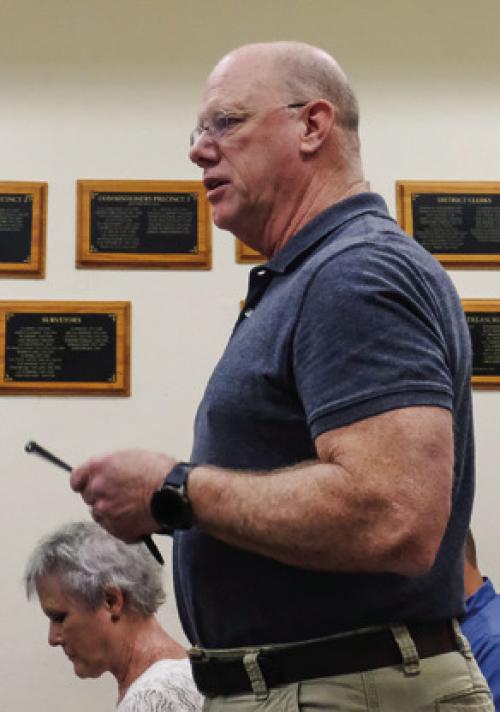
The Fayette County Commissioners Court invited Fayette County Groundwater Conservation District Manager David Van Dresar to their meeting last Thursday at the Courthouse. Van Dresar spoke to the Court about a hot topic in Fayette County lately – data centers and their impact on groundwater resources.
Remember When?
The wreckage of a twinengine plane and its two fatally injured occupants from McAllen, Texas, were discovered near Waldeck around mid-morning Wednesday. Sheriff T.J. Flournoy, who headed the local investigation, said the Cessna 402B was apparently flying in a southerly direction on Tuesday night when it clipped a grove of trees and came apart on the Steglich place on County Rd. 137. The aircraft had taken off earlier that night from the Austin airport.

Cattle Thieves and Gamblers
Over the last 120 years, there have been an incomprehensible number of changes in our society. However, the use of the news media to sway our thoughts and actions seems to still occur daily. This installment in the Footprints of Fayette shows the reader that this aspect of our society has not changed that much. Opinions, money, and the lure of worldly possessions seem to always remain the same, and the power of the printed word can bring out the good and the bad in people. In a 1916 article in the La Grange Journal, an informative and likewise humorous incident that happened in nearby Columbus was told. The tale had a Fayette County connection, and it involved cattle thieves and gamblers. Our story was spun by Mr. August Palm, a man of Swedish descent and most likely Swante Palm’s nephew. In the 1860 U.S. Census, he was listed as working as a clerk and living in Austin. Before the story, one thing should be noted. Regarding the topic of cattle thieves and gamblers, the television and movie industry seem to have a surfeit of each of these types of characters in just about every production with a “western” theme. In reality, the theft of livestock is a recurring issue even in Central Texas, and the Fayette County area. The Texas and Southwestern Cattle Raisers Association, working with its commissioned peace officers, investigates an average of $5 million in stolen cattle and other assets for ranchers annually. Longtime sheriff of Fayette County, Will Loessin (Sheriff from the mid-1920s to the mid-1940s) was involved in many cases of cattle and horse theft. In an incident in 1938, Sheriff Loessin and Deputy Cooper of Flatonia followed horse tracks for a distance of 31 miles from Cistern, well into Caldwell County, before they were able to catch up with a horse thief. Mr. Loessin reported that it was the first time in forty years that he had to follow the hoof tracks of a mare and her colt down country roads in order to safely return them to their rightful owner.