

Van Dresar Says Fayette’s Groundwater Safe from Large Scale Developers
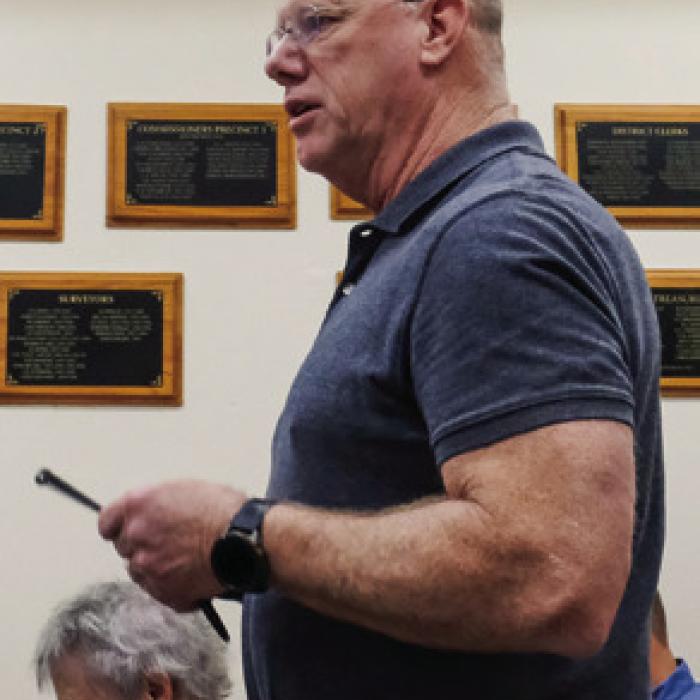
The Fayette County Commissioners Court invited Fayette County Groundwater Conservation District Manager David Van Dresar to their meeting last Thursday at the Courthouse.
Van Dresar spoke to the Court about a hot topic in Fayette County lately – data centers and their impact on groundwater resources. Data centers use water to cool computer equipment that powers the increasing global demand for artificial intelligence services. Some new technologies are being developed to lessen their water needs. Currently, however, most data centers require massive amounts of water. Companies building these data centers often locate them in rural areas where land is cheaper. That means they usually require groundwater for their cooling needs – and lots of it.
“This is something that the water planning groups from the region are just getting started with in this next cycle,” Van Dresar said. “We do have groundwater conservation districts surrounding us that seem to have these units that are coming in right now.”
One of those is a large data center currently under development near Brenham in Washington County, which does not have a groundwater conservation district. Van Dresar said that here in Fayette County, large consumers of groundwater are subject to permitting and rationing requirements set by the local groundwater conservation district. In places like Washington County that do not have such a district, the only rule in place is the so-called “Rule of Capture.”
“The rule of capture says the biggest pump gets all the water,” Van Dresar said.
If some company wants to drill a water well for large commercial or industrial purposes here, Van Dresar said they would need a permit from the Fayette County Groundwater Conservation District. However, he said, local groundwater resources cannot accommodate the amount of water data centers need.
“Some of the questions that keep getting asked of me: is there (a data center) that could come into Fayette County?” Van Dresar said. “No. Why? We cannot produce that volume of water that they’re looking for. We just cannot. The groundwater here is stingy. It’s good for domestic use, livestock use, and small cities. It just cannot produce these volumes that these people are wanting.”
According to Fayette County Groundwater Conservation District rules, if a data center needed 40,000 acrefeet of water, they would need complete control over 20,000 contiguous acres.
“I just don’t see 20,000 acres getting sold or leased to a company like that in Fayette County,” Van Dresar said. “The same is true with the water marketers and these kinds of large productions that are taking water and sending it somewhere else. They have to own and control the water rights on that land to equal the amount that they want to purchase, or to produce, and I just don’t see people giving it up.”
Of all the different aquifers that lie underneath Fayette County, Van Dresar said, only the Carrizo Aquifer offers enough volume to satisfy the needs of data centers. But only a “small sliver” of that aquifer lies under Fayette County, which is located along the Bastrop County line, he said. Most of the County gets its water from the shallower Gulf Coast Aquifer, which doesn’t provide enough volume, he said.
Van Dresar said oil drilling uses large volumes of water, especially during fracking operations. However, he said those usages are short-lived.
“Their usage right there may be high for a very short duration, then the aquifer comes back to stabilize,” he said.
On another water topic, County Judge Dan Mueller asked Van Dresar whether the current drought is worse than the historic drought of 2011. That’s the year of the Bastrop Lost Pines Fire and several other major grass fires that burned thousands of acres in Fayette County.
“It is not worse,” Van Dresar said. “Remember, in 2011, we weren’t getting these sporadic showers. It was a solid year of nothing but dry.”
Mueller noted that the driest part of 2011 was during the hot summer months, which made the lack of rainfall even more noticeable.