


Walking the Earth With Eyes Turned Skyward
LG Aviator Dick Peck Never Tires of the Exhilaration of Flight

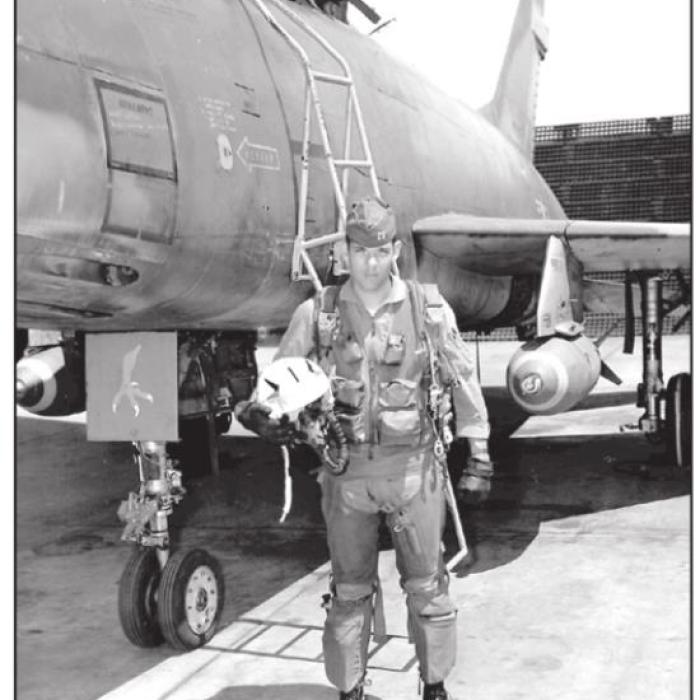
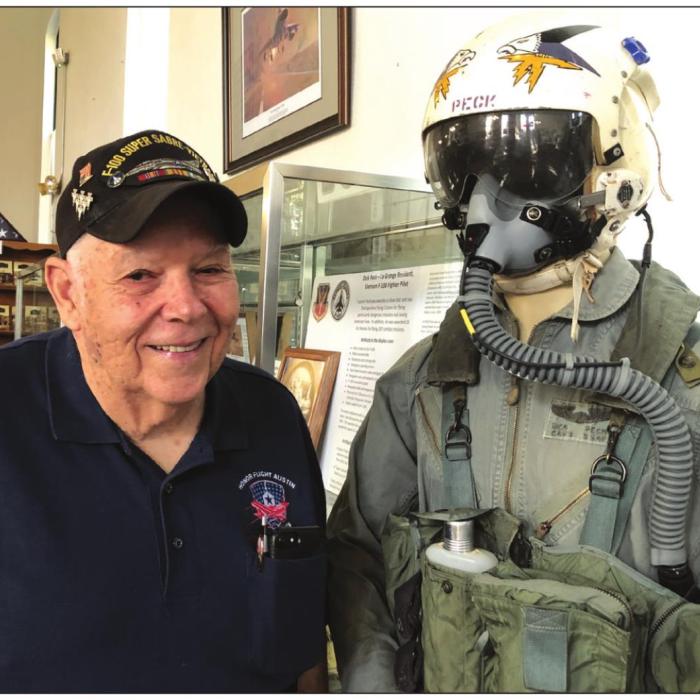
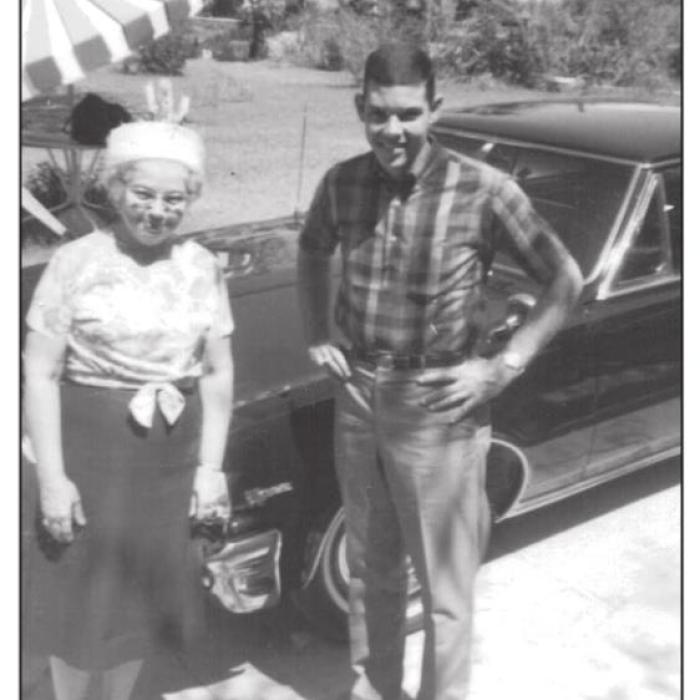
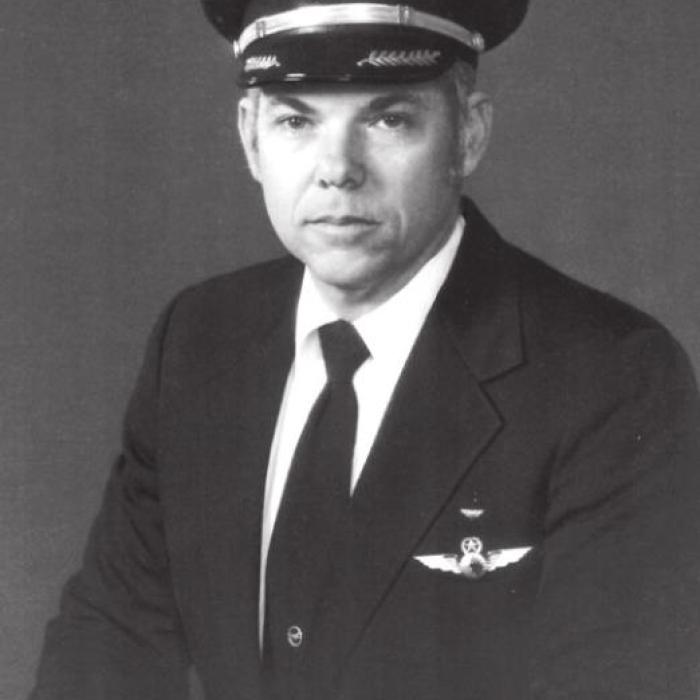
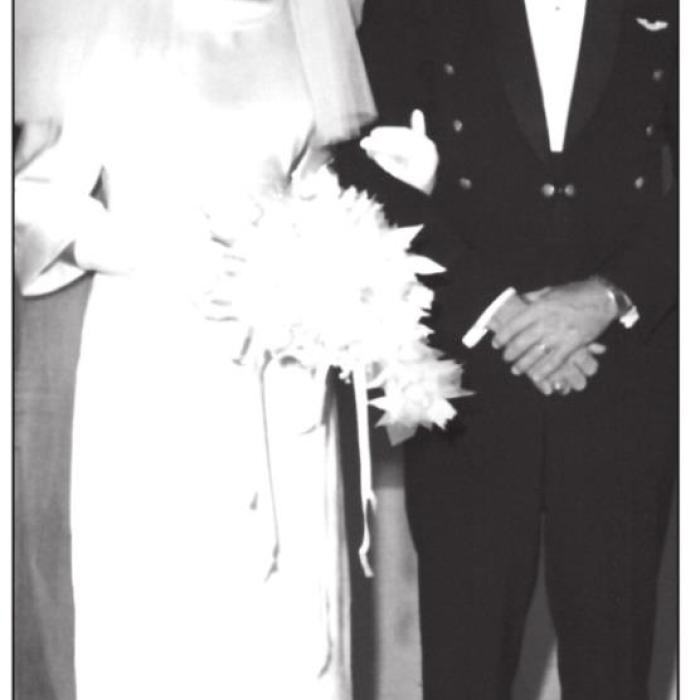
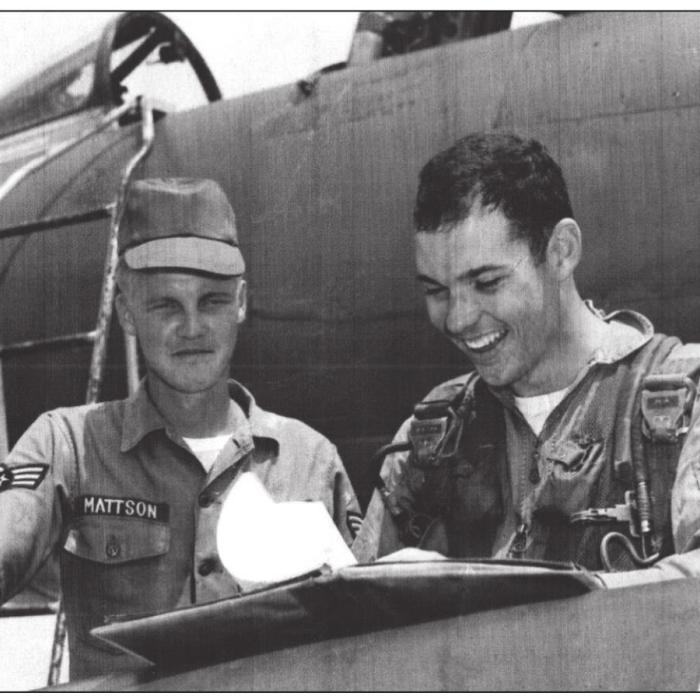
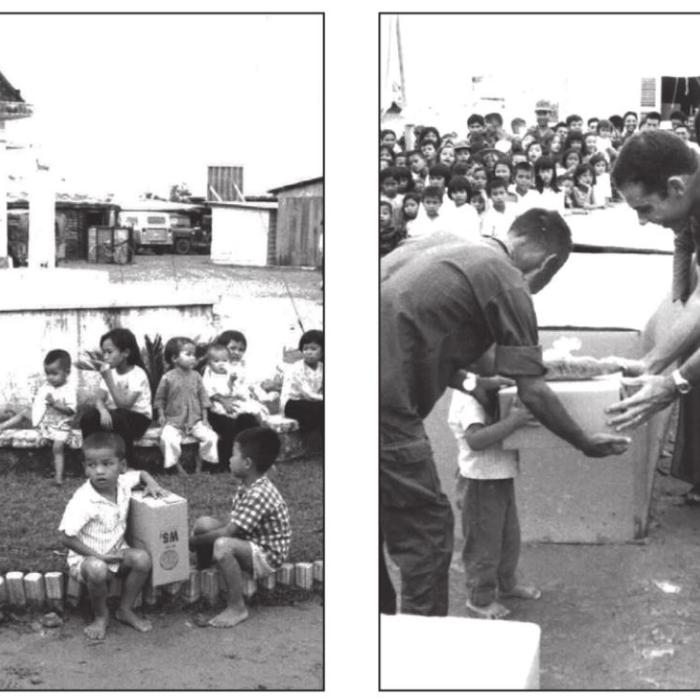
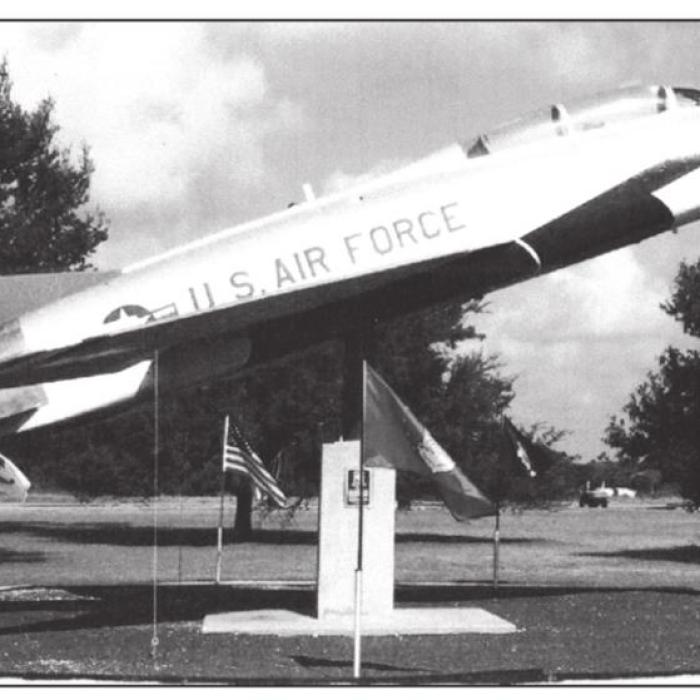
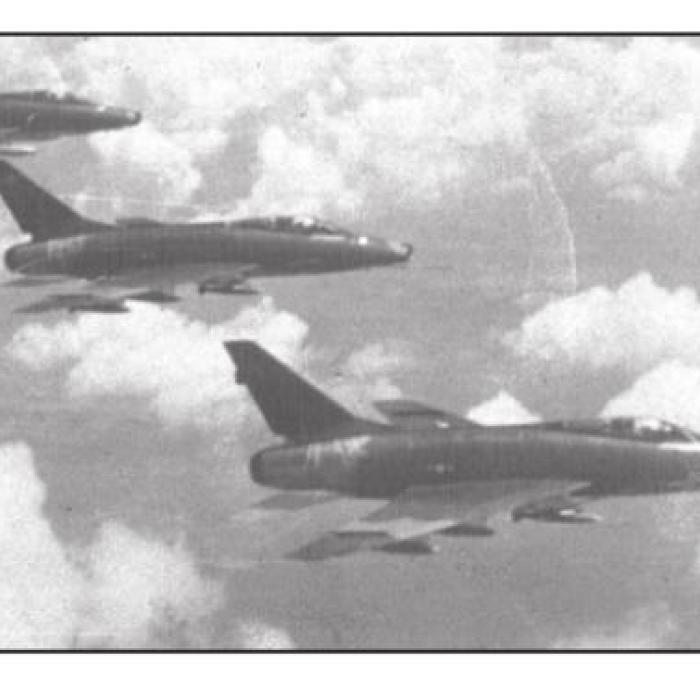
For his service as an F-100 fighter pilot in Vietnam, Dick was awarded a silver star and two distinguished flying crosses for flying dangerous missions to defend American troops. He also received 16 air medals for his 287 combat missions. Dick Peck stands beside a mannequin wearing his flight suit and helmet at the Texas Heroes Museum in La Grange. On the wall near the display is a print of artist Keith Ferris’ famous painting depicting an F-100 in flight during the 1968 Tet Offensive in Vietnam. Dick was among the F-100 pilots who defended the Ben Hoa Air Base during that battle. Photo by Elaine Thomas Before he left for Vietnam, Dick’s mother, Mossie Peck, (left) who had been a nurse, gave her son some advice. She told him not to fly too high or too fast. Dick (right) gently informed his mother that most of the time he would fly as fast and high as he could. Dick encourages youth to find their passion and follow that path for a satisfying life. He’s pictured in his National Airlines uniform during the early years of his commercial pilot career flying for major U.S. carriers. Dick Peck and Sherry Green were married in October 1966 at Laredo. Although they lived in several different states when Dick was flying commercially, Texas has always been home. After signing out after his last mission in April 1968, Dick boarded a TWA 707 airliner headed home. Although he enjoyed the military, Dick was not interested in making it a career. If he had it to do again, though, Dick is adamant that he would be proud to fly an F-100 in Vietnam. During his service in Vietnam, Dick was given the extra duty of helping at the local orphanage that was part of the U.S. Pacification Program during the war. The children, many fathered by American GIs, were unwanted by the Vietnamese and the U.S. At left, several youngsters are seated on a little fence constructed of 2.75-rocket fin covers. At right, Dick presents a gift to one of the orphans. Friends and family on the home front sent all sorts of items of food, candy and toys for the kids. Dick recalls how much that experience touched his heart and always has wondered what happened to those children. Dick was a key player in creating the static F-100 display at the county-owned Fayette Regional Air Center Airport entrance. In retirement, one of Dick’s greatest joys has been teaching young people to fly. The club that he and La Grange’s Bob Field and other aviation enthusiasts established some years ago is still going strong. After his tour to Vietnam flying F-100s like these pictured, Dick left the U.S. Air Force in 1968 and flew commercial airliners for the next three decades. In 2019, he was awarded the Federal Aviation Administration’s Wright Brothers Master Pilot Award for flying 50 years accident-free. While there is no formal award to recognize the accomplishment, Dick actually flew 60 years without an accident or incident.
When Dick Peck talks about flying, he gets a little sentimental. “Flying is almost spiritual to
“Flying is almost spiritual to some people. You either love it or you don’t,” says the 81-yearold aviator, his mind seemingly drifting off to a far-away blue sky. “Flying is my thing, my passion.” But ask former U.S. Air
But ask former U.S. Air Force Captain Harry Richard (Dick) Peck about the 287 combat missions he flew in 12 months during the Vietnam War and his attention snaps back to the here and now. “I’m no hero,” he says, his
“I’m no hero,” he says, his gentle voice firm with conviction. “The soldiers on the ground and the young airmen who took care of our planes in Vietnam? They were the heroes. Those 18 and 19-year-old kids were doing the dirty work.”
After making his belief abundantly clear, Dick relaxes and leans back. Once more, he’s comfortable talking about his love affair with flight.
Dick was born in Jacksonville, Florida, where his family lived close to the naval air station during World War II.
“I would lie down in the backyard to watch little naval fighters fly overhead. I told my mother, ‘Someday, I’m going to fly one of those.’
Dick’s dad, Harry, worked as an accountant for National Airlines, which eventually became a part of Delta Airlines. Although he was not an aviator, Mr. Peck’s office was at the hangar where mechanics worked on the company’s three little airplanes. Dick tagged along on Saturdays any time he could.
First flight foray After the Peck family moved
After the Peck family moved to Miami, Dick couldn’t believe his good fortune. His uncle’s Lions Club was holding a fun-draiser that involved selling cartons of light bulbs.
“For every carton you sold, they’d give you a ride in a Boeing Stearman, a little two-seat biplane. I went through the neighborhood peddling those light bulbs as hard as I could and earned quite a few rides.”
Tragically, Dick’s father died while he was in high school. A friend of his dad’s, a commercial airline captain, followed through on his promise to teach Dick to fly. He took lessons in a little Cessna throughout high school and college at the University of Miami. He also flew with a friend whose dad owned a Piper Cub.
After graduating from college in 1962 with an ROTC commission, Dick’s first assignment was Laredo Air Force Base in southwest Texas.
“At the time, I was really disappointed, but it worked out well in the long run because that’s where I met my future wife, Sherry. We got married at Laredo in October 1966 before I left for Vietnam in April 1967.” A true-blue Texan, Sherry
A true-blue Texan, Sherry Green was no stranger to the U.S. Air Force because her father, Lieutenant Colonel Cecil E. Green, was a career officer who had been stationed at various U.S. bases as well as in Spain for six years.
While Dick was stationed in Laredo, he heard about a place where he would someday serve. “A guy who had left the
“A guy who had left the squadron had been killed at a place called the Train Compound. None of us knew where or what that was. Then somebody said, ‘That’s in a country called Vietnam.’ That was in the early to mid-1960s. Later on, we all realized we would get to go there.
“I remember a guy questioning me about my choice of words. ‘Get to go there?’ he said. ‘Why would anyone want to go there?’ I replied, ‘Well, to get to be a fighter pilot. That’s what we train for.’”
An Overview of the Vietnam War According to History.com,
According to History.com, the Vietnam War was a long, costly and divisive conflict that pitted the communist government of North Vietnam against South Vietnam and its principal ally, the United States. The conflict was intensified by the ongoing Cold War between the United States and the Soviet Union. More than 3 million people
More than 3 million people (including over 58,000 Americans) were killed in the Vietnam War, and more than half of the dead were Vietnamese civilians. Opposition to the war in the United States bitterly divided Americans, even after President Richard Nixon ordered the withdrawal of U.S. forces in 1973.
Communist forces ended the war by seizing control of South Vietnam in 1975, and the country was unified as the Socialist Republic of Vietnam the following year.
As the fighting in Vietnam escalated, many of the students and instructors from Laredo Air Force Base where Dick was stationed were sent straight to advance training bases and onto the conflict to fly fighters, bombers and transports.
“I was sent to a replacement training unit (RTU) at Cannon Air Force Base in Clovis, New Mexico. That’s where I first got to fly the F-100,” he recalls.
The F-100 had one engine, one seat and was virtually a visual fighter-bomber. There was no glass cockpit and no smart bombs. Everything was done by visual reference.
“Even though it was an aging aircraft by then, it was my first choice. Flying a single engine, single seat fighter was my lifelong dream. At the time, I think most of the guys wanted to fly the newer, faster, bigger and more powerful F-4 Phantom, a Mach 2 fighter.”
Dick smiles at the memory of sarcastically characterizing the F-4 Phantom as a troop carrier because it was equipped with two seats, two engines and an anti-collision light.
“For me, the scariest thing in the world would have been to sit in the backseat of that F-4. I would have wanted to control it, not go along for the ride. As far as I was concerned, flying an F-100 for close air support was the only good job in the Vietnam war.”
Dick flew all of his 287 missions in the F-100 from Bien Hoa, the southern-most of four F-100 bases mostly located on the coast of South Vietnam. Ben Hoa was home to 10,000 American and Allied soldiers, including several South Vietnam fighter and Air Defense and Transportation squadrons, as well as units from Allied countries.
“The base, including the quarters where we lived, was built by the French during the French Indochina War from 1945 to 1954. It actually belonged to the Vietnamese Air Force,” he adds.
From April 1967 to April 1968, Dick was attached to 510th TAC Flight Squadron, one of the four of the Third TAC Fighter Wing, Tactical Air Command F-100s. At Bien Ho, each squadron had about 25 pilots and approximately 15 aircraft.
Most of Dick’s daytime missions involved cleaning out areas before U.S. troops hit the ground, primarily in the Mekong River Delta and in the southern half of South Vietnam.
Dick’s biggest fear was very real to him. He was not so much afraid of being shot down, captured or killed. He worried about accidentally hurting or killing American soldiers with friendly fire: dropping U.S. bombs on U.S. troops.
“Thank God that never happened to me,” Dick says.
Piloting a scrappy little jet fighter
“In its day, the F-100 was a very lethal weapon. We carried a lot of napalm, a lot of big bombs and some pretty exotic bombs from that era,” he explains. Napalm came in a canis
Napalm came in a canister and the bombs weighed anywhere from 250 to 1,000 pounds.
“You’ve heard of smart bombs? Well, we had dumb bombs. They were strictly trajectory. To direct a bomb where you wanted it to go you had to practice, you might say, to hit the correct angle, speed and altitude all at the same time.
“On one of my first missions, we had a bad weather ceiling which made hitting the spot really difficult. I don’t think that the bomb landed in Vietnam. I think it hit somewhere in Cambodia. We would never have done that close to our troops, of course.”
On display in the Texas Heroes Museum in La Grange is the book that Dick carried on every single mission. It’s a little beat up.
“The book contains bomb tables for all the different weapons we delivered,” he explains.
Alongside the book in the Texas Heroes Museum display are: Dick’s F-100 pilot checklist, survival knife, parachute cord-cutting knife, emergency signaling mirror, Gyro-Signal launcher tube with signal flares and navigation aids and weapons checklist.
“The best missions, to my way of thinking, were almost 100% flown in darkness. The enemy probably chose to fight at night because they thought we couldn’t get our airpower in, but that was an incorrect assumption. We could usually end the battles,” he says.
“I was always a religious guy who was brought up in the church. I was a believer and I didn’t like killing people.”
Two F-100s flew most night missions, but often three or four aircraft went on daylight assignments. The pilots flew as many as three missions per day averaging an hour each.
“The F-100s were a highmaintenance airplane, so sometimes only four or five would be available on a given day,” he adds.
Dick carried another book in Vietnam that’s also a little beat up. It’s his Bible.
Target practice
“One night, we were scrambled off the alert pad to help some troops in contact with enemy forces. There was a fairly high ceiling and we had to drop down below the ceiling to find the forward air controller. That was usually was a fellow F-100 pilot in a small observation plane flying at low altitude and low speeds over the target. He was in communication with both the planes in the air and the troops on the ground, directing the various flights in as needed like a control tower.
“It was a very eerie scene with the flares floating down on the parachutes below the clouds and below our altitude as well. The flares, dropped from C-47 Spooky gunships at a higher altitude, were very bright – one million candlepower each.”
In the jungle, the enemy shot at the F-100s with mostly small firearms – up to 50-caliber. Further north, however, the Viet Cong had fired missiles and radar-guided guns.
“We’d come back now and then with a few holes in the airplane. I have some shrapnel souvenir that the crew chief took out of the fuel tank,” Dick remembers.
“Our base was constantly getting attacked. When I finally got tired of getting up and running to the bunker in the middle of the night, I put sandbags around my bed. If the base came under attack, I just rolled over, got under my bed and went back to sleep. I said to myself, ‘Well, if they hit me square out, it won’t matter anyway.’”
At 25 or 26 years old, Dick says he didn’t fret about the dangerous missions. He expected to come back or if he didn’t, he would be dead. There was nothing in-between for pilots, unless of course, they were captured, which was unlikely in the south.
The Tet Offensive, a major escalation and coordinated series of North Vietnamese attacks on more than 100 cities and outposts in South Vietnam, was one of the largest military campaigns of the Vietnam War. It occurred in 1968 during Dick’s tour of duty.
“Hordes of invading North Vietnamese overran our base,” Dick recalls. “Our colonel came in that night and issued us all rifles and told us we were going to be defending the base. I can still remember hearing a young lieutenant in the back row say, ‘Colonel, I’d like to call in sick for this one.’
“That day when the Viet Cong owned part of our runway, we didn’t get off until late. Two out of our first three aircraft were hit taking off. In fact, a lieutenant had the canopy on his F-100 taken off by a shell that went right by his head.
Dick remembers incoming rockets also hit their squadron building that night.
“People were hiding under beds and so forth. When we finally got the F-100s airborne, we methodically bombed all the way around the base. That put a stop to the rat-tat-tat-tat and the rockets coming in, so people on the base said, ‘Maybe those F-100s aren’t so bad after all.’
Dick recalls that when the F-100s had taken off and landed at all hours, they almost shook the earth. Not surprising, there had been complaints about the noise they made.
“But after the night we stopped the rockets, we got treated a little nicer. The worth of our airplane was realized,” Dick says.
That was also the time that many of the young airmen who labored on the F-100s around the clock finally got to see them in action.
Dick was awarded two Distinguished Flying Cross Medals for his heroism during the Vietnam War. The citation below describes events that earned him one of the honors.
Citation to Accompany the Award of the Distinguished Flying Cross
(First Oak Leaf Cluster) Captain Harry R. Peck distinguished himself by extraordinary achievement while participating in aerial flight as an F-100 pilot near My Tho, Republic of Vietnam, on 19 February 1968. On that date, Captain Peck was wingman in a flight of two F-100s scrambled from the Bien Hoa Air Base alert facility to provide close air support to United States Forces receiving intense fire from a large hostile force.
Despite the intense hostile ground fire continually directed at his aircraft on each attack, Captain Peck made numerous low level, low angle, highly vulnerable passes against the Viet Cong positions.
With exceptional aerial skill and a complete disregard for his own personal safety, he delivered his ordnance within 50 meters of friendly positions. Overcoming the nearly insurmountable obstacles of complete darkness with no flares available and extreme proximity of the friendly forces to the hostile positions, Captain Peck delivered the ordnance with unerring accuracy, routing the hostile attack. The professional competence, aerial skill and devotion to duty displayed by Captain Peck reflect great credit upon himself and the United States Air Force.
His girl back home
Like many American married servicemen serving in Vietnam, Dick had a wife waiting for him stateside. When he was granted R&R in February 1968, he arranged to meet Sherry in Hawaii. There, a string of airmen filed off the plane, but Sherry didn’t see Dick. At the time, there were no cell phones for instant communication.
It wouldn’t have been the first time that a wife had arrived to join her husband on R&R to discover he had been killed, but official word had not yet been delivered to her. Fortunately, that wasn’t the case for Sherry and Dick. After exiting the plane that day, Dick had suddenly turned around and rushed back into the cabin. To celebrate their R&R, he had bought a bottle of champagne on the way to Hawaii and had almost forgotten it on the plane.
Civilian life
Dick left Vietnam on April 13, 1968, and separated from the U.S. Air Force. After gaining 24 hours from crossing the International Date Line, he was on the payroll of National Airlines on April 15, 1968, two days later. This was a dream come true for Dick because his father had worked at that airline.
Eventually, National Airlines merged with Pan-Am. That’s where Dick had the opportunity to train on the Airbus A-300 in Southern France. His first Airbus trip as captain was from Tokyo to Bangkok. Later, Pan-Am merged into Delta, the company that he stayed with until retirement. Dick’s commercial airline pilot career covered 32 years. For 20 of them he had the rank of captain.
These days the former F-100 pilot often wears a black ball cap embroidered with the words ‘F-100 Super Saber Vietnam’. It regularly serves as a conversation starter with complete strangers.
“A lot of times the conversation will go sort of like this: ‘When were you there?’ Then we talk awhile. I tell the veteran, ‘Well, you probably didn’t see me, but you might have seen my little airplane zip by.
‘Glad you made it back. Welcome home.’
The Vietnam vet often responds, ‘You, too, brother.’
This is Dick’s way of reaching out to recognize those young men who fought the Vietnam War up close and personal. He says they deserve that respect and more.
To read more stories written by Elaine, visit www. elainethomaswriter.com/blog/ and sign up to receive new posts twice a month. You can also call Elaine at 979-263-5031.