


Two Brothers Thrown and Killed by Same Horse
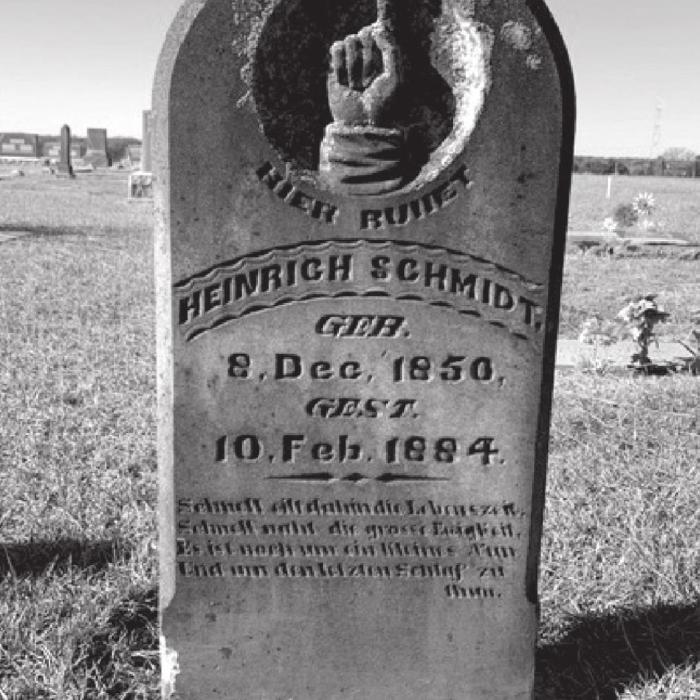
What are the odds that two brothers could be thrown and killed by the same horse?
Researching my Schmidt ancestors for a family book, The Portal to Texas History online offered up The La Grange Journal article of February 14, 1884 about the death of the two Schmidt Brothers. Were these my Schmidt ancestors?
Here is the article in its entirety: “The Journal learns from Mr. M. Zwernemann, who was in town yesterday, that a distressing accident occurred last Sunday in the Haw Creek neighborhood. Mr. Henry Schmidt was thrown by his horse against a tree and his neck broken, causing, of course, instant death. He leaves a widow and five small children to mourn his untimely death. Mr. Zwernemann also informed us that a brother of Mr. Schmidt was killed a few years ago while riding the same horse. It seems he [Wilhelm Schmidt] was running cattle and the horse fell, throwing him, and breaking his neck also.”
Yes, these were my family and to fully understand the magnitude of this article I needed more information.
Henry and Wilhelm were the sons of Fred and Mary Elise (Wunderlich) Schmidt of Prussia. Fred and Elise had married and decided to immigrate to the United States in 1852. Landing in Galveston the couple made their way to Shelby on foot and with their possessions on a wagon pulled by stock horses. In Shelby they joined relatives who had preceded them. Ultimately, Fred and Elise owned approximately 160 acres and had fourteen children of which eleven lived to adulthood. However, Fred, the family’s dad, died in January of 1880.
The 1880 census, taken in July 1880, showed only six of the widow Mary Elise’s children, were still home with her. Katy, the oldest, was listed on this census as blind. Wilhelm was 24 and the second oldest of the sons and still at home. All of the other sons (August, Rudolph and Frederic) were listed as farmers like Wilhelm. Only the youngest daughter, Alvena, was still attending school. Another loss came in April of 1881, with the death of Wilhelm, from the horse accident detailed above.
Henry Schmidt and his wife, Frances, had married December of 1871 and per the tax rolls, had 59 acres and two horses in 1881. The July 1880 census records of both Henry and the rest of his Schmidt family were only a page apart and appear to have lived close by. Henry’s horses were valued at $25 each on the tax rolls. It was in late February of 1884 when Henry was thrown from this horse and died, only three years after the death of his brother.
The Schmidt family needed horses to work the improved agricultural acreage and handle the livestock. There were plenty of opportunities for hard work to keep this family fed, clothed, healthy and educated. These horses would also have been useful for both transportation, farm work, hunting and delivery of products to another destination.
Just like humans, horses of all breeds have differing qualities and faults. Perhaps these two accidents were of no consequence of what the horse did or did not do but the situation caused these accidents. It would be interesting to know what became of this horse. As well as, it is interesting to note that Henry’s wife, Frances, was apparently pregnant with their sixth child. My research shows Frances never remarries but maintains the land with the help of her children, one servant and family. Researching our ancestors sometime provide us with unbelievable and sad stories to pass onto their descendants. These documents also show us nuggets of strong family ties. Rudolph Schmidt, my great grandfather, took care of his sister Katy, until her death in 1912. I strongly encourage you to check The Portal to Texas History site for interesting stories about your ancestors.
Bibliography www.Ancestry.com
www.Ancestry.com
The La Grange Journal, (La Grange, Tex). Vol 5 No 7, Ed 1 Thursday, February 14, 188
Footprints Of Fayette
Fayette County is one of the most historic counties in Texas. In this weekly feature from the County Historical Commission, a rotating group of writers looks back at local history.