


Trying Out a Heating Pad for the Seedlings
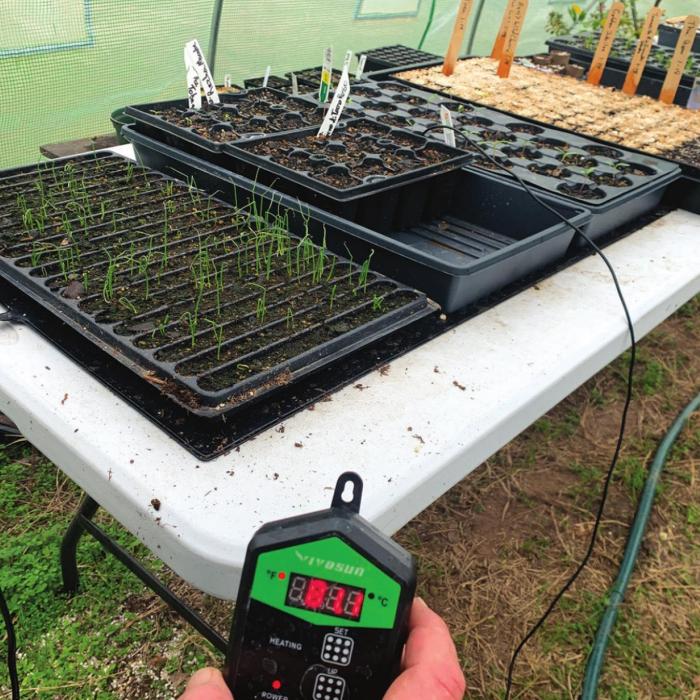

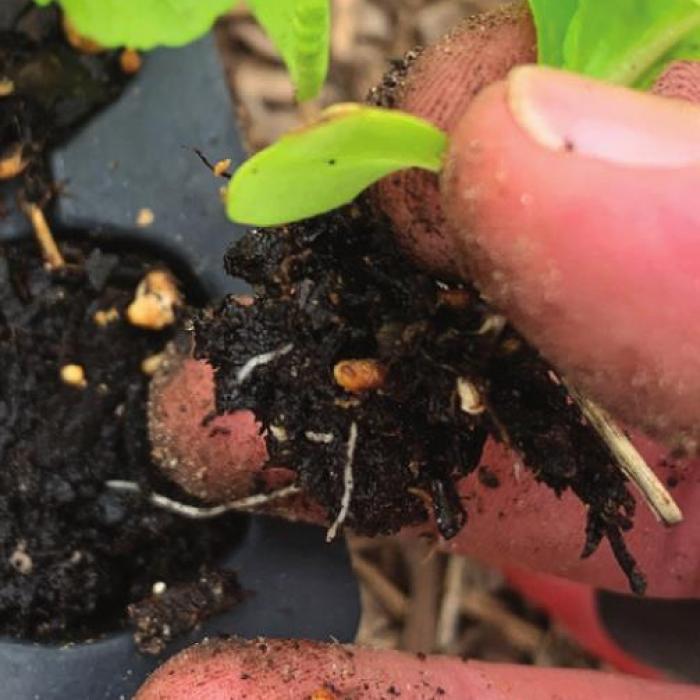
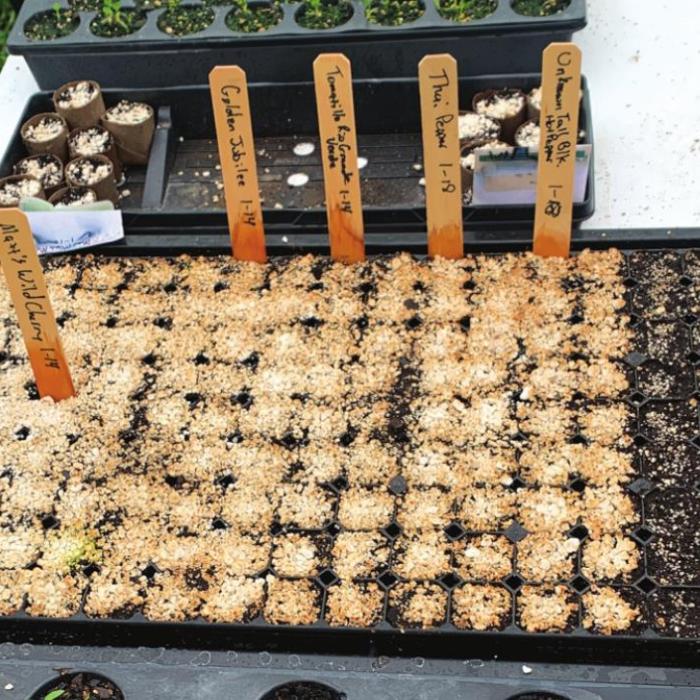
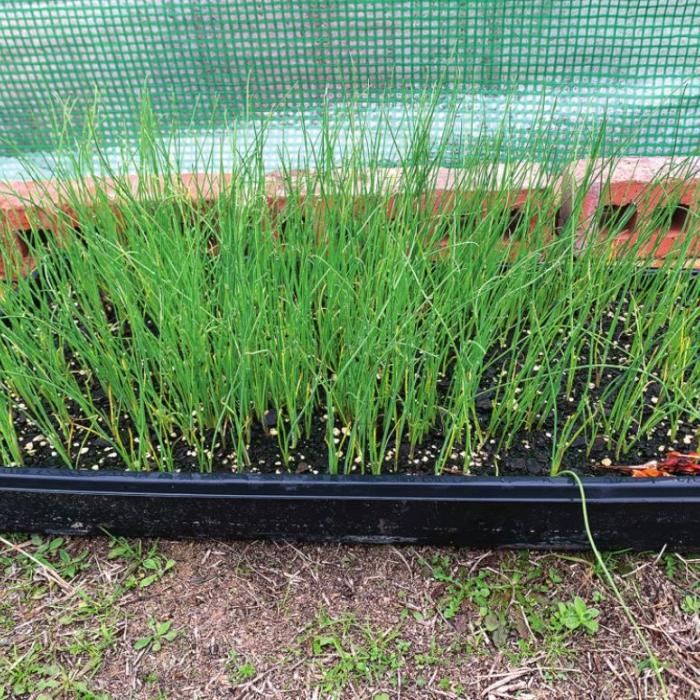
I use a heating mat to keep the soil in my seed trays warm on cold nights. A few weeks back I started some Chinese cabbage seeds in potting soil instead of seed starting mix. Potting soil is too coarse and doesn’t allow the plants to form a good root ball. Many times, the tender roots pull right out of the soil, as pictured above. I should have used seed starting mix, which has a much finer texture for the roots to grab and hold. Photos by Andy Behlen I use a variety of homemade, recycled and purchased seed starting trays. In the center of the photo above is a profession tray manufactured by Hoss Tools. Made of heavy-duty plastic, this 162-cell tray should last for years. These trays from Hoss Tool feature special ridges inside each cell that encourages the plant to grow its roots down instead of out and in a circle. Behind it are some cells I made from recycled toilet paper and paper towel rolls. Pictured below is a standard “1020” nursery tray. I’m growing some leeks in it, and they are just about ready to plant out in the garden.
Now is a great time to start growing peppers, tomatoes and eggplants from seed.
These crops require a long growing season. Tomato plants tend to stop producing during the hottest part of the summer. Some varieties of pepper and eggplant take 100 days or more to start producing fruit. That’s why we need to start these seeds early.
Starting seeds this time of year can be a challenge, however. Pepper, tomato and eggplant seeds need warm soil to germinate. Pepper and tomato seeds germinate best in soil 80 degrees Fahrenheit. Eggplant seeds like it even warmer, 85 to 90 degrees. A heated greenhouse works great, but most people don’t have a greenhouse, much less a heated one.
You can start seeds inside your home, but the seed trays need to be placed under growing lights or a bright south-facing window. Seedlings that germinate with too little light become “leggy.” The young seedlings grow tall in an effort to find light. Many will fall over and eventually die. The ones that survive turn into weak plants that take a long time to get established.
There are many inexpensive grow light setups available for purchase on Amazon and other online retailers. The best ones use LED lights, which put off practically no heat and the bulbs seldom burn out. Fluorescent lights also work well, but they create a little heat. Incandescent bulbs should never be used because they produce too much heat and will kill your seedlings.
I’m using a heat mat inside my greenhouse to keep the soil in my seed trays warm. The model I use is a Vivosun 48 by 20.75 inch mat. It came with a digital thermostat and soil temperature probe. I couldn’t find a plant heating mat for sale locally, so I bought this one on Amazon for about $60. This mat can accommodate four standard 10x20 inch seed trays. There are better heating mats available, but I’m happy with this one. Vivosun also makes a smaller mat that accommodates a single seed tray. It sells for about $35. If you buy a heating mat, make sure it comes with a thermostat so you can set the temperature.
The heating mat I use seems to be able to raise the soil temperature about 20 degrees above the ambient temperature. Using a plastic lid or dome above the seed tray helps to retain heat on the coldest days.
Once you find a way to provide ample light and heat, you’re going to need some seed trays and seed starting soil mix. I used to start seeds in potting soil. Most potting soil mixes contain pieces of bark and other materials too coarse for starting seeds. Seedlings need very fine soil to establish a strong root ball.
A few weeks ago I started some lettuce and Chinese cabbage seeds in a coarse potting mix. This week, when I planted them out in the garden, I had a hard time getting the young plants out of their pots. The roots wanted to pull out and leave the soil behind. I ended up using a spoon to scoop the plants out of the trays.
I recently discovered the product that professional nurseries use to grow seeds: seed starting mix. ProMix is a very popular brand, but it can be hard to find outside greenhouse supply companies. I’m using a brand called SunGro, which seems to be easier to find. I’m also experimenting with a homemade seed starting mix made from equal parts pearlite, peat moss and earthworm castings.
I don’t normally recommend peat moss because it is an unsustainable resource and it acts as an antimicrobial agent in the soil. However, it’s fine texture and ability to hold water makes it great for starting seeds. Peat’s antimicrobial properties may also help the seedlings fend off disease as they emerge. Coconut fiber, also known as “coir” (pronounced like “core”), is a good renewable alternative to peat, but it can be hard to find.
Now you need some seed pots, cell blocks or trays to fill with soil. I collect plastic seed cells from the plants I buy at nurseries. The six- and fourpack cells that most nursery plants come in are pretty flimsy and fall apart after the second or third time you use them. The four-inch pots that larger nursery plants come in are more sturdy and last a long time. Four-inch pots are useful for “stepping up” smaller plants, but they take up a lot of space and don’t work so well for germinating seeds.
I recently made a bunch of homemade seed pots out of some old paper towel and toilet paper rolls. I cut them into twoinch long sections. For the bottom, I made four half-inch cuts around the end of one side and folded the tabs in. This leaves a small space in the middle for water to drain. Pack the little pot with soil mix and plant a seed on top. When it comes time to transplant, unfold the bottom and stick the entire pot into the ground. The paper pot will decompose and become part of the soil.
You can also fill a standard 1020 tray with soil and sprinkle seeds on top. This is my preferred way of starting allium seeds like onions, leeks and chives. Once they are ready to transplant to their permanent home, you can “prick” them out with a pocket knife or small fork and stick them in the ground. You can also start pepper, tomato and eggplant seeds this way. After the plants grow two true leaves, prick them out and step them up into a four-inch pot until they are ready for the garden.
I’m using all of these methods in my greenhouse right now. Another method involves planting seeds in soil blocks. I have not tried this method yet because it requires a special tool called a “soil blocker.” The company Ladbrooke makes the most popular model. This hand-operated device compacts moist soil starting mix into a sturdy block. It leaves a little indention on top of the blocks. That’s where you plant the seed. The blocks are placed in a standard 1020 tray with a little space between each one. This system takes advantage of plants’ tendency to naturally “air prune” their roots. They grow stronger root balls and they don’t experience as much transplant shock when you put them in the garden.
Making soil blocks takes a little more labor and a specialized tool, but it might be worth the effort.
Gardening News Of the Weird
People in Washington state can now choose to compost their bodies after death.
The Washington state legislature voted in 2019 to allow this new form of death care. One of the first companies to offer such a service opened last month in Seattle.
The company Recompose turns dead human bodies into compost. The service costs $5,500. Family members can choose to pick up the compost to use in their yards or gardens, or they can donate it to a nature preserve in Washington state where it will improve the soil. According to Recompose, the process involves laying the body in a cradle surrounded by wood chips, alfalfa, and straw. The cradle is placed into a vessel and covered with more plant material. The body and plant material remain in the vessel for 30 days. Microorganisms break down the body and transform it into a nutrient-dense compost. Recompose says each body results in about one cubic yard of compost.
How about that for pushing up daisies? Email me at andy@ fayettecountyrecord.com.