


St. Mark’s Medical Center Promotes Stroke Education During Stroke Awareness Month
St. Mark’s Medical Center (SMMC) is recognizing May’s National Stroke Awareness month to help educate community members on stroke risk factors, signs of stroke that affect all ages and the critical importance of immediately seeking care at the closest emergency medical facility. According to the American Stroke Association, stroke is the fifth cause of death and a leading cause of disability in the U.S.
Stroke occurs when a blood vessel that carries oxygen and nutrients to the brain is either blocked by a clot or bursts (or ruptures). When that happens, part of the brain cannot get the blood and oxygen it needs and brain cells die.
Risk factors for stroke include high blood pressure, heart disease, diabetes, high cholesterol, obesity, and a previous transient ischemic attack (TIA) or stroke. Healthy behaviors such as physical activity, eating a low-fat diet, regulating blood pressure, and not smoking can help reduce your risk of stroke.
SMMC is equipped to identify and start treatment for a stroke patient, 24/7. SMMC Emergency Medical Director and board-certified family medicine physician Roger Willis, M.D., advises the community to act F.A.S.T. if any of the following stroke symptoms are present and to call 9-1-1. “Minutes lost in treating a stroke patient increases brain function loss. I cannot emphasize enough the importance of quickly acting on any stroke symptoms,” said Dr. Willis.
• Facial drooping
• Arm weakness
• Speech difficulty
• Time to call 9-1-1
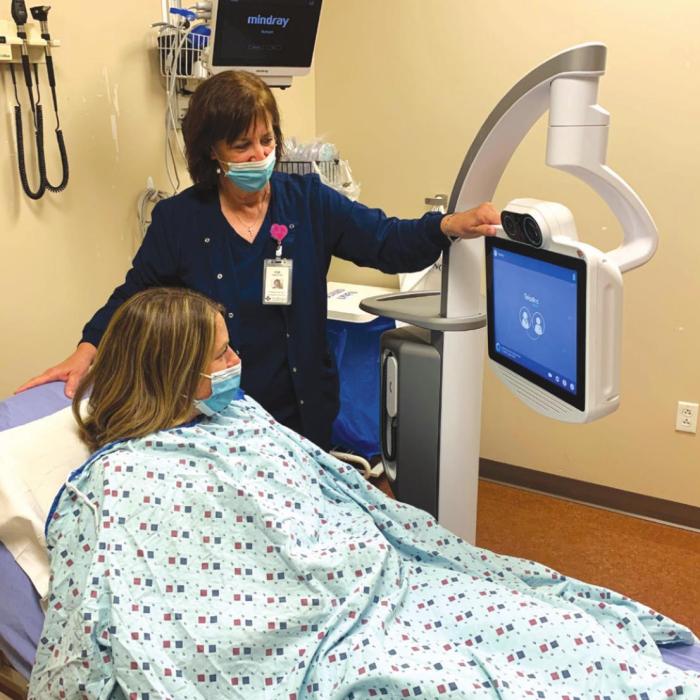
“Our community is fortunate that in addition to our emergency department team, St. Mark’s Medical Center has had a clinical affiliation with St. David’s HealthCare in Austin since 2012,” Mark Kimball, president and chief executive officer of St. Mark’s Medical Center, said. “This connection allows us to do a teleneurology consult exam from the patient’s bedside here with their advanced neurological team, and act quickly. It can make the difference between the patient’s life and death,” he continued.
St. Mark’s Medical Center’s clinical affiliation with St. David’s HealthCare’s neurology team and other specialists creates a virtual extension of the hospital.
“As a clinical affiliate, St. Mark’s Medical Center has access to all St. David’s Health-Care facilities for specialty care including our comprehensive stroke center at St. David’s Medical Center,” Ken Mitchell, M.D., chief medical officer of St. David’s HealthCare, said. “If the patient ultimately needs to be transported to one of our facilities for further care, treatment can continue while the patient transfers. Every minute is critical to the stroke patient’s outcome.”
Once treated for the cause of the initial stroke event, rehabilitation helps the patient to regain lost strength and functionality.
“Starting rehab as soon as possible after a stroke is important,” Dr. Willis, said. “The severity of the stroke and the part of the brain affected determine the recommended rehab plan. And often, patients significantly benefit from a follow-up therapy program with a break after the first one is completed,” he added.
Locally, St. Mark’s Medical Center offers a variety of care for post-stroke recovery including temporary inpatient transitional care, sometimes referred to as Swing Bed Care, for patients who are not quite ready to return home or need more monitored care than a nursing home provides.
“Convenience is a plus for patients and their families managing stroke or any serious health event. Minimizing long travel and busy traffic in larger cities is a tremendous benefit of receiving care at St. Mark’s. We also offer physical, occupational and speech therapy in the hospital, for inpatient and outpatient care,” Dr. Willis continued.
For more information about St. Mark’s Medical Center, please visit: smmctx.org.
Other common signs for both women and men include problems seeing out of one or both eyes and balance or coordination problems. Women can also experience some signs of stroke that are subtle enough to be missed or brushed off that can lead to delays in getting time-sensitive, lifesaving treatments:
• General weakness
• Disorientation and confusion or memory problems
• Fatigue, nausea or vomiting
St. Mark’s Medical Center (SMMC), one of the top 100 Rural and Community Hospitals in the United States as ranked by the Chartis Center for Rural Health, is a 65-bed, 100,000 sq. ft. community hospital serving residents of Fayette County and surrounding communities. At SMMC, patients benefit from the latest medical technology along with comprehensive healthcare from highly skilled physicians, nurses and professional staff. Services include cardiac rehabilitation, wound care, orthopedic care, inpatient and outpatient care, a 24-hour emergency department, outpatient/elective surgeries and procedures, as well as laboratory and imaging services.