


By Slim Margin, 2020 Was Deadliest Year in Recent History in Fayette County
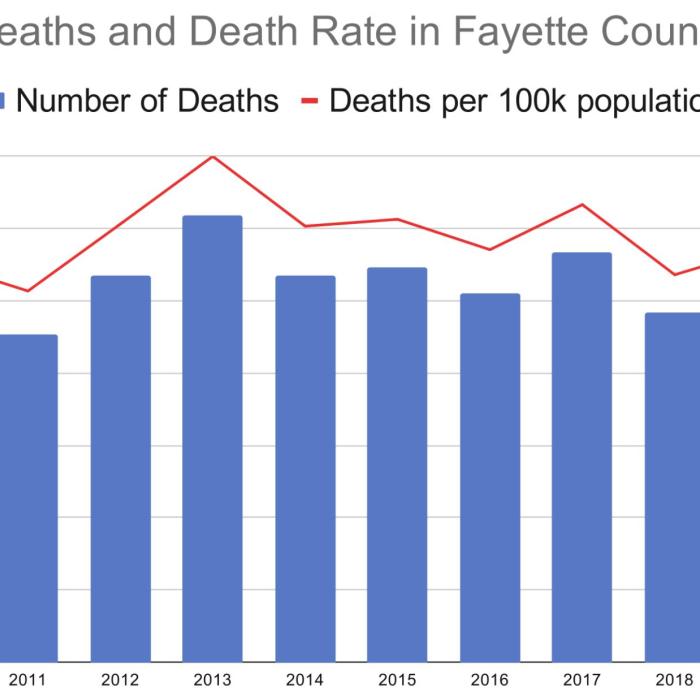
The chart above shows the number of death certificates filed in Fayette County from 2009 to 2020 (indicated by the blue bars). Using those numbers and population figures from the U.S. Census Bureau, we calculated the annual death rate for each year, defined as number of deaths per 100,000 population (indicated by the red line). The numbers on the left axis are the total number of deaths. The numbers on the right axis reflect the death rate. Sources: Death certificate data from the Fayette County Clerk’s Office, County population estimates from the U.S. Census Bureau
More people died in Fayette County in 2020 than any of the previous 11 years. While the number of total deaths is up from previous years, it’s not up by a extraordinary amount.
According to death certificate records from the Fayette County Clerk’s Office, 317 Fayette County residents died last year. That number includes deaths from all causes. The Texas Department of State Health Services reports that 40 people in Fayette County died of COVID-19 between March 7 (when the state began keeping such records) and Dec. 31, 2020.
The year with the second highest number of deaths was 2013, with 309. That was the same year as another world wide pandemic associated with a lesser-known coronavirus, the Middle East Resperatory Syndrome Coronavirus, known as MERS-CoV. That year, the death rate in Fayette County was actually a little higher than 2020.
The death rate is defined as the number of deaths divided by the population time 100,000. To calculate the numbers, we used annual population estimates from the U.S. Census Bureau. In 2013, the death rate was 1,249.95 per 100K. That compares to 1,247.34 per 100K in 2020.
The year with the third highest death rate was 2009, the year of the Swine Flu. That year, 284 people in Fayette County died, resulting in a death rate of 1,160.60 per 100K.