


Silver Star & Purple Heart Honoree Pat Lyons Recalls Vietnam
Veterans Day 2023
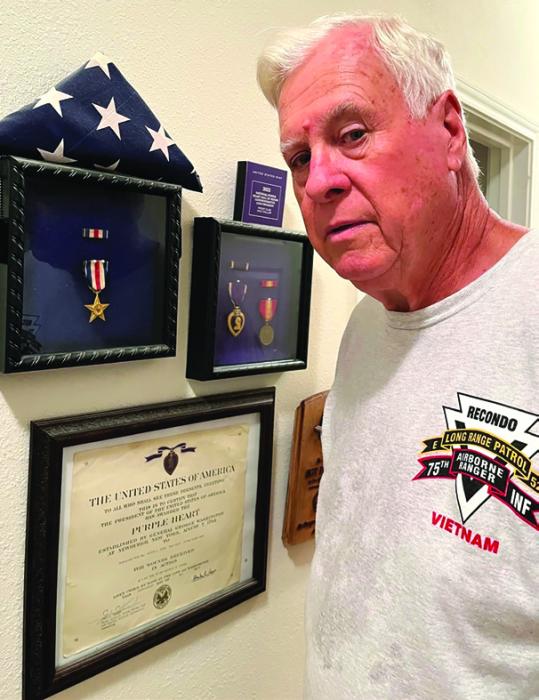

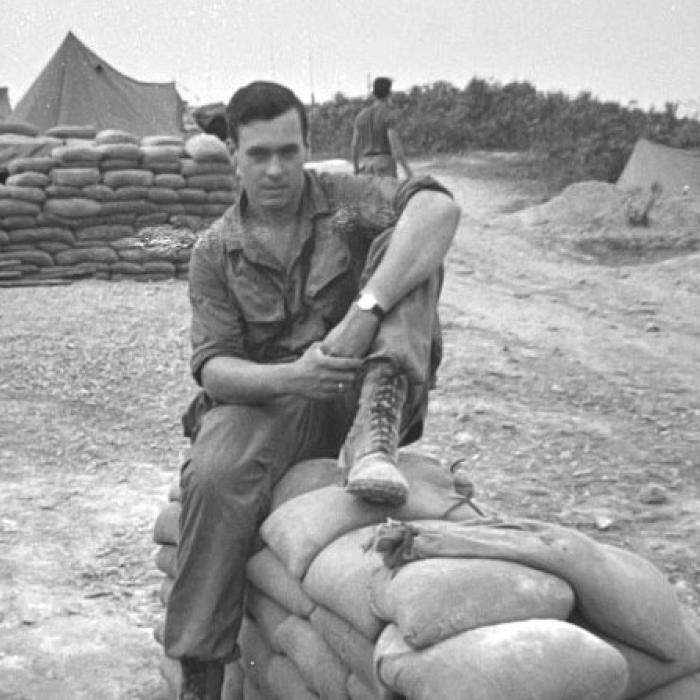


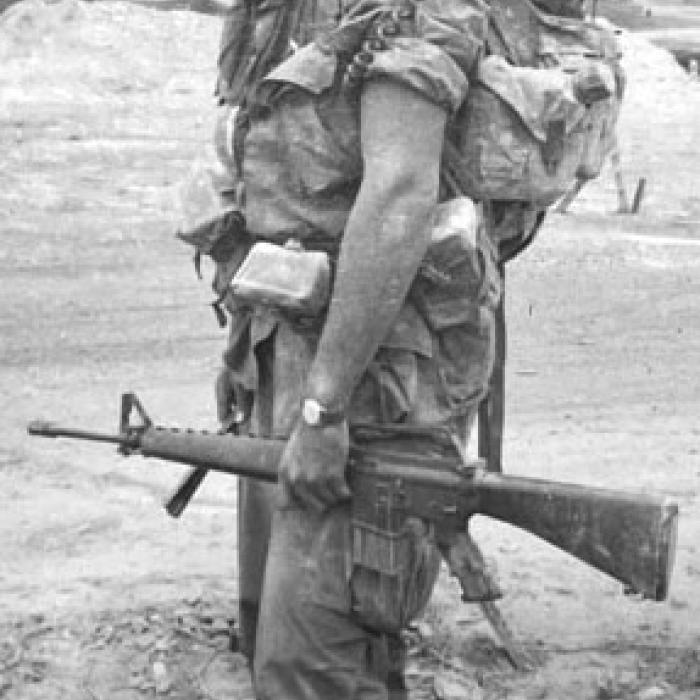

Pat Lyons of Muldoon was awarded a Silver Star and a Purple Heart, as well as other military honors, for his service as a longrange reconnaissance patrol (LRRP) ranger during the Vietnam War. As a big, strong young man, Pat recalls he didn’t ‘take much off anybody.’ He was in his element training and working as a member of elite reconnaissance missions. He weighed 238 pounds when he served in Vietnam. Pat dreaded the mundane tasks and pace of life when he wasn’t on a mission. He was constantly eager to go out and use his extensive training. Pat credits his wife, Anita, for helping him to enjoy a rich, fulfilling life, something some other Vietnam veterans have been unable to do. Anita respects Pat’s service to our country and all it has entailed. The couple will celebrate their 54th anniversary on Dec. 4th. Huey helicopters transported LRRP teams on their missions. At left, a team loads up. Last summer, Pat was a guest of the Wounded Warriors in Action Foundation (WWIA), along with other Purple Heart recipients from the Afghanistan and Iraq conflicts. WWIA serves the nation’s wounded by providing all-expensepaid, world-class outdoor sporting activities with the goal of connecting those who have been awarded Purple Hearts. Because the comradery and sharing of war and post-war experiences were so meaningful, Pat encourages other local Purple Heart veterans to contact him to discuss the opportunity. When headed out on a mission, Pat carried an M-16 rifle, four one-quart water bottles, extra ammunition, one Claymore mine, three hand grenades, one smoke grenade, rations and a poncho liner. In addition, he routinely carried a radio. Under the sign of the 75th Ranger Division, the most highly decorated unit in Vietnam, are Pat and two other LRRP rangers.
When Pat Lyons recently arrived at an urgent care office requiring stitches for a badly cut finger, he told the nurse not to wait for the anesthesia to take effect. Shocked, she warned him that getting stitches would be very painful. The Muldoon resident told her it was a long story, but he’d faced worse and survived.
Drafted!
The U.S. Army drafted Pat in 1967 when the 19-year-old was working for Dresser Industries in his hometown. The Bedford, Pennsylvania, native went through basic training at Fort Dix, New Jersey, and advanced infantry training at Fort Polk, Louisiana. Fort Lewis near Tacoma, Washington was his jumping-off point for Vietnam.
“After a 27-hour flight, we landed at Cam Ranh Bay about the same time as a typhoon. We were involved in the huge clean-up and rebuilding effort,” Pat says.
“Then one day, this lieutenant came in looking for a few volunteers. Working in six-man teams, they’d be dropped behind enemy lines. They’d wear no dog tags or anything else that identified them as American soldiers. No one would know who or what they were. If they got lost, they’d be lost.”
Pat, one of about 40 soldiers who stepped forward, was the only one chosen. He then embarked on the arduous education of a long-range reconnaissance patrol (LRRP) ranger with the 1st Cavalry Division. His training was to equip him to undertake observation missions deep in enemy territory as a member of an elite army unit. In addition to learning to exist in the jungle, every member was required to skill-verify in every single position on the team. The best LRRP rangers, Pat included, were selected for highly specialized infantry training run by Special Forces. Called Recondo School, it repeatedly emphasized cross-training competence.
In addition to intense live training, there was a heavy schedule of classroom instruction. Those who scored less than 90 on tests ‘washed out.’ Pat scored less than 99 only once. The instructors admitted that although his answer on the medical test wasn’t wrong, it wasn’t what the book said and the exam was based on the book.
Getting to the
Ground Fast
Jumping out of a helicopter was another necessary LRRP ranger proficiency.
“With a helicopter, you use a 120-foot rope rather than a parachute to get to the ground. The helicopter holds steady at 160 feet in the air and the rope stretches out with your weight. As you touch the ground, the rope is suddenly gone, so you know you can go in shooting. We only wanted certain helicopter pilots, though, because some were better than others at maintaining altitude,” he says.
After completing LRRP training and Recondo School, Pat had what it took to gather intelligence working on a team.
“Because we LRRPs were 100% interchangeable, we were in demand. Each team had a team leader and an assistant team leader. We had a front scout and a rear scout, so we trained to do all those jobs. We had a medic and one guy would carry the medic bag, but we were all medics. One guy was the RTO (radio telephone operator) and another guy carried a spare radio because they regularly malfunctioned in the heat and humidity. We each knew how to operate it,” he recalls.
Pat describes the jungle as having a triple canopy of vegetation. The ground was generally not visible from the sky because three different age groups of trees obscured it.
“When we jumped out of a helicopter and hit the ground, we didn’t move immediately because we never knew if anyone had seen us come in or who was nearby. When we got started hours later, we didn’t walk on trails. We didn’t walk on roads. We found our way through the jungle. The rear scout covered up any footprints or broken branches we had left to make it look like we’d never been there.”
Patience was not just a virtue but a necessity for LRRP rangers.
“We’d sometimes sit in the jungle for two or three days observing North Vietnamese and civilians and soldiers from a very close vantage point. Since we were trying to find how they were getting from Point A to Point B, for example, we were interested in how many people went by, what they wore, what they were carrying and when or if they came back from the fields. I recall once sitting just outside a village a couple of feet apart from the five guys I was with for several days.”
Missions, generally five to seven days long, were followed by five to seven days of rest in the rear. Pat intensely hated that downtime. Using his wits and training appealed to Pat much more than loading sandbags, being bussed somewhere to set up tents or cleaning the latrines, all necessary but dreary jobs.
“After we came back, I’d go out the next day if I could. I was a very good map reader, so different teams were willing to take me out. Since I was a radio telephone operator, I could call artillery in on us or handle communication with the helicopter. Whatever a team needed done, I could do it. I would always do what I was told.”
Operation One
Zulu Went Wrong
Human error on the May 1968 mission One Zulu resulted in the death of several LRRPs. Pat came very close to being one of those fatalities.
“I can’t believe I’m here to tell you this,” he says.
“Three teams were being sent out because the Vietnamese were coming over a mountain, somehow, somewhere. The first two teams were put together and I agreed to go out as the assistant team leader on the third team. So we made the flight over, found out where we were going to land and where we were going to get picked up. The top of the mountain had a saddle-like ridge with a low spot in the center. Both the team leader and I looked at that and said we had to find out what was going on up there.”
By the time the team spent the day fighting their way through the incredibly thick jungle, they were exhausted.
“As a rule, we never walked out into an open area, but the team leader did, so we followed him. We were looking at the saddle when he realized what he’d done. There wasn’t a noise, not a sound. There wasn’t even a bug moving. About that time, a sniper’s shot rang out, and one of our guys was hit multiple times. Three of us grabbed him and moved him off into the thick jungle. I opened up a clip or two across the mountain in front of me, but I didn’t see anything, not a thing. So I called in medevac because the RTO’s radio wouldn’t work even after the batteries were changed out.”
Pat recalls that medevac got there quickly, but the enemy’s burst of fire almost shot it out of the sky.
“We didn’t know it at the time but that bowl was an extensive North Vietnamese complex. Although we didn’t know it then, tunnels ran out the back side of the mountain. There were a whole bunch of people up there, maybe 100 to 400 soldiers. This was no little deal. I saw the odd person run wearing a kind of blueish suit or shirt – North Vietnamese. By that point, I couldn’t see the other members of our team. I didn’t know where they had gone. It was a weird feeling. I noticed that out in front of me was an old, old deep and wide bomb crater. If somebody crawled into it, I wouldn’t know it until they popped up in my face.”
Pat threw a grenade into the hole to make himself feel better.
“Out of nowhere, the team leader showed up. I had already been wounded in my right arm below the elbow by some shrapnel from an explosion. Maybe a grenade? I don’t know. I told him medevac had just about gotten shot out of the sky and they’d thrown a stretcher. Then I had called for a gunship. Instead of popping smoke to indicate our location, he put a strobe light on his chest and started flashing it at the helicopter. I told the helicopter to identify the strobe light. Then, when the team leader turned and hit the strobe light button, he was shot - bang, bang, bang. I knocked the strobe light out of his hand and pulled him down next to me. I put my hand on his chest to try and stop the bleeding.
“Then I rolled the smoke off the end of my fingertips and left it for the helicopter to see. That’s when the first round started. It actually hit a tree right close to me. If that rocket would have hit me, I wouldn’t be here. It exploded and then another rocket blew up. That’s when the North Vietnamese began emptying their guns on us. I reached over and looked at the team leader. His eyes were gray and no blood was pumping, so I just pulled him down next to me. There was nothing I could do.”
The helicopter pilot, who witnessed the assault, asked in a hushed tone if he had anybody left down there to talk to.
“I replied, ‘You do.’ He asked how I was doing and I told him I was dying. He knew where I was because he’d seen the concussion of the rocket blow me five feet in the air. He said I bounced. He asked what I wanted him to do. He stopped over top of me and fired the mini-guns. They’re hot coming out of that gun and hundreds and hundreds of shells were pummeling down on me. Then the helicopter pulled away.
“My radio is still working and I hear, ‘Pat, we’ve got a quick reaction team coming in to get you.’ Ok, great, I thought. They’re going to try to get anybody that’s alive out on the helicopter and grab bodies.”
The helicopter came in and was shot up, too. Medevac wouldn’t come back, but a gunship did. Expending its ammunition to keep the enemy away from Pat, it then dropped down and pulled out five or six soldiers. A third gunship repeated the process.
“Even though the quick reaction force had landed, I couldn’t see them. They were trying to find me, the missing LRRP. Everything said on the radio had to go to Camp Evans, Vietnam, and then relayed back to me. I couldn’t talk to the team directly. The 15 guys on that team never made it and were pulled out by helicopter.
“Out of nowhere, a guy shows up and offers to help, but he gets scared and runs. About 20 minutes after that, another guy, Eddie Kent from the 196th, crawls up to me. He is part of a platoon they’d sent in for me. The platoon’s arrival took the pressure off me because the North Vietnamese started back up the mountain. Ken looks at the soldier I’m with, tells me the guy is dead and says he needs to get me out of there.”
Pat was badly shot up. His rescuer decided to grab him by his arm because he had more holes in his back than his leg. He passed out from loss of blood and pain as he was dragged down the hill. When the medics offered him morphine when he regained consciousness, Pat declined.
“You don’t know where I’m hit, I told them. Besides, I was going to pass out anyway. When I asked him about the other guys, he said they hadn’t found any other guys. The next morning when I woke up, it sounded like there was a whole herd of helicopters coming in on top of me. Two guys walked over, picked me up and put me on a stretcher. A soldier came running toward me, hunched over, and stood at my feet. He started to speak, to thank me, when a sniper dropped him dead.”
Pat was transported and treated at Camp Evans before he was sent on to Da Nang.
“The doctor is rolling me over back and forth. I had shrapnel all over my back and at the base of my spine and half my leg was gone. They’re telling me they’ll take my leg off once they get me to Hawaii. So they boxed me up, flew me to Tripler Hospital on Oahu and put me in the amputee ward.
“I’m 19 years old and that isn’t about to happen. A doctor, who was going to make a decision about the amputation, comes in one morning. The nurse tells him I bent the bedframe with my injured leg. (Well, it may have been made of aluminum.) So that settled that. They put 108 steel stitches in my leg and pulled me back together. I still have shrapnel in my back. I had a couple of pieces taken out last month,” Pat says.
About
Volunteering
If he had to do it all over, Pat says he would still volunteer to train as an LRRP. However, on the day he was injured, he would have insisted that he lead the mission because the team leader was wrestling with a personal problem. If Pat had done so, it’s likely there might have been a much more positive outcome.
Pat still can’t resist volunteering. La Grange Knights of Columbus honored Pat and his wife, Anita, as Family Knight of the Year for 2022-23 for their contributions. The couple is involved with the Muldoon Volunteer Fire Department and recently enjoyed teaching fourth graders about beekeeping at a school event at the Fayette County Fairgrounds. Pat is also a member of the Veterans of Foreign Wars, American Legion, Vietnam Veterans of American and several other organizations.
As the years have gone by, Pat has reconnected with soldiers associated with his life in Vietnam. Some of the information he’s learned is wildly inaccurate, which doesn’t bother him. He’s also learned facts that have given him a different perspective on his experiences. He’s also discovered more about what took place the day he nearly lost his life. Those memories are never far away, but he can live with them.
By the way, Pat’s finger that was stitched up at urgent care a few weeks ago is healing nicely.
Want to get in touch with writer Elaine Thomas? Visit www.elainethomaswriter.com and fill out the contact form, email elainethomaswriter@cvctx.com or call 979-2635031. Thank you!