


One of These Things is Not Like the Other
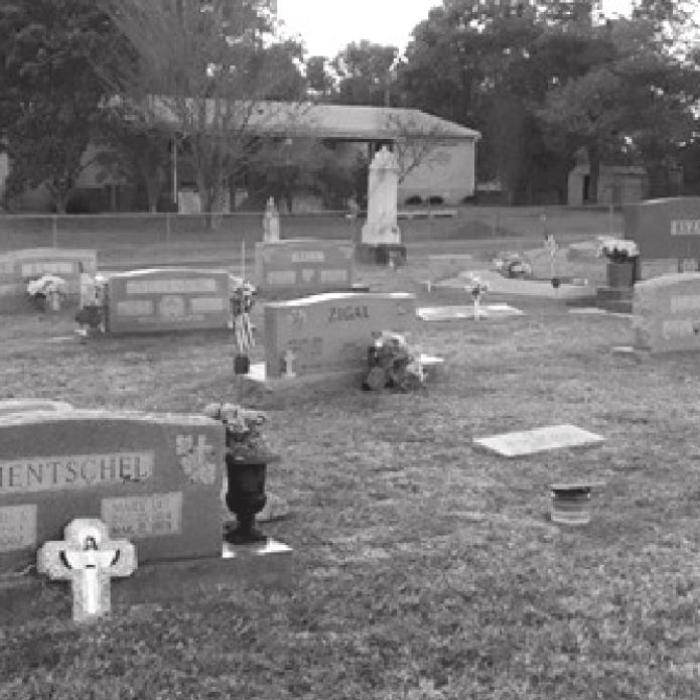
Actually, several of the gravestones shown in the picture just don’t belong. One day, after spending some time at the New La Grange City Cemetery, I noticed several graves in the newer section of the cemetery that seemed a little out of place. In a section where the burials dated to the 1970s and 1980s, I noticed three older gravestones with death dates of 1870, 1892/1904 (one marker shared by two people), and 1878. It piqued my interest and a quick search indicated these graves (all belonging to members of the Scherrer family) were originally buried at the Scherrer Family Cemetery in Biegel. It made sense right away then, to assume that these graves were relocated from the family cemetery in Biegel to the New City Cemetery in La Grange during the construction of the Fayette Power Plant and Reservoir in the 1970s. This would explain their odd placement in the New City Cemetery.
The history of the cemetery relocation project began around 1973 when the Lower Colorado River Authority (commonly known as the LCRA) purchased land in Fayette County for the construction of the Fayette Power Project. The purpose was to build a clean, coal-burning power plant near La Grange that would provide energy to large parts of central Texas. The project area included the community of Biegel and parts of the community of Park. With its beginnings no later than the 1850s, Biegel initially grew into a small, but vibrant community and it holds an interesting history. The settlement even boasted a pickle factory operated by the Kroll family from possibly the 1860s to about 1916. In about 1887, the railroad came to Fayetteville, bypassing Biegel and causing the community to somewhat decline into more of a quiet, agricultural center with some social activities. By the 1970s, Biegel had become more of a ghost town.
At the time the LCRA began construction in 1974, only three buildings from the town of Biegel remained and they were all moved to different locations – for example, the Bernard Scherrer home, formerly of Biegel, is now at Henkel Square in Round Top. Although the buildings were removed, many of its former residents were still there, albeit six feet under. There were several cemeteries and individual graves that were identified as being within the boundaries of the project acreage. They could not be left there, as many would undoubtedly be covered by the 2,400 acre cooling pond, now commonly known as Fayette Lake. All descendants of the deceased, if possible, were contacted to sign permits that allowed LCRA to relocate the burials and proceed on the project. Thus, all the burials were disinterred and removed to other burial sites.
The town of Biegel and portions of Park, along with the old resting places of many individuals, are now covered with as much as 70 feet of water in some places. It can be noted that the LCRA and many local historians did a great deal of research to determine the locations of graves, descendants of the deceased, and burial places for relocation. We are grateful for their diligence and hope that the memories of the deceased are not forgotten.
The following is a list of cemeteries and individual graves that were in the boundaries of the LCRA Power Plant Project that had to be relocated. Listed is the original location in parenthesis, the number of graves, and where they were relocated:
1. Biegel-December Family Cemetery (four miles NE of Halsted) – 7 graves, all relocated to the New Biegel-December Family Cemetery in Halsted, near original site on LCRA property.
2. Charpentier Family Cemetery (1.5 miles NE of Halsted) – 3 graves, all relocated to the Nordheim City Cemetery in DeWitt County, Texas.
3. Helble Family Cemetery (five miles E of Halsted) – 3 graves, all allegedly relocated to the Helble family plot in the Fayetteville City Cemetery, although no markers exist for the three. *Joe Cole surveyed this site in 1959 and found seven or eight graves with no markers. However, in 1970, only three graves were identified at the site.
4. Hill Family Cemetery (located on Cedar Creek) – 4 graves, two were relocated to the Old La Grange City Cemetery and two (slaves) were relocated to the New Spring Hill Missionary Colored Baptist Church Cemetery in Fayetteville.
5. Scherrer Family Cemetery (located at the Biegel Settlement) – 4 persons, 3 graves, relocated to the New La Grange City Cemetery.
6. Spring Hill Missionary Baptist Cemetery (1/2 mile west of the New Spring Hill cemetery) – 123 graves, relocated to an entirely new cemetery established for this relocation purpose – the New Spring Hill Missionary Colored Baptist Church Cemetery near Fayetteville on Burnside Road. Of the 123 graves relocated, 70 had markers and 53 did not.
7. Kroll Family Cemetery (five miles NE of Halsted) – 4 graves, all relocated to the Kroll family plot in the New La Grange City Cemetery.
8. ‘Jennie C. A. Holmgren Meitzen’ Grave (five miles NE of Halsted) – 1 grave, relocated and buried in the Meitzen plot of the Fayetteville City Cemetery.
9. ‘William Short’ Grave (located at the Biegel Settlement) – 1 grave, allegedly relocated and buried in the New La Grange City Cemetery
10. ‘Garett Wormley’ Grave (was located in the Spring Hill Missionary Baptist Cemetery, ½ mile west of the New Spring Hill cemetery) – 1 grave. This was the only grave from the Spring Hill Missionary Baptist Cemetery to be relocated to the New La Grange Black Cemetery.
11. ‘Adolph Weber’ Grave (near Biegel Settlement) – 1 grave, relocated to the Weber plot in the New La Grange City Cemetery.
Sources:
Fayette County History, Volume I – Fayette Power Project by Gary McKee
Fayette County Footprints Articles from Gary McKee, Sherie Knape
fayettecountyhistory.org
Joe Cole cemetery surveys: 1959
Norman C. Krischke – Biegel Settlement
Footprints Of Fayette
Fayette County is one of the most historic counties in Texas. In this weekly feature from the County Historical Commission, a rotating group of writers looks back at local history.