

My Continuing Research on the History of the Shorthorn
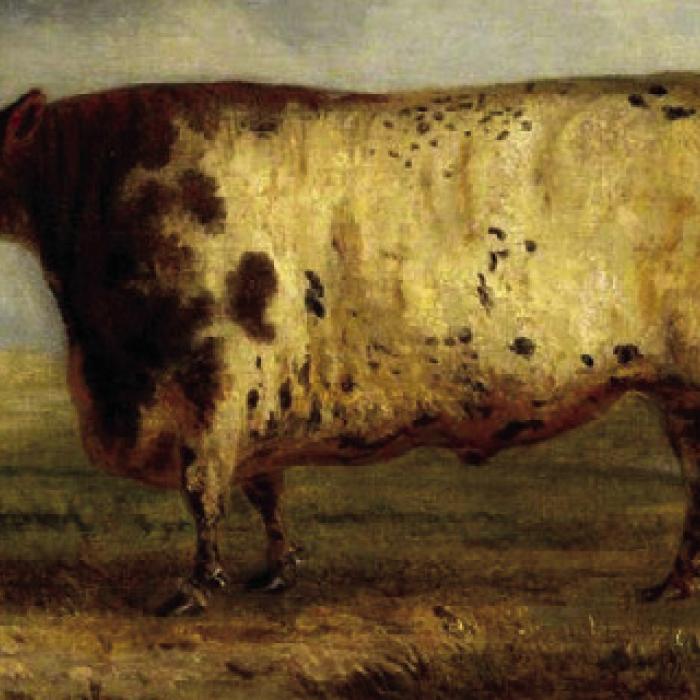

As some of you know, I’ve had a fascination with Shorthorn cattle for a long time. That’s mostly because I grew up in Schulenburg, where our school teams are known as The Shorthorns.
It’s an unusual mascot. Only one other school in the state can boast the same: Marfa. But their school colors are purple and white. The Schulenburg colors are orange and black, somewhat closer to the appearance of actual Shorthorn cattle.
The last time I wrote about Shorthorns, a retired Schulenburg school teacher reminded me that the school mascot wasn’t necessarily named after the breed of cattle. She cited an excerpt from Jane Knapik’s book, “Schulenburg: 100Years on the Road 1873-1973.”
In it, Knapik writes, “According to left guard Harry Vogelsang, the team was called ‘Shorthorns’ because they were short on everything – they had thirteen suits and eleven helmets for the whole team. The suits consisted of jerseys with no pads for protection…” About 20 years ago I was an animal science major at Texas A&M University. One semester, I took a meat science class. It was awesome. We basically worked as indentured servants for a few hours every week at the school’s in-house butcher shop. Once in a while, we grilled steaks to deliciously learn about the various grades of meat quality. Throughout the semester, we periodically checked on a pen of feeder calves to document their progress up to the time of slaughter.
In this pen, as I recall, there were four Angus calves, one Shorthorn, and various mixedbreed cattle. Our instructor asked us which calf would grade the highest for meat quality. All of us predicted it would be one of the Angus calves. He disagreed, picking the Shorthorn. Sure enough, at slaughter time, we graded the carcases and the Shorthorn came out on top.
This surprised me, because I grew up around cattle and watched my dad transition his herd from a bunch of mixedbreed cattle to predominately Angus. This was around the time the American Angus Association launched its “Certified Angus Beef” program. It has been perhaps the most successful marketing effort by any breed association. Consumers around the nation and even the world learned to associate the Angus name with delicious, highly-marbled steaks.
As a result, black Angus cattle brought higher prices at the sale barn. And they still do.
But I learned a lesson in that meat science class –Angus isn’t the only breed capable of producing high-quality beef. Since then, the American beef industry has embraced other breeds known for quality, notably the famous Waygu cattle of Japan.
Still, I’ve always had this curiosity about Shorthorns. I’ve been wanting to introduce some Shorthorn genetics into my herd of predominantly Angus cattle. Stockers who raise calves for the feedlot market have long-favored “black baldy” Hereford-Angus cross calves. These calves exhibit “hybrid vigor” – they tend to be healthier and faster-growing than purebred stock.
I suspect Shorthorn-Angus cross calves may have similar characteristics. Lately, I’ve been looking for a Shorthorn bull. But hardly anyone raises purebred Shorthorn cattle in Texas anymore. They were once quite popular. The last time I wrote about Shorthorns, several readers emailed me with stories about how their parents or grandparents used to raise Shorthorns. In addition, Shorthorns were one of the breeds used to develop the famous Santa Gertudis cattle of the King Ranch. Today, unfortunately, I’d probably have to drive to Oklahoma to buy one.
So let me end this with a story about Shorthorn cattle I recently came across.
A few days ago, the Traces of Texas account on X (formerly known as Twitter) shared this story published in the Norfolk (Virginia) News on March 20, 1926, concerning Thomas Jefferson Shannon. Shannon was a land speculator and cattle breeder born in 1808 in Warren County, Kentucky. He came to Texas in 1837 and died in 1864. In 1848, he received a gift of a bull and two cows of the “Durham” breed from none other than the Empress of Britain, Queen Victoria.
These cattle were almost certainly Shorthorns. Shorthorns were developed from the old Durham breed in England in the 18th century. The name “Durham” fell out of favor and by the 1860s these cattle were becoming known as Shorthorns. This 1926 article explains how some of the first Shorthorns got to Texas from Britain.
“An old, old man got to remembering down in Texas the other day, and when somebody questioned a statement he made, he hauled forth from the tray of an ancient horsehair trunk yellowed letters that have the haughtiest crest of British royalty, and two very famous signatures ...
The venerable Texan’s name is Shannon – last survivor of that famous family that, headed by Colonel Thomas Jefferson Shannon, prairieschoonered its way into that vast and howling wilderness in the days of head-rights and buffalo. The old Colonel, a bluff, hard riding, sharpshooting old plainsman, is remembered as the man who introduced the Red Durham strain into the cattle business of the West.
It now appears that that start – probably the parent herd of all the Durham cattle in America today, was a male and two females sent to Colonel Shannon by none other than Victoria, herself, and sent to him merely because he wrote her a letter saying he’d like a sample of the cattle she liked best.
He was only a plainsman living in an uncharted wilderness, but ... he sat down and wrote the Queen of England ... simply asked her to sell him some of her livestock. He told her who he was, where he lived, and what he wanted with it. The order was for a male and two females, and he generously offered to let her set any price she thought was fair.
Two months later the Queen herself wrote. It was a friendly but business-like letter. She said she’d be glad to let the colonel have the stock as he requested, and if he’d pay the freight on them from New Orleans to his North Texas home, she’d be glad to make him a present of them .... and in 1848 the bull and two cows landed from a British ship in New Orleans.
The colonel conveyed them carefully from there to North Texas. There were no railroads, but he placed them in wagons. At frequent intervals he unloaded them, fed them, and let them graze for a day or two. He at last got them home in perfect condition and they founded the herd that was the sensation of the old Southwest.
The old colonel never forgot the graciousness of England’s queen. He sent her reports from time to time as to how her transplanted stock was flourishing in the New World. He named his first daughter ‘Victoria’in her honor and one of his sons was christened ‘Albert’ in honor of her consort.”