


The Murder of Frank Sugarek
Footprints Of Fayette
Fayette County is one of the most historic counties in Texas. In this weekly feature from the County Historical Commission, a rotating group of writers looks back at local history.
The following story is taken from the book Dubina, A Place of Freedom and Hope written by Ed and Margie Janecka.
Frantisek (Frank) Sugarek was born on January 22, 1819, in house #22 in Kuncicky Ubasky, Moravia. He married Barbora Simicek. Barbora was born on November 30, 1831, in house #36 in Hajov, Moravia. They emigrated to Texas on the Anna Elise in 1856 along with two children from a previous marriage - Marianna and Karel. In 1859, Sugarek purchased 35 acres in the Content community south of Weimar in Colorado County. That same year, he and Barbora had their first daughter, Veronica. In 1861, they had another daughter, Amalie, who died in early childhood before 1863. That same year, Thaddeus Warsaw Hunter bought a large tract of land near the Sugarek homestead. According to histories of Ft. Bend County, Hunter was the son of a wealthy slave-holding plantation owner who was related to some of America’s early heroes. His tombstone in the Masonic Cemetery in Weimar states that he was the “firstAmerican born in Texas at Morgan Point near Galveston on September 29, 1822”. By 1860, Hunter himself was a wealthy landowner with seven slaves in Ft. Bend County.
Records in the Colorado County courthouse tell the story about Hunter, Sugarek, a dog and the murder. Apparently, Sugarek’s dog had killed some of Hunter’s sheep, which resulted in ill feelings and threats made to Sugarek by Hunter. This ultimately led to Hunter going to the Sugarek farm with the intent to kill their dog. When Sugarek was approached by Hunter, he armed himself, and the confrontation resulted in Hunter shooting Sugarek, killing him on June 3, 1863.
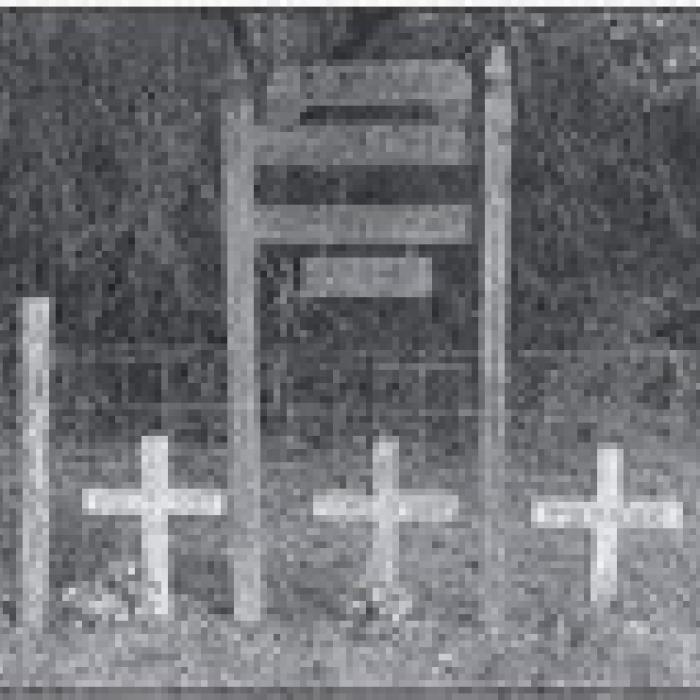
Barbora Sugarek walked from their small farm in the Con-tent community all the way to Dubina to borrow a wagon from one of the families living there, probably someone with whom they had emigrated, so that she could transport Frantisek’s body back to Dubina to be buried. At that time, however, the Catholic cemetery was not yet established there, so Frantisek was buried at a spot south of Dubina which today is alongside FM 1383. There are a total of seven known early Czech settlers buried there, including their daughter, Amalie.
Unfortunately, Texas justice for the Sugarek family was slow in coming. Hunter was indicted for the murder on November 3, 1863, five months after the actual shooting. The trial did not take place until November 2,1866 due to a series of delays and postponements. Judge Shropshire, who oversaw the court during the trial, instructed the jurors that “the defendant had no right to go, armed, to the house of premises of the deceased, for the purpose of killing his dog and the deceased, when thus approached, had the perfect right to arm himself for the protection of his person, his premises and his dog, or other property.” Hunter pled not guilty, was tried, and despite the comments made by the judge, was found not guilty and discharged. Perhaps, his money and standing in the community had an influence on the outcome. And perhaps, after all, Frantisek Sugarek was “just a Bohemian.”