


The Monster at Biegel
Footprints Of Fayette
Fayette County is one of the most historic counties in Texas. In this weekly feature from the County Historical Commission, a rotating group of writers looks back at local history.
In his book Fayette County, Her History, and Her People, published in 1902, Frank Lotto described the county as consisting of 963 square miles, with a population of 36,542 inhabitants. He gave further details about the county, such as the surface and soil, from its rolling prairies, post oak belts, to its islands of pinewoods in the northwestern sections of the county. He mentions the diverse soils, from sandy soils with clay subsoil to rich black lands and, also, that which lies below the surface, the gravel beds. Today, scientists, archeologists, and even we common folks love to speculate and dream of what this land mass would have looked like hundreds and even thousands of years ago. The petrified wood, rocks with seashells embedded within, and even arrowheads of previous cultures and people seem to propagate an interest in “just what was here way back yonder?” Actually, that question is nothing new. Take for instance, an article written in the La Grange Journal, dated June 25, 1903, entitled “Another Skeleton of a Monster.” It stated that “last Sunday, August Scherrer, while walking about his pasture found what afterwards proved to be a tooth of one of those prehistoric monsters we hear and read so much about. After hearing of the discovery, [the Journal sent its reporter out] to see for himself. It seems to be a complete skeleton. It was buried about fifteen feet below the surface, on the property of Mrs. E. Scherrer, near Biegel.” Speculation was that recent heavy rainfall had exposed the skeleton.
Let it be noted here that this piece of property, at that time, was probably being used as a gravel pit. Currently, it probably lies under the LCRA Power Plant lake. The community of Biegel, founded in 1832, was situated about eight miles east of La Grange on the old La Grange-Fayetteville Road. It was considered one of the oldest settlements in the county. Also, note the word “another,” which implies that similar discoveries had already revealed themselves to the landowners. In fact, the early La Grange Journal had numerous articles about ancient artifacts, petrified bones, remains of human bones, and even an article about valuable stones, including diamonds being discovered within the county.
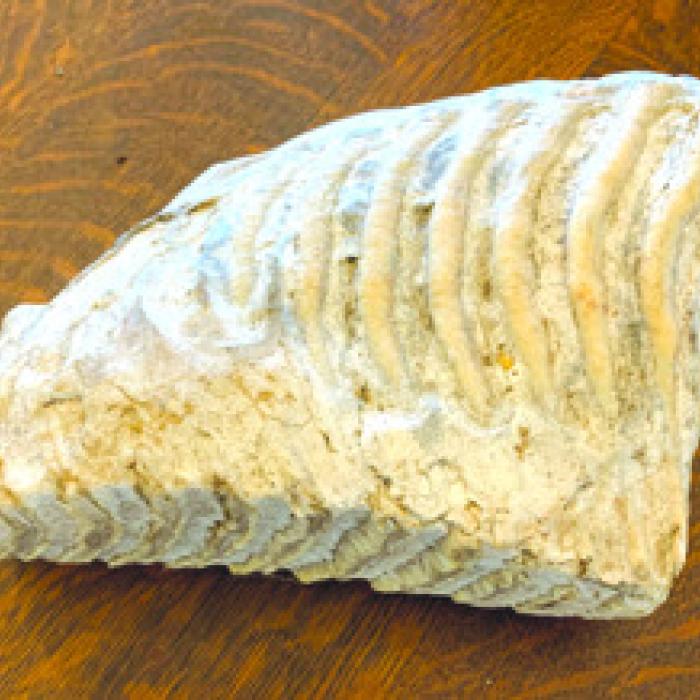
The original article went on to state that another tooth was found and something of enormous size had also been found. Then, there was discovered something resembling an ox horn, but much greater in size. “It measured seven feet two inches in length from the point to where it seemed to be grown to the head and at its thickest portion it measured about thirty inches in circumference. The exact distance between the tip of the horns cannot be ascertained as the bones of the head are in such decomposed condition that no part can be unearthed without crumbling to pieces… All the bones and the horn also are in such decomposed state that they were not removed from the place, for fear of their breaking, however the shape is well to be seen… The only thing taken from the place so far were the teeth which are in a perfect state of preservation. The teeth measure four and one-half inches by nine inches long.” It was further added that “quite a number (of people) have already visited the place to get a glimpse of this wonderful skeleton.”
What happened to this “monster?” In an article written in the Journal a few weeks later, it was noted that a group of men from Ellinger, led by Dr. A. P. Knolle had gone to the Scherrer property and “carefully unearthed everything that looked suspicious or resembled a tooth or bone and carried it back with them to Ellinger. Deed records reveal that members of the Knolle family may have been part owners of this property. Dr. Knolle had an office in the old downtown Main Street of Ellinger; however, this building burned in the tragic fire the first week of December, 1971. The Knolle home stood on the southeastern edge of the town; although, it also no longer stands.
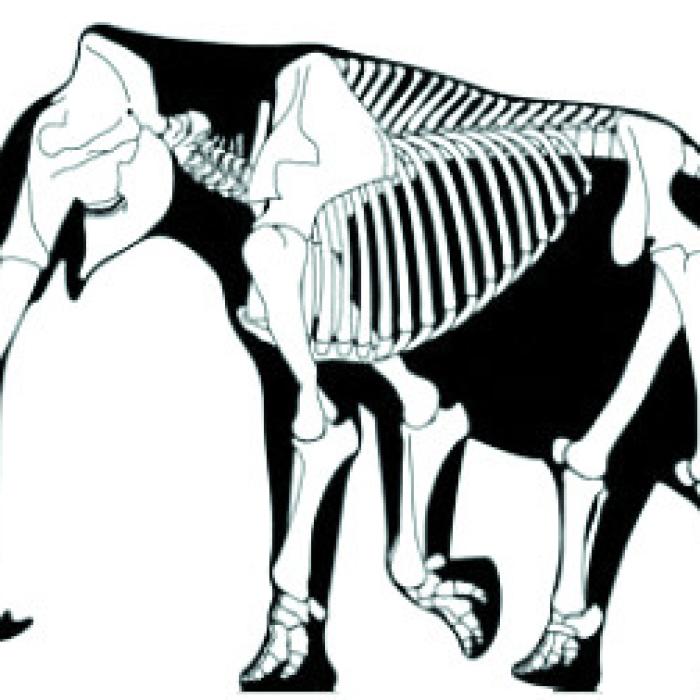
So, the question lies open, whatever happened to the skeleton of the monster? No one seems to know. However, the author of this article personally saw other artifacts, skeletal remains, petrified remnants, etc., that the men who worked at the gravel pits in Fayette and Colorado Counties would bring home from work and put on display. Considering the length of the tusk, it is more than likely this creature was a Columbian mammoth, which also had ridged teeth like many of those that have been found in our area. Our modern-day archeologists, using new methods and materials would probably have been able to excavate and preserve the mammoth found at Biegel. Perhaps another hidden ancient monster or historic artifact is just waiting to be revealed to a new generation of Fayette County residents. Let’s hope so.