


Marvin Stichler: The Unassuming Philanthropist

When his modest retirement income morphed into a multimillion dollar investment portfolio, perhaps no one was more surprised than Fayette County native Marvin Stichler.
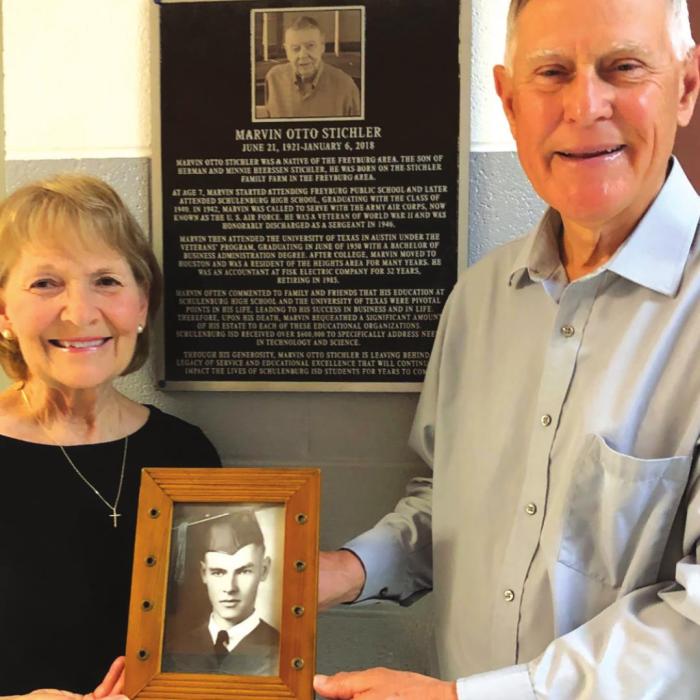
A plaque honoring Marvin O. Stichler hangs in the hallway of Schulenburg High School. At the McCombs School of Business at the University of Texas in Austin, a second nameplate is mounted beside a classroom door. Each commemoration represents a bequest of $621,121.35 from a grateful alumnus.
There’s no doubt that this bold signage would have made Marvin uneasy. Throughout his life, quiet and thrifty Marvin, who died in Houston at the age of 96 on Jan. 6, 2018, was content to remain in the background. He purposely dodged attention.
Humble Beginnings
Marvin was born on June 21, 1921, in his parents’ farmhouse at Freyburg, northwest of Schulenburg. At the age of seven, he began attending the brand new two-room Freyburg School. Years later, he recalled taking a footpath home through neighbors’ pastures and fields and once being chased by a bull. A good student who enjoyed learning, Marvin wanted to continue his education but in that era rural areas still had no school bus transportation.
Fortunately, Marvin had the opportunity to ride with a neighbor who drove a Model T Ford into town to attend Schulenburg High School in 1938. Since the vehicle had no heater, their daily commutes in the winter were sometimes breezy, he recalled years later. Marvin didn’t have the money to purchase an instrument and join the school orchestra. However, he was delighted when legendary band director Carl Morene, who wrote the school’s official song, “Shorthorns Forever,” asked him to pull the curtains at performances. Marvin never forgot Mr. Morene’s kindness.
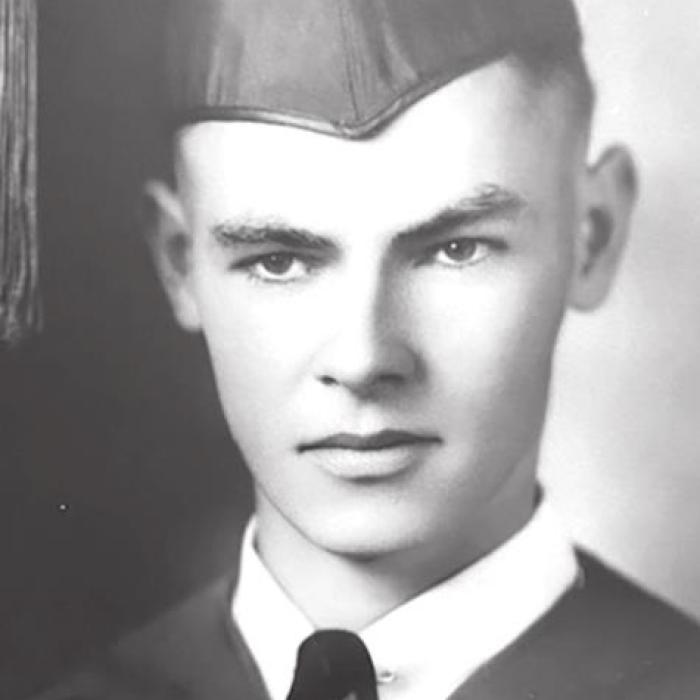
After graduating from high school in 1940, Marvin returned home, even though farm work ‘wasn’t to my liking,’ as he later recalled. It looked as if that was his future until the day a persuasive recruiter from Draughon’s Business College in San Antonio drove into the Stichler’s yard. If he enrolled, Marvin was promised a part-time job to help pay his expenses. The opportunity sounded so good that Marvin was soon boarding a Greyhound bus in Schulenburg headed to the Alamo City.
His first job was waiting tables at a restaurant on the Fredericksburg Road called Wolf’s Inn, where he was provided with living quarters and an old Chevrolet car to drive to the business school. After seven months, Marvin was hired for a civil service job paying $105 per month at nearby Kelly Field.
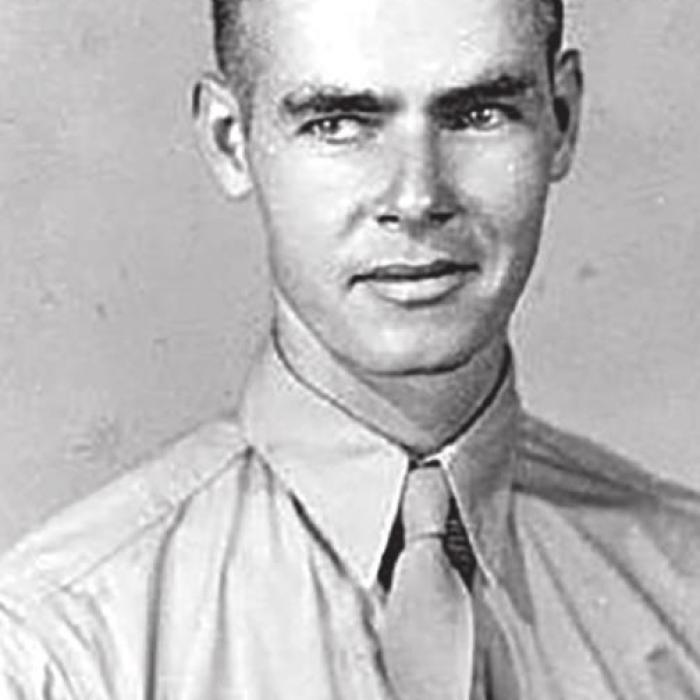
In October 1942, Marvin was drafted, returning to Kelly Field as a squadron clerk for a unit of the U.S. Army Air Corps. He served three and a half years in a clerical capacity, most of the time at the San Antonio base, along with five months at a Kingman, Arizona, facility.
After his honorable discharge, Marvin returned to his civil service position at Kelly Field until entering the University of Texas at Austin under the GI Bill. He worked part-time as a waiter at Kappa Kappa Gamma House, a sorority for wealthy female students on University Blvd., graduating with a Bachelor’s Degree in Accounting in June 1950.
Had it not been for the GI Bill that offered veterans assistance in acquiring a higher education, Marvin said it was unlikely that he could ever have financed a four-year college degree.
For 36 months, Marvin was employed by a company that manufactured products for railway freight cars in Houston. He then joined Fisk Electric Co., which also was headquartered in Houston. He faithfully worked in accounting there for the next 32 years.
Marvin was always a gentleman of the old school and a faithful son and brother to his Schulenburg kin and extended family. He regularly returned to attend family get-togethers, whether at Christmas, Easter or celebrations for birthdays and anniversaries. Although he never married, Marvin cared deeply for his relatives and enjoyed watching several generations grow up.
Nurturing Nest Egg
“I know what financial assets Marvin had when he retired in June 1985. It wasn’t that much, but he had enough to live on,” says Stan Quiring, who served as executor of his extremely frugal family member’s estate.
Marvin always lived well below his means because his wants and needs were meager.
His small, one-bedroom rented apartment in the Houston Heights received next-tono routine maintenance for over 20 years. The carpet hadn’t been replaced in at least two decades, the sheetrock had cracked and peeled and the bathroom fixtures were so rusty they barely worked.
“I remember visiting Marvin in August a few years ago and the window air conditioning unit in his tiny kitchen/living room wasn’t working. He was sitting at his table with sweat pouring down his face. I told him either he call the apartment manager or I would. He hated to bother him, but I insisted,” Stan says.
“Marvin never wanted to make a fuss,” explains his cousin, Darlene Quiring. “He didn’t want anyone to be upset with him, so he never complained.”
Marvin never opened the blinds in his apartment. He finally broke down and bought a new telephone when the numbers on his 1960s-model pushbutton phone wore off completely. The elderly accountant watched the three Houston TV channels because he didn’t purchase cable TV channels. Marvin never owned or operated a computer.
Marvin Studied and Studied
What interested Marvin was working the daily crossword puzzle in The Houston Chronicle and reading The Wall Street Journal, as well as its sister publication, Barron’s.
“Once, when The Wall Street Journal raised its rates, Marvin refused to renew his subscription, but eventually made peace with the increase. He also went out every Saturday to buy a copy of Barron’s, but didn’t want anyone to know because every copy cost $5. His pile of public companies’ annual financial reports in the corner of his small kitchen/living room was several feet tall,” Stan remembers.
Marvin was content to let others spend money on what they thought was important. He stayed immersed in business news. He was utterly fascinated by the factual coverage on companies and stock market developments. Undoubtedly, his accounting degree helped him plow through the financials and draw savvy conclusions.
“Marvin created his wealth by studying companies he read about in those papers. He invested wisely and many of those stocks did very well. The wealth Marvin built after his retirement just happened. It wasn’t something he set out to do,” Stan adds.
Despite making some great stock picks, Marvin continued to be cautious about spending money. He approached Stan about serving as his executor because he thought banks charged too much to do so. The old bachelor economized in other ways, too. Once a year, the Quirings received one birthday card that read, ‘Dear S, D, K, K & P, Happy birthday. Love, Cousin M.’ The abbreviations stood for the members of the Quiring family: Stan, Darlene, Kimberly, Kristen and Patrick.
Marvin’s correspondence to family and friends was formal in tone with impeccable spelling and grammar. His penmanship was always legible, even in old age.
Marvin’s Breakfast Club Buddies
Marvin’s Houston social life had revolved around his breakfast club. He looked forward to meeting with this informal group of retired men on weekday mornings at Harry’s, a legendary Midtown restaurant in business since 1948.
“He would tell us about his friends, but never refer to them by name. There was a guy Marvin called Deacon, who I guess was a deacon at a church somewhere, and there was the Cadillac Man. Perhaps he either drove a Cadillac or worked at a Cadillac dealership,” Stan recalls.
Marvin didn’t venture far from home as the years went by, but always welcomed a visit from Stan and Darlene.
“Marvin asked me one day if I could adjust the driver’s mirror on his 2003 Ford Taurus because it had gotten moved somehow. So I tapped the button on the door and rolled down the window to move the mirror. ‘How did you do that?’ he asked. He had never used any of the buttons because he didn’t know how,” Stan says, adding that Marvin kept the vehicle meticulously clean.
When he was well over the age of 90, Marvin decided to stop driving in Houston traffic and sold the vehicle back to the dealership where he’d purchased it. The car had very, very few miles and although the tires looked good, they were rotten.
“When he got older, we talked with Marvin about moving into an assisted living place and took him brochures to look at. He said he would let us know. Time went by. Darlene and I were in Italy when I got a call saying he was ready. Could we come and move him? I told him we’d be home in a week or so and would be glad to. We would have liked to see Marvin move close to us in Sugar Land, but he wanted to stay in the area of Houston he knew. He selected Brookdale The Heights.
“Once we got Marvin moved, I’ll never forget him sitting on the end of his bed watching the ticker tape of the stock prices running across the screen on a financial channel. He was mesmerized. Since he had never had cable TV, Marvin had no idea something like that existed. It was a revelation to him,” Stan explains.
When Marvin shared the list of beneficiaries in his will with Stan, the Schulenburg Independent School District and the University of Texas at Austin were on the list. Marvin said they represented pivotal forces that changed the trajectory of his life and he was grateful.
Although Marvin did not voice a preference about how the UT monies should be spent, he wished that his bequest to the SISD be directed toward technology to better equip students and teachers.
“I was curious that Marvin didn’t want to fund scholarships instead. He didn’t explain why, but perhaps it was because he worked his way through college,” Stan adds
Although very quiet and amiable, one thing did annoy Marvin.
“He hated lukewarm coffee,” Darlene says. “If we were in a restaurant and served coffee that wasn’t hot, he would grumble. Now when that happens to Stan and me, we look at one another and say, ‘Marvin wouldn’t be happy.’ Then we smile. We have so many special memories of my cousin Marvin.”