


Local Became Couples Therapy Pioneer
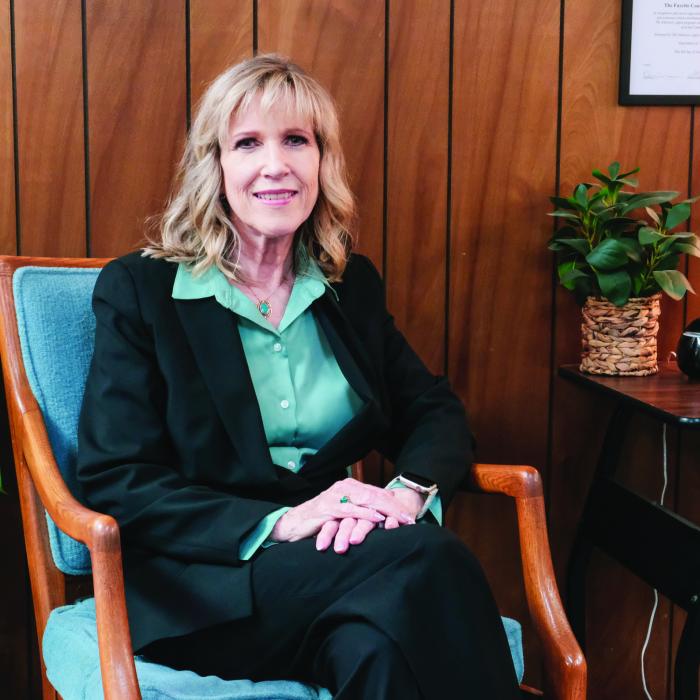
Dr. Carrie Ullrich Cole came to town last week for her 50th class reunion. The renowned therapist and researcher graduated from Round Top-Carmine High School in 1976. She went on to become a pioneering expert in intensive couples therapy.
Cole sat down with the Record on Friday, June 12, to discuss her career and a new book coming out this fall that she and her husband edited.
Cole, along with her husband Dr. Donald Cole, helped to develop a type of couples’ therapy known as “marathon therapy.”
“Basically, marathon therapy is intensive couples’ therapy that happens over the course of four days,” Cole said.
Traditional marriage counseling usually involves 90-minute to two-hour sessions in a therapist’s office. Cole said couples in these sessions might finally get to what she called “the heart of the matter” just as the session comes to a close. Then the therapist needs to see another client.
“You kind of rip open the band-aid,” she said. “The wound is exposed, and then they’ve got to go out into the world. If they’re lucky, they come back in a week. Then a lot of things happen. Life happens, and that wound is getting more irritated.”
In marathon therapy, on the other hand, couples spend four days together. The first day takes place in a “Love Lab.” A therapy team takes all sorts of physiological readings. The couple is connected to electrodes. They each have one-on-one conversations with the therapist, and those conversations are video recorded.
“We’re measuring their respiration, so how fast they’re breathing,” Cole said. “We’re measuring their skin conductance, so how much they sweat. We measure pulse transit time, which is how long it takes their heart to get to their ear, which indicates the velocity at which their heart is pumping. And then two channels of facial muscles.”
Cole said facial expressions and tone of voice are also recorded. All of this information is compiled in a report. Her sister Heidi Ullrich, who works for the Coles, described it as “an MRI for your marriage.” The report guides the course of therapy over the coming days.
“So it’s kind of like a marathon,” Ullrich said. “It’s very intense, but it allows them to go deep on some issues.”
Cole said she began studying psychology as a way to fix her first marriage. She married her first husband soon after graduating high school and had children. She went to Blinn College and later the University of Texas at Austin, where she majored in psychology and graduated with honors. She worked as a research assistant for some social scientists on the subject of self esteem while attending graduate school at UT.
“I really needed that,” she said.
Cole graduated with a master’s degree in counseling psychology and went to work for Lutheran Social Services.
“I went to college and specialized in psychology to figure out how to fix my marriage,” Cole said. “I was told that everything that was wrong in that marriage was my fault, and I believed that. So I was going to fix myself and fix my marriage. By the time I was finished, I realized I couldn’t fix the marriage. So it ended.”
Around that time, Cole said Lutheran Social Services got out of the counseling business. She opened a private practice in Giddings and Brenham and met her current husband, Dr. Donald Cole, who had also worked for Lutheran Social Services.
At the time, Cole said she was interested in relationship therapy. But in private practice, she counseled people with all sorts of psychological issues. For example, her practice was one of the mental health care providers covered under insurance for the British Petroleum workers after the Deepwater Horizon explosion in 2010.
“I got a lot of those guys,” Cole said. “I saw about 10 or 15 of them, and I was traumatized from that.”
She and her husband also provided mental health services to many of the Hurricane Katrina victims who flooded into Houston.
“There were people who were lined up everywhere and had trauma stories after trauma stories of their loved ones floating by them,” Cole recalled.
One day, her husband asked her to visit with some Katrina victims who were being housed at the Astrodome.
“I didn’t have anything left in the tank,” she said.
A few years before Hurricane Katrina, Cole and her husband attended a training session by the Gottmann Institute, let by world-renowned relationship therapists Dr. John Gottman and his wife Dr. Julie Schwartz Gottman of Seattle, Wash. They attended another training session with the Gottmans shortly after Katrina – an experience Cole described as “life-transforming” for both she and her husband.
She recalled a conversation they had afterwards: “I said, ‘This is what I want to do. I want to specialize in just working with couples,” Cole said. “And he said, ‘Me too.’” The Coles eventually became certified in the “Gottman Method” of couples therapy. They even became certified trainers to teach other counselors the Gottman Method. Cole later became research director for the Gottman Institute and helped launch the Gottman Love Lab, mentioned earlier, with its focus on physiological observations. The Love Lab might be John Gottman’s greatest contribution to the field of relationship psychology. Dr. Carrie Cole has led the Gottman Love Lab since 2017 and continues to oversee studies by the Gottman Institute.
In 2022, Cole graduated from Capella University with a PhD in psychology with a specialization in research.
She and her husband have traveled throughout the United States and the world teaching and practicing couples therapy. The Coles also offer luxury couples retreats twice a year here in Fayette County. They take place at Rustic Barn Retreats in Round Top and are limited to seven couples at a time. Cole said she and her husband lead the couples on exercises aimed at strengthening the three systems that need to be healthy in a relationship. The first one is the friendship system.
“Part of the friendship system is fondness and admiration, playfulness, humor, and that’s also where your sex life is developed and flourishes,” she said.
Next is the conflict management system.
“How can you manage conflict?” she said. “You’re never going to eliminate it. What we’ve learned is that 69% of all of couples’ problems are perpetual problems. They’re going to deal with those problems their whole lives together. So how do we manage it in a way that feels good for each person? Even though you can’t eliminate it, you can make it better.”
The third system is the shared meaning system.
“This is really where your values, beliefs, and philosophy of life are, as well as your rituals and your traditions,” Cole said. “So how similar are those for couples? What gives them a sense of ‘us’– this is who we are.
Cole said she was excited to visit with her old classmates from Round Top and friends in the area, some of whom she hadn’t seen in many years. One person whom she kept up with most was the recently departed Jill Stueber. She had planned to attend her class reunion for some time now, but it just so happened that Stueber’s funeral took place while she was in town. Cole said she and her parents moved to Fayette County when she was in the sixth grade, and Stueber was one of her first friends.
“I just can’t quite process yet that she’s gone,” Cole said.
Cole and her husband also recently edited a book that’s coming out in September titled “The New Marriage Clinic Casebook. It’s available for pre-order on Amazon.