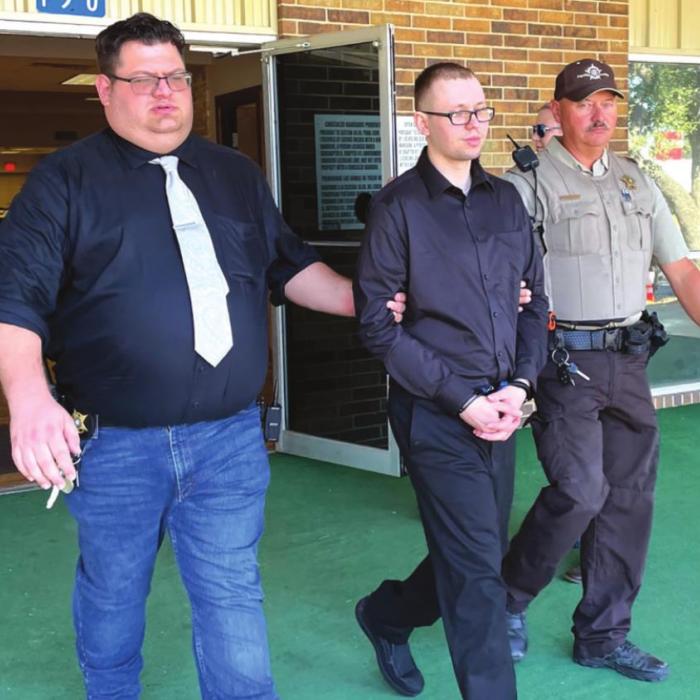
Jury Sentences Nelson to Life in Prison for Murder
A Fayette County Jury convicted Dylan David Nelson for the 2017 murder of Jeremy Cornwell last Thursday, Sept. 23. The following day they sentenced him to life in prison plus a $10,000 fine.
Cornwell, a 43-year-old plumber from La Grange, was shot and killed on the steps of his home on Creamer Creek Road on July 5, 2017. His mother Karen Cornwell discovered his body the following day after he failed to show up for work.
Early in the trial, Nelson’s lead defense attorney Richard Halpain spent much effort attempting to discredit the state’s key witness David Williams, a jailhouse informant. Williams, who helped investigators find the murder weapon in 2017 through his conversations with Nelson in Jail, also testified that he was out of jail on probation and had moved out of state without permission.
Any doubts the jury had about Williams’ credibility were put to rest later in the trial by evidence and witnesses that corroborated the informant testimony. Williams testified that Nelson told him he came to La Grange on the day of the murder to take back the pistol he gave to Tessa Mangis for her birthday a few months before the murder. The jury saw text messages from the phone of Tessa Mangis, purported to be from Nelson, which corroborated that part of Williams’ testimony.
Williams said he devised a rouse in which Nelson thought he and Williams were trying to pin the murder on Mangis’ then-boyfriend, Jakorian Wilson. Through this rouse, Nelson told Williams where he tossed the murder weapon and his cell phone. They drew a map that led investigators to a watery ditch near the TA Truck Stop between Sealy and Columbus where Nelson tossed the gun and phone.
The jury also saw text messages from the same phone number to Ross Garcia, a Houston ship channel worker who was the last registered owner of the 9mm pistol used in the shooting. Garcia testified that he sold the gun through the Houston Gun Trader’s website. Garcia said he and the buyer made the transaction in the parking lot of Bass Pro Shop in Friendswood. The state never offered phone records or any other evidence that the phone number in Mangis’ and Garcia’s text messages actually belonged to Nelson. Garcia could not positively identify Nelson in the courtroom, saying he could not recall what the man looked like after four years. However, the buyer in Garcia’s text messages said he drove a red Saturn Ion – the same kind of vehicle Nelson was driving on the day of the murder.
Malory Foster, a ballistics expert from the DPS crime lab in Austin, testified that the casings and bullets found at the murder scene and recovered from Cornwell’s body matched the 9mm pistol recovered in the ditch near Sealy.
Texas Ranger Brent Barina, the lead investigator, testified about surveillance video he collected from various businesses in Fayette County that showed Nelson’s red Saturn Ion traveling through the County on July 5. Video from Sammy’s Sports Grill, the business where Mangis worked at the time, showed Nelson stalking Mangis at the restaurant. Karen Cornwell testified about seeing the top of a red car at her son’s house at the time of the shooting.
Later the red car was captured in video from Kort’s Korner. The car was seen turning south on US 77 from Country Club drive about 20 minutes after Cornwell was last week alive. Cornwell’s residence on Creamer Creek Road lies just a few miles away from that intersection. Video from Colorado Valley Telephone Cooperative showed the same car heading south on US 77 a few minutes later. Additional video from the Pilot Truck Stop and the Best Western in Schulenburg showed the same car getting on Interstate 10 and heading east. A licence plate reader in Colorado County also captured the car heading east within the timeline that Barina established.
The jury watched a video of Barina’s first interview with Nelson a few days after the murder. In the interview, Barina caught Nelson in a lie about where he had been on July 5, 2017. Nelson said he went to Columbus that day and got in the wreck on his way back to Houston. When Barina said he saw video of him at Sammy’s that day, Nelson admitted to being in La Grange.
The defense attempted to cast doubt based on several unusual circumstances about the murder. The medical examiner who conducted the autopsy stated that Cornwell likely died instantly from one of the gun shots that struck his heart. That explained the little amount of blood found at the scene considering that Cornwell suffered several other bullet wounds.
However, the defense pointed to evidence of blood stains in Cornwell’s pickup truck parked several feet away. Investigators found items from inside the pickup laying on the ground outside, suggesting some kind of struggle. According to testimony at the trial, investigators have never been able to locate Cornwell’s cell phone.
On several occasions, the defense brought up Jeremy Cornwell’s strained relationship with his son Josh. Some time before the murder, Josh had beat up his dad’s pickup by striking the truck with some kind of object. Josh moved to Arizona a few days before the murder. Ranger Barina testified that law enforcement officials in Arizona “laid eyes” on him there the day after the murder.
Halpain pointed out that the prosecution never called a witness who actually saw Josh in Arizona. At one point, Halpain mentioned that Josh’s girlfriend drove a red car, but the defense never offered any evidence or testimony about that, either.
Following closing arguments last Thursday, the jury took less than an hour to return the guilty verdict. District Judge Jeff Steinhauser retired the jury for the day. They returned the next morning for the punishment phase.
Friday’s proceedings began with additional testimony from Tessa Mangis about her relationship with Dylan Nelson. Mangis, 21, previously testified that she first met Nelson, 25, when she was 15. He would have been around 19 years old at the time. Nelson was friends with Mangis’ cousin.
Mangis testified that she cut off contact with Nelson after a traumatic experience in April 2017. Nelson was 21 at the time and Mangis was 17. She testified that up to that point, Nelson often provided her and her friends with alcohol and drugs.
Prosecutor Natalie Tise asked Mangis about the events that led up to her breaking off contact with Nelson. Mangis said she one woke up at her cousin’s house in Houston to find Nelson standing over her and watching. Later, Mangis said Nelson showed her an image on his cell phone of something he did while high on the hallucinogenic drug LSD.
“It obviously upset me,” she said crying. “He decapitated a dog with a shovel. It was a brown dog covered in blood.”
On another occasion, she recalled playing with a stray kitten at Nelson’s apartment.
“I was playing with a gray one with blue eyes,” she said. “He stepped on his head and was laughing. He just stomped on in and kicked it into a wall. He showed me another cat and said it was OK, but it wasn’t OK.”
Mangis testified that Nelson often used marijuana, cocaine and exctacy in addition LSD. She said he bragged about being friends with people connected to a Mexican drug cartel and that they called him “Guero Loco” (Spanish for crazy white guy).
“He said he killed 30 people in Mexico,” Mangis testified. “At the time I thought he said it to be cool. Now I don’t know. I think it could be true.”
Mangis said Nelson would sometimes stay awake for days at a time while using drugs. During these times, she said Nelson spoke about being able to see “shadow people.”
One day, Mangis said, Nelson gave a ride to her and her friend Scharlotte Kay. During the drive, she said he began playing with a pistol and pointed it at her and her friend.
“He asked if we were scared,” Mangis said. “I said I wasn’t, but I was scared. I tried to be cool. But man, I was scared.
Kay later testified about the same episode.
“One time while he was driving, he claimed to go into psychosis and said he could see shadow people,” Kay said. “He said he didn’t know who was real and who wasn’t.”
The defense called Nelson’s mother Janet Erin. She testified about abuse that Nelson received from his father and step-father, bullying in school, mental health problems and other troubling circumstances from Nelson’s early childhood. She testified that Nelson was twice hospitalized as a child for mental health issues.
Upon cross examination, assistant county attorney James Herbrich asked Nelson’s mother about her son’s numerous encounters with law enforcement before the murder. Those included a burglary of a vehicle in 2013, a threat to shoot up his school and a hospital, a marijuana charge in 2013, delivering drugs in 2015, tampering with evidence for swallowing drugs in 2015. Each time Erin said she didn’t know about the incident or that she didn’t remember.
Herbrich then played the audio of a phone call from earlier in the week between Nelson, his mother and his sister that was recorded at the Fayette County Jail. During the phone call Nelson instructed his mother to say “I don’t remember” if asked certain questions. He said that if prosecutors questioned why she could not remember, she should respond, “I remember you’re an ugly [expletive] [expletive],” at which point everyone on the phone started laughing.
Herbrich chastised the mother for breaking Judge Steinhauser’s order that witnesses may not speak to anyone about the case except attorneys representing the two sides.
“Do you think this is a laughing matter?” Herbrich said.
The defense then called Dr. John Matthew Fabian, a forensic psychologist and neuropsychologist who examined Nelson after the murder. Fabian said Nelson suffered from a litany of mental health conditions that Fabian blamed on several factors, including medical problems at birth, abuse and drug addiction.
Upon questioning from the prosecution, Fabian said he was paid $300 per hour for his work on behalf of the defense. Fabian testified his total bill amounted to about $6,000, which was ultimately paid by Fayette County taxpayers since Nelson is an indigent defendant.
“Not everyone who suffers trauma grows up and shoots people, do they?” Tise asked Fabian.
“Typically not,” Fabian said.
Later, Fabian agreed with Tise that part of the purpose of the trial is to make society safe.
“In your final diagnosis, is this a seriously disordered defendant?” Tise asked Fabian, to which he responded “Yes.”
“What could happen if he’s turned out,” Tise asked.
“Anything,” Fabian said.
During closing arguments, Tise asked the jury for the maximum sentence, life in prison plus a fine of $10,000.
“The fine doesn’t do anything and it will probably never be paid,” she said. “It’s an exclamation point. Why do it? I think Dr. Fabian made it clear. Whether those things happened to him or not – lots of people experience terrible things in life but they don’t grow up and kill people.”
Halpain pleaded for some leniency, saying Nelson could receive counseling in prison and could eventually become a useful member of society.
“Without a doubt, Mr. Nelson suffers from serious mental illnesses caused by various things, to be honest, not any of his own making,” Halpain argued. “That doesn’t give him an excuse, but we’re not dealing with Ghengis Khan. He had a terrible start to life. In time, with proper therapies and medications, and in time with advances in medication, he will be better than he is now.”
Herbrich had the last word.
“Dylan Nelson should have turned his life around,” Herbrich said. “Giving him anything less than life will not make him a member of society. There’s never been a tear in his eye. There’s never been any sympathy for Mrs. Cornwell. You got to hear his language (in the jailhouse phone call). They laughed about it. There’s no family support there. You saw Jeremy Cornwell’s mother in here crying. Four years later and she’s still crying. Life – because Jeremy Cornwell deserves justice.”
The jury took only 30 minutes to return the life sentence.
After the trial concluded, Karen Cornwell gave the following statement to the Record:
“I don’t hate him, but I hate what he did to my son and the people who cared for my son,” she said. “I’m glad it turned out the way it did. Because of COVID, the trial was pushed back so many times. My life was on hold. It has been an ordeal.”
When asked, Halpain declined to comment about the outcome.
“We are very pleased with the jury verdict,” Herbrich said after the trial. “We thought justice has been done in this case.”
“I feel like the right thing happened,” Tise said.