

Inflation Up, But Local Sales Up Even More
At the halfway point of 2022, La Grange has already received nearly a million and a quarter dollars in sales tax revenue.
That’s by far the most it’s ever notched in a six-month period.
According to the U.S. Labor Department, inflation for the 12-month period ending May 2022 is 8.6%, the highest in 40 years.
Local businesses, however, saw sales increase 13.4%, as reflected in sales taxes rebated to the city by State Comptroller Glenn Hegar. Even factoring in inflation, local economies have surged this year.
While the 13.4% increase for La Grange was impressive, it was meager compared to Schulenburg, which has seen a 32.0% increase so far this year.
The county’s second largest city has topped $600,000 in sales tax receipts this year, when it’s never before seen half a million in half a year.
All across south central Texas, towns and counties are posting strong gains over last year, which in turn saw gains over the prior year, 2020, when the pandemic had its most effect.
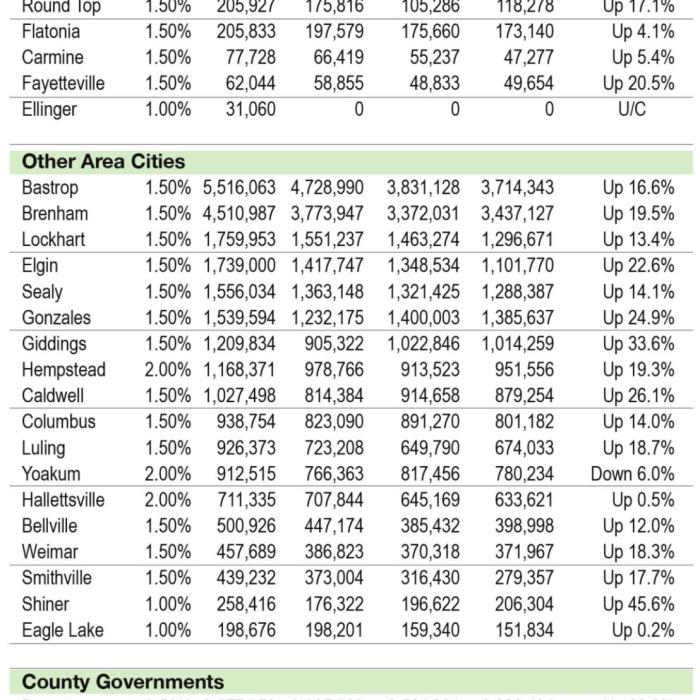
Of the 25 towns tracked by the Record, all but one were ahead of last year. Of the 25, only two, Shiner and Giddings, had greater growth than Schulenburg, at 32.0%.
Among the nine area counties that levy the optional local sales tax, Fayette was second only to Burleson County in growth. Burleson was up 33.5% and Fayette up 33.3%.
With nearly $1.5 million is sales tax so far this year, Fayette County is the third largest trade center in the area, following Bastrop and Washington counties.
Four of Fayette County’s towns have had double-digit gains so far this year. Schulenburg is up 32.0%, Fayetteville up 20.5%, Round Top up 17.1%, and La Grange up 13.4%.
Carmine has seen a 5.4% increase this year and Flatonia is up 4.1%.
The county’s newest town, Ellinger, has taken in $31,060 in sales tax so far this year, about half of Fayetteville’s revenue. In prior years, Ellinger was not incorporated.
Texas law allows local governments to tax retail sales at a combined rate of no more than 2%. If a city has a 1.5% tax rate, the county can adopt a half-cent tax rate.
If a county does not levy a tax, its cities can take the full 2%. Lavaca and Waller counties, for example, do not have a county sales tax, so towns like Hallettsville and Hempstead have 2% city tax rates instead of 1.5% like La Grange.