


How LG’s Old Historic Oak Received Its Scars
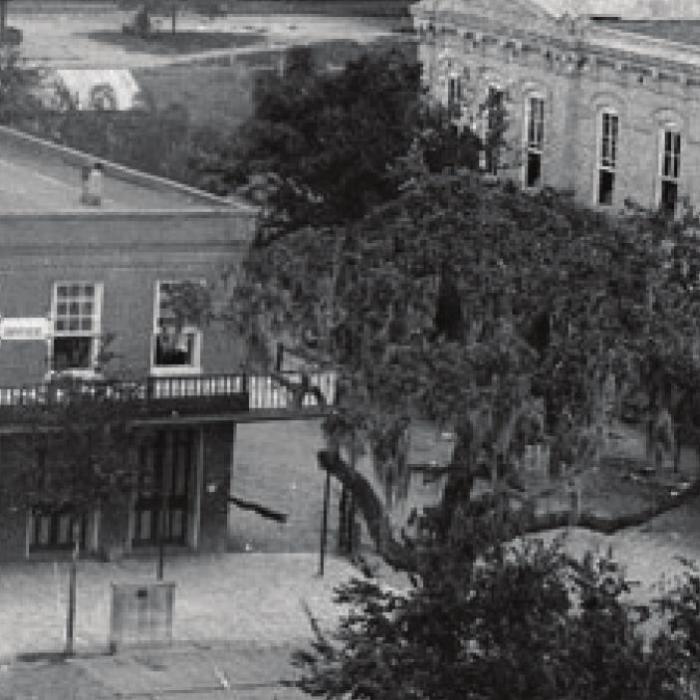
Back on September 15, 1842, Nicholas Mosby Dawson organized his ill-fated company under the branches of a large oak tree on the square in La Grange. They planned to come to the aid of San Antonio by repelling an invasion by Mexico. However, three days later, in a fight outside San Antonio near Salado Creek, Dawson and thirty-five of his men were killed. Two escaped, but fifteen others were captured and imprisoned in Mexico.
In the years since, numerous other young men have gathered under this same oak before being sent off to war, causing it to be called the “Muster Oak.” It has also been called “Dawson’s Oak,” but today it is usually referred to simply as “The Historic Oak.”
It was only a few years after the Dawson Massacre that the old oak received the massive scars that are still visible today. In a letter published in The La Grange Journal on February 3, 1910, J. S. Lewis of Austin recounted the incident that his father had witnessed sixty-five years earlier:
“My father, John E. Lewis, who has long since passed to his reward, owned at the time of this story a valuable horse which we children called ‘Roan.’ Now old Roan worked admirably in any capacity in which his services were needed, but one particular trait which we boys remember so accurately was his great aversion to storms, particularly a storm accompanied by thunder and lightning. If we chanced to be behind the plow when such a storm descended, we knew the wisest plan was always to hastily unhitch and seek shelter, more on old Roan’s account than on our own, for his antics at that moment were lively indeed.
“On this particular day of my story, my father rode horseback into La Grange from our home, some five miles in the country. Old Roan behaved remarkably well until, when just on the outskirts of the town, a storm was seen to be gathering. Increasing in speed, my father reached town just as the storm descended. Riding hastily up to this old oak tree, he dismounted, tossed the reins over a limb and ran into a mercantile store, a long wooden structure owned and operated by Mr. G. W. Sinks, father of Judge Ed. Sinks, of Lee county. This store was located on the identical spot on which the John Schumacher Bank stands today [Prosperity Bank in 2020].
“Not finding Mr. Sinks in the front part of the store, my father walked to the rear, where the two men engaged in conversation.
“In the meanwhile, the storm seemed to be increasing, thunder and lightning filling the air. Remembering old Roan’s great aversion to such manifestations, and fearing that the tree, then the highest object anywhere around, would be struck, my father decided to change the location of the horse. He had reached the front door, when Mr. Sinks suddenly interrupted him by calling his attention to something within the store.
“In this brief interval, while he was responding to the question, a fierce bolt of lightning struck the old tree, ranging down the side, killing old Roan instantly.
“So great was their consternation that neither of them, for the moment, realized what undoubtedly would have befallen my father had he proceeded uninterrupted to the rescue of the horse.
“The stricken limb and a burned furrow down the side of the old oak tree may be plainly seen to this day.”