


Gardening: Preparing for the Cold Snap

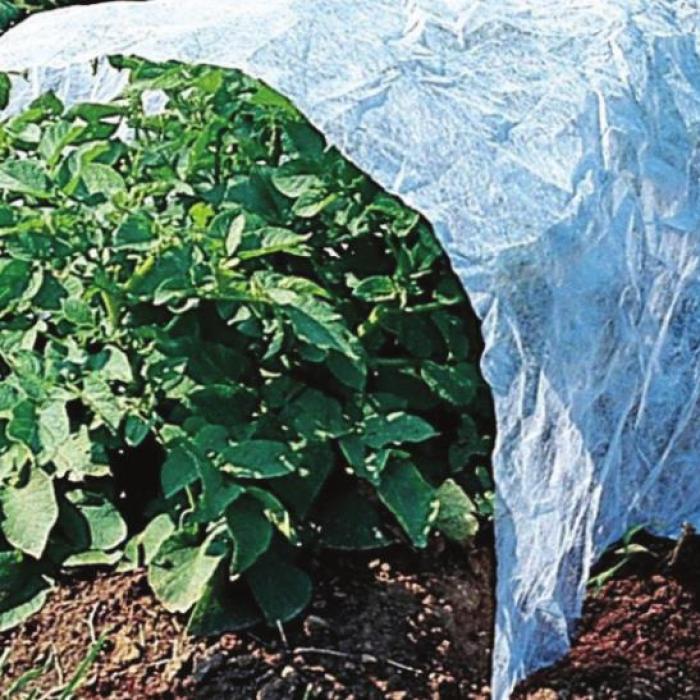
I hope everyone got their gardens ready for the frost that’s supposed to arrive this weekend.
The best way to protect your crops in cold weather is by using floating row cover. This spun fiber material protects plants from damaging frost while also allowing light to enter during the day. Some people also use floating row cover during the summer time to keep insect pests away from their crops.
The material is really lightweight, so you don’t have to worry about it crushing your crops. Unfortunately, I have not found a local supplier of floating row cover, so I often use bed sheets and blankets. You have to support bed sheets and blankets due to their weight, however. I simply suspend sheets above my crops by poking sticks in the ground. You can also construct hoops from PVC pipe. You can’t leave bed sheets or blankets covering your crops indefinitely, however, because they will block light from reaching your plants.
I would advise against using clear plastic to cover your crops. It will keep the frost off your plants, but you better take the plastic off early in the morning. Clear plastic will act like a magnifying glass after the sun comes out, intensifying sunlight to the point that it can kill your plants.
Raised Bed Math
A reader from the Round Top area recently asked me how much dirt she will need to fill a raised bed. I wasn’t the best math student in school, but I have learned some formulas to calculate the volume of dirt needed to fill a container.
Soil volume is typically measured in cubic feet or cubic yards, and that’s how soil is usually sold. This gardener from Round Top was asking about a bed measuring eight inches wide by 60 inches long by 24 inches deep. First, you must convert the inches to feet. Then you multiply the three numbers together. According to my calculations, she will need seven cubic feet of soil.
If the raised bed or container is round, the formula is a little more complicated. You may recall from geometry class the formula to find the volume of a cylinder:
V = πr 2 h
where V is the volume, π is pi, r is the radius and h is height.
Thankfully, there are some really helpful calculators online to assist you with these formulas. My favorite one is available at https://www.gardeners.com/ how-to/soil-calculator/7558. html.
Whenever I fill a new raised bed with soil, I find that the fresh, fluffy soil settles a few inches over time. I like to water my new raised beds thoroughly after filling with soil and then let it sit for a few days. It usually settles an inch or two. I then top off the raised bed with some more soil and water again before I plant anything in it.
Plant Sale Coming Soon
Ever since I got my greenhouse for Christmas, I’ve been starting seeds like a mad man. I have over 100 tomato plants of different varieties growing in there right now, along with dozens of heirloom peppers and eggplants, several varieties of basil and other herbs.
I plan to transplant only four or five of each variety into my garden, so I will have a lot of extra plants available. To recoup some of my investment, I’ve decided to offer these plants for sale. Look for an announcement in this column next month. I plan to hold a plant sale at the Fayette County Record office sometime around middle to late March. My wife Janessa or I will set up a pop-up tent outside the office. With every purchase we will give away a free copy of “A Year in the Garden,” the gardening calendar and magazine that the Fayette County Record published last month. All of my plants will be in four-inch pots and they should be ready to plant in the garden at that time. I can’t say they are organically grown, because that involves a bunch of bureaucracy. I’ll just say they are naturally grown. They only thing I’ve applied to these plants is fish emulsion, liquid seaweed, Superthrive, water and sunshine.
The tomato varieties I will have for sale are New Girl (an improved version of Early Girl), Tiren (an hybrid San Marzano type), Golden Jubilee, Matt’s Wild Cherry, Brad’s Atomic Grape, and Costaluto Florentino (a ribbed Italian heirloom). I’ll also have a heirloom tomatillo variety called Rio Grande.
The peppers I hope to offer are Hungarian Black, an unknown variety small Thai hot pepper, Chiltepin, “Zapoteca” jalapeno, Biquino (a small Brazilian yellow pepper similar to Chiltepin), Quadrato d’Asti Rosso (an heirloom Italian bell pepper), Rezha Macedonian (a long hot pepper with an “embroidered” appearance to the skin), Tobago (a Caribbean spice pepper), Lemon Drop, Sugar Rush Red and East Indian Habanero.
Almost all of these are rare heirloom varieties from around the world. You will not be able to buy most of these at nurseries. I have only grown a few of these before, so I cannot make any guarantees about whether they will grow in our environment. But I encourage you to experiment along with me.
I’ll probably sell them for $2.50 to $3 a piece. Look for an announcement about the sale in this column over the next few weeks.