


Fayette County Courthouse Ghost Stories
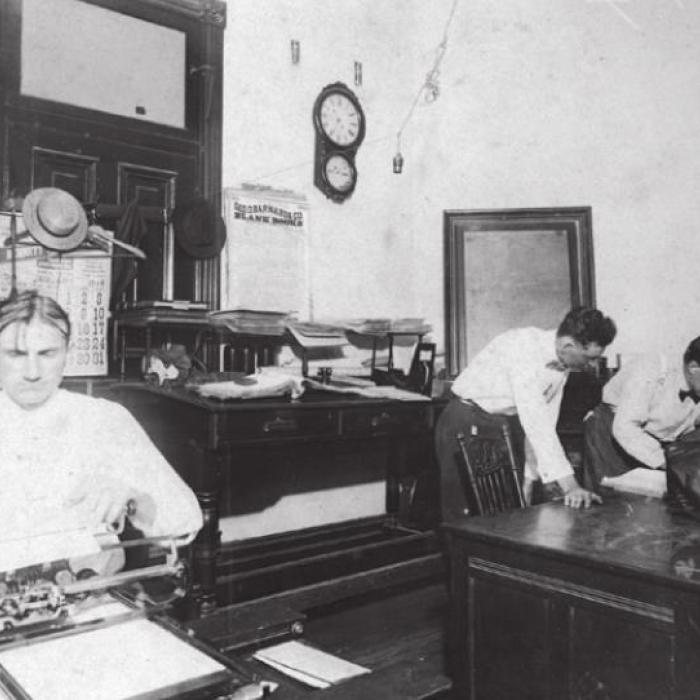
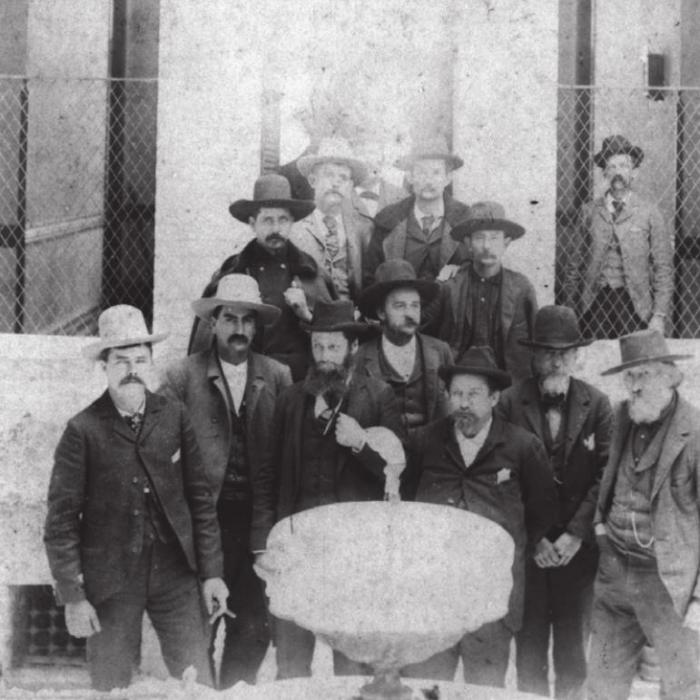
The most recognizable building in Fayette County is undoubtedly the Fayette County Courthouse located in the county seat of La Grange. The stately temple of justice was designed by 27 year old James Riley Gordon of San Antonio and constructed in 1891 at the cost of $99,407.04. The architectural structure of the courthouse is Romanesque Revival style, which was popular during the mid to late 1800s. Both the casual tourist and busy local are often surprised by the natural light of the atrium that falls upon them as they enter through the large wooden door. Taking a stroll down the hallways and into the courtroom, many visitors are quickly engrossed by the various designs – the hand-carved wooden staircases, solid marble flooring, ornate ceiling tile, thick green foliage in the atrium, not to mention a courtroom in which you would expect to find Atticus Finch pacing the floor. It can be quickly overlooked that the building is not a preserved museum, but indeed a working courthouse – bustling with customers conducting their business. But some claim that the sounds of our working courthouse do not end when the doors are closed at five o’clock.
With age and history come a myriad of tales that might make the hairs on your neck stand up. Many claim to have both heard and seen things of which they have difficulty explaining. I want to preface this with the statement that this article is not reflective of my opinion on the matter of ghosts, spooks, and the like, but simply a passing on of information that has been told to me throughout the years.
Some of the more common stories that have been shared over the years are that of simple sounds. When the employees shuffle out and the doors lock it seems as though the courthouse breaths a heavy sigh from the workload of its day (it is 130 years old after all). At night, every breath can be heard more loudly and clearly. Employees who work late or have run to their office late at night to grab forgotten items claim to hear some of the large office doors closing as well as footsteps echoing from the hallways. And the sound of rollers (shelves that have rolling units on them allowing for large books to slide easily onto shelves) are a common sound in certain office vaults.
Prior to building the Fayette County Justice Center near the Hwy. 71 bypass, the Fayette County Sheriff’s Office was located on the first floor of the Courthouse. Former deputies might share their stories with you if you’re lucky. Dispatchers who stayed through the night have their own stories to share. One dispatcher in particular shared that on numerous occasions he heard the sound of someone walking the halls. This happened at times when all doors to the courthouse were locked and no one else was inside the building. He also claimed that he and several others heard the sound of laughter coming from the courtroom in the afterhours. One evening, after the doors were locked to the public, noises were heard in a breakroom that was kept locked. Deputies approached the room, which had only one door, and prepared themselves to face an intruder who they thought was stealing something. Loud noises were heard from inside as if there were furniture or boxes being shuffled around. When the door was opened, the sounds ceased. The deputies walked in to a silent, empty room.
Over the decades, many changes have been made throughout the courthouse. The iron fence enclosing the block of the courthouse was taken down in the early ‘20s, the chimneys were removed in 1927, an elevator was added, as well as many other modernizations. But perhaps the biggest change came in 1949 when the atrium was enclosed with offices and vaults on each floor. In 2002, the Fayette County Commissioners’ Court received a grant from the Texas Historical Courthouse Preservation Program for the complete restoration of the courthouse to its original grandeur. This was a grand task that involved efforts from many entities and people. At one point during the renovation, some of the workers who were renovating a room on the third floor left for a lunch break, leaving their tools and bags in the room. Upon returning from their break, they found the door to be nearly stuck, having to push it with some difficultly to re-enter. After entering they found the cause - their tools, bags, and equipment were pushed up against the back of the door – which was the only entrance and exit to that room.
Certain employees have also claimed to have seen what they thought were real persons... Two employees have described the same man from two separate encounters. Normally, this wouldn’t stand out as anything unusual. Only, the first employee could tell he wasn’t quite… real. And the second employee described the same man when she witnessed him walk into a vault, but never come back out. In another instance, an employee saw a man who appeared to be working busily behind a counter, dressed in what you would imagine a male clerk would wear in the 1910s and 1920s. His hurried efforts to finish his work were almost as surprising as his translucency. In yet another instance, a woman who seemed to belong more in the Gilded Age than the new millennium was seen in the old women’s bathroom in the second floor, which is now an office.
Regardless of the various sights and sounds that people have witnessed, one thing is certain - the Fayette County Courthouse has a rich history that merits re-telling over and over. Oftentimes the truth is stranger and more fascinating than most fiction. Court cases with names such as Langhorne, Dach, and Ross are now forgotten, but upon opening their files, you will find a world that you didn’t even know existed in Fayette County. However, that’s another article. Until then, enjoy the spooks.
Footprints Of Fayette
Fayette County is one of the most historic counties in Texas. In this weekly feature from the County Historical Commission, a rotating group of writers looks back at local history.