


Fayette County Could be Affected Amidst Redistricting Push
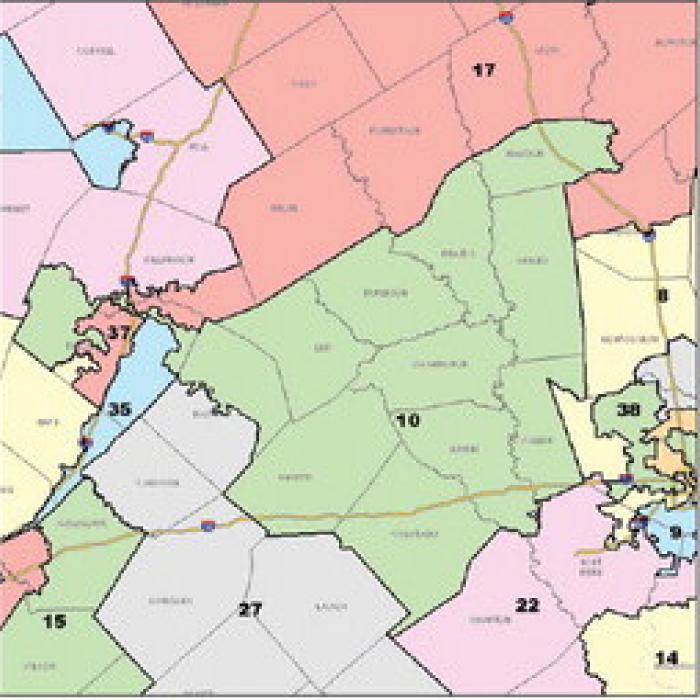

Fayette County could wind up in an entirely new congressional district before the 2026 mid-term elections.
A special session of the Texas Legislature kicked off on Monday, July 21. Texas lawmakers will tackle a number of issues related to disaster warning and preparation in light of the recent July 4 Hill Country Floods. But they’ll also take up an unusual middecade push for redistricting.
Typically, states redraw congressional and state district maps every 10 years following the U.S. Census. But in Governor Greg Abbott’s proclamation calling for the special session, he tasked lawmakers with revising the state’s congressional district plan “in light of constitutional concerns raised by the U.S. Department of Justice.”
The Department of Justice (DOJ) Civil Rights Division sent a letter to Abbott and Texas Attorney General Ken Paxton on July 7 urging the state to redraw what it called “racially based gerrymandering” of district lines.
The letter argued that three districts in the Houston area and one in the Metroplex were unconstitutional “coalition districts,” which were drawn to combine two or more racial minority groups so they make up a majority of voters. U.S. Courts have ruled that these kinds of districts are not protected by the Voting Rights Act.
Erin Anderson of the Texas Scorecard, a right-leaning publication, recently wrote that “Coalitions almost always result in Democrat districts.”
The DOJ letter said that if Texas fails to correct the “racial gerrymandering,” the U.S. Attorney General may seek legal action.
The letter comes just as President Donald Trump urged Texas leaders to redraw district lines to give Republicans more seats in the U.S. House after the 2026 midterm elections. The GOP holds a narrow 220-212 majority in the House. Three seats are currently vacant, and all of them were previously held by Democrats. Of the four Texas districts that the DOJ wants redrawn, three are held by Democrats. The other one is currently vacant, and it was previously held by a Democrat.
“Redrawing the congressional district maps ahead of the 2026 mid-term elections could help the GOP maintain a majority in the U.S. House and continue Trump’s America First agenda,” Anderson wrote for the Scorecard. “Such a boost would require shifting Republican voters from GOPheld areas while maintaining the party’s majority in those districts.”
Such changes could affect district lines throughout the state – even here.
Fayette County currently lies in U.S. House District 10, represented by Congressman Michael McCaul. While his district isn’t on the DOJ’s chopping block, the boundary lines look very much like the definition of gerrymandering.
It comprises a big swath of rural Central Texas stretching from Madison County and the western edge of Houston to Fayette and Lee counties, and then a smaller block of territory around the wealthy areas of Lake Travis and the western edge ofAustin, where McCaul lives. These two blocks are connected by a narrow strip of land less than a mile wide through the well-heeled Avery Ranch neighborhood of North Austin.