


Fall is the Perfect Time to Plant Some Trees

Fall is probably the best time to plant trees. It gives young trees time to grow a healthy root system before the stress of summer.
Some people plant trees by digging a big hole and backfilling around the rootball with rich, store-bought soil and compost. I don’t think that’s a good idea. The tree will get used to the rich soil as it grows. It might grow quickly. But when the roots expand far enough to reach the native soil, the tree is suddenly shocked. I think it’s better to backfill with the native soil. I think its a good idea to fertilize fruit and ornamental trees annually, ideally with a granular organic fertilizer like Micro-Life Multi-Purpose applied at the dripline of the canopy. But I would not mix fertilizer with the backfill soil for the same reason cited above.
For shade trees such as oaks and Mexican sycamore, I would fertilize the first year or two until they get established. I wouldn’t want a shade tree that requires a lot of maintenance after that.
Also, I think its better to dig a wide, dish-shaped hole when planting a tree, instead of a narrow hole shaped like a bucket. The tree’s roots like to grow in the loose backfill soil. When they reach the hard, compact soil beyond the hole, the roots tend to grow in a circle and never expand out. This is known as girdling. Planting in a wide, dish-shaped hole discourages the girdling root phenomenon.
The roots instead grow out and down into the hard soil underneath. The quicker they get acclimated to the native soil, the better.
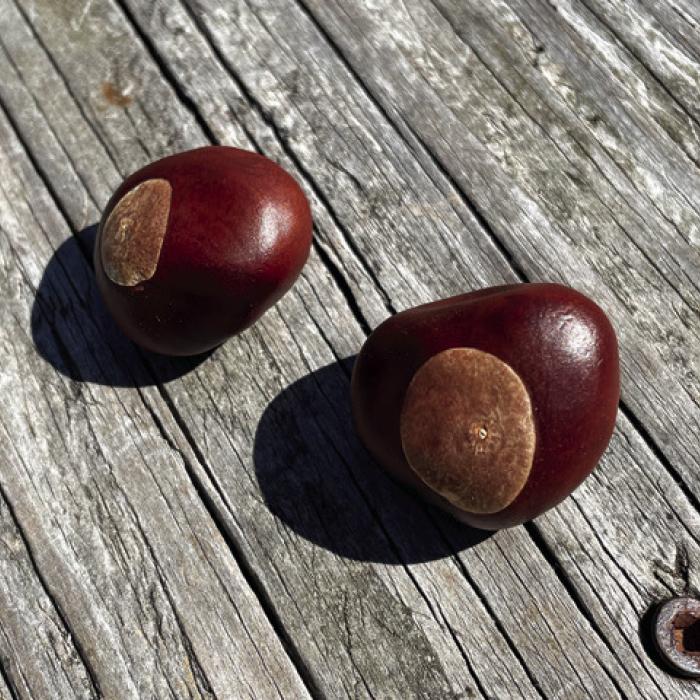
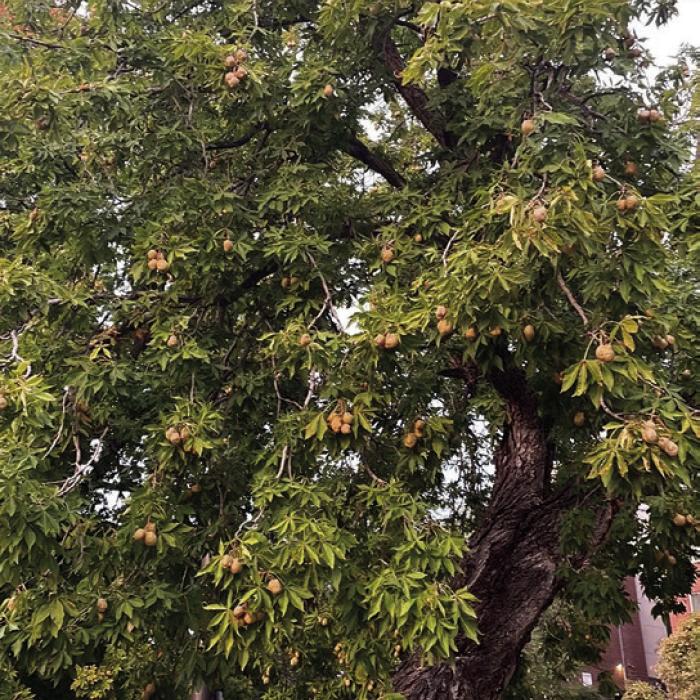
During our trip to Colorado a few weeks ago, I saw Ohio buckeye trees ( Aesculus glabra) for the first time. These trees line many neighborhood streets in Ft. Collins. I was blown away by the strange fruits and the huge buckeye nuts they contain. I saw some pictures of these trees online and was even more impressed by their flowers that appear in the spring.
We picked up a few buckeye nuts and brought them back to Texas. Their native range extends into the Dallas-Ft. Worth and the Cross Timbers area of Texas. Fayette County might be a little too far south for them to survive. But I’m going to try to germinate them and see what happens. I’ve read they need 120 days of cold temperature to germinate. So I’ll be keeping them in the refrigerator for a while.
While reading about the trees, I learned that we have a few buckeye trees that are native to Texas – the Mexican buckeye ( Ungnadia speciosa) and scarlet buckeye ( Aesculus pavia). The Ohio buckeye grows to 50 feet tall. These native buckeyes are more of a large shrub or small tree. For landscaping purposes, they might be superior to the Ohio buckeye. What they lack in stature, they make up for in color.
Both trees bloom in the spring like their Ohio cousin. The Mexican buckeyes are often mistaken for redbud trees in the spring. Their pink flowers look very similar from a distance. The scarlet buckeye, sometimes known as firecracker plant (not to be confused with Russelia equisetiformis, which has an identical common name), produces spectacular red blooms in the spring.
The Ohio buckeye, scarlet buckeye and Mexican buckeye are all in the soapberry family. All parts of them are poisonous to humans and livestock, so keep that in mind.
Do know of any buckeye trees growing in Fayette County? I’d love to hear about it and see some pictures. You can reach me by email at andy@fayettecountyrecord.com.