

Easter on the Bluff
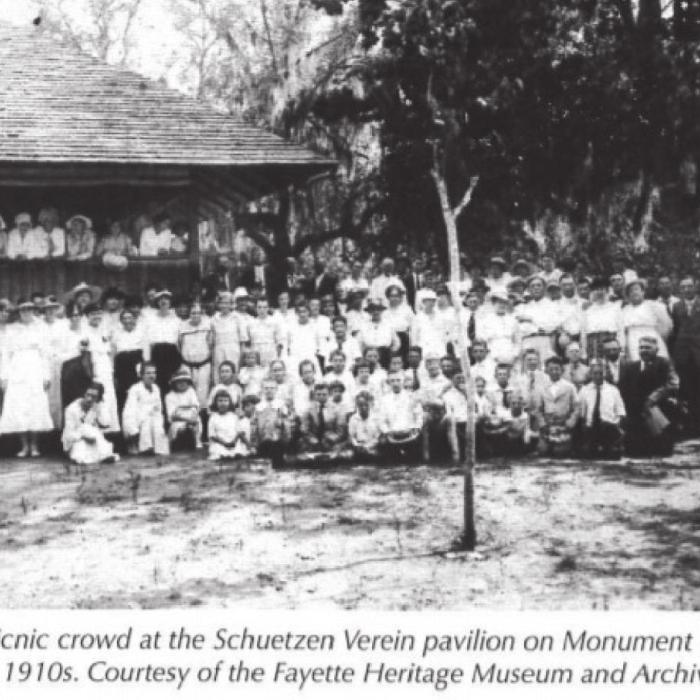
As we leave the Lenten period and enter Easter, the Kreische Brewery/Monument Hill State Historic Sites are bringing back one of the traditions celebrated on the Bluff. From the early days of La Grange, the pavilion at the historic site was the hub of the Bluff community. Although as members of the community remembered, the people who went out to the events on the Bluff were “mostly Germans, and big beer drinkers,” the social occasions on the Bluff and at the pavilion seem to have been relatively sedate and family-oriented affairs.
Long time community member, Verna Reichert recalled participating in Easter egg hunts held around the Schuetzen Verein pavilion when she was a child. “Oh boy, did we hunt Easter eggs up there. Of course, they always had committees for everything, like they do now. Usually the men did it—they’d go up there the day before, and with these great big sugar kettles you know they’d boil hard-boiled eggs and dye ‘em—then they’d go up there and hide all the eggs—most of the kids would turn loose to find them. That was more fun, you know…that was a big area up there to look for eggs. And I remember Mr. Hine was one of those who worked on the committee and he’d always have some eggs in his pocket and if the kids couldn’t find any, why he’d put one down where they could find it.”
In an effort to keep this tradition alive the Historic Sites are hosting an Easter Egg Hunt on Sat. April 3. You must reserve in advance so please call Kreische Brewery/Monument Hill State Historic Site to reserve your spot.
Many other of our Easter traditions have originated in Germany according to an article titled “The Best Easter Traditions come from Germany.” One of these is the Easter bunny some thought to be based on the pagan goddess Eostre, whose spirit animal was a rabbit, but was brought by German immigrants to the United States in the 17th century as the floppy eared egg bearing bunny we are all familiar with. One tradition I’ve often seen and wondered “Why? Eggs don’t grow on trees,” is an Easter Tree or Osterstrauss which is a bouquet of budding fruit tree boughs clustered together in a big vase and hung with delicately painted Easter eggs replicated by the Easter eggs hanging on our fruit trees we see in many yards near Easter. We might also see an Osterkranz or Easter wreath with hand painted eggs. Easter parades which we can remember from the song, “Easter Parade” by Irving Berlin and “In Your Easter Bonnet” made famous by Judy Garland both in the early 1900s.
Another tradition I think we are all happy for are Pfannkuchen or donuts made when the lard gathered at Karneval time when animals were prepared for the family before the Lenten fast prohibited killing animals for meat. I’m always happy to celebrate with a donut!
My personal favorite were the bonfires lit on Easter Sunday. The bonfire was lit as a symbol of ushering out the cold and darkness with the resurrection of Christ and the advent of springtime. In the Celtic world bonfires were lit at the Beltane Festivals. At this time all hearth fires and candles would be doused before the bonfire was lit, generally on a mountain or hill. In the 19th century, the ritual of driving cattle between two fires—as described in Sanas Cormaic almost 1,000 years before—was still practised across most of Ireland and in parts of Scotland. Sometimes the cattle would be driven “around” a bonfire or be made to leap over flames or embers. The people themselves would do likewise.
Regardless of the way you choose to celebrate Easter and the resurrection of our Lord we hope you will be joined by friends and family and together remember the importance of traditions.
References
The Kreisches and Their World, by John J. Leffler
The Best Easter Tradition come from Germany, Luisa Weiss
Hutton, Ronald. The Stations of the Sun: A History of the Ritual Year in Britain. Oxford University Press, 1996. pp. 218–225
Footprints Of Fayette
Fayette County is one of the most historic counties in Texas. In this weekly feature from the County Historical Commission, a rotating group of writers looks back at local history.