David Zapalac Celebrates 40 Years of Local Banking
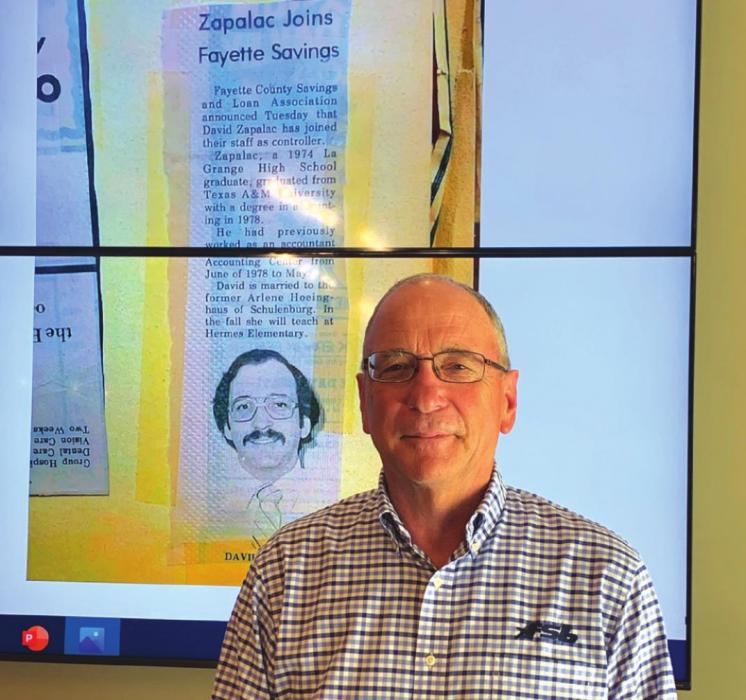
Not many people can say they’ve worked at the same place for 40 years, except for David Zapalac, CEO of Fayette Savings Bank (FSB).
Zapalac, who grew up in the La Grange area, graduated from Texas A&M University in 1978 and went to work three years for Gulf Oil in Houston. He started at the bank in 1981, when it was known as the Fayette County Savings and Loan Association. In those days, the company that later became FSB offered savings accounts and loans, primarily home mortgages, but not checking accounts and other services found at traditional banking institutions.
“At that time there were just four people here,” he said. “The bank opened in 1978 and had been operational just three years. I continued to work, and time just got away. I became president in 1987. I worked with some tremendous people along the way.”
Zapalac said that besides himself, six other people working at the bank today have been there 30 or more years and another five employees have worked more than 20 years at the bank.
“It’s not abnormal to come to work here and work that long,” Zapalac said.
Zapalac said the bank weathered some tough times over the years. During the 1980s and 1990s, over a thousand savings and loan institutions around the country failed. Fayette County Savings and Loan was established just a year before the event that precipitated the national savings and loan crisis.
In 1979, the Federal Reserve raised the discount rate that it charged other banks from 9.5 percent to 12 percent. Those interest rates seem exorbitant today, but as Zapalac noted, the general public was used to higher interest rates in those days.
“People were coming in and borrowing money for homes at 18 percent interest,” Zapalac said. “We were paying 14 or 15 percent on deposits back in those days.”
The sudden increase in 1979, however, sent the savings and loan (S&L) industry into a shock. The loan payments couldn’t cover the interest that many S&L institutions were paying. Zapalac said Fayette County Savings and Loan survived the crisis by employing adjustable interest rates.
“Years ago, there weren’tadjustable rate mortgages,” he said. “The interest rates were pretty much fixed. But when we started making loans, the majority of our loans had adjustable rates. We didn’t make a lot of money, because of those adjustable rates. But we made a little money. The problem a lot of savings and loans had back then was the cost of paying interest on deposits was more than what they were getting on the loans, so they would lose money. We always had adjustable rates, and that kept us going.”
When the crisis subsided in the 1990s, Fayette County Savings and Loan elected to become a state savings bank. It began offering checking accounts like other banks. And it changed its name to Fayette Savings Bank.
“We became more competitive with banks,” Zapalac said. “We made some mistakes along the way, but we survived. The growing pains - the first ten years it was really hard. We had to heal to get where we are today. But the local people have been so supportive.” Zapalac said he couldn’t im
Zapalac said he couldn’t imagine working as a banker in a large city.
“We’re all neighbors here, we’re all friends,” he said. “To be able to know people, know the families, it makes it a lot easier.”
Sometimes, however, the small community makes the job harder. Zapalac said the worst part of the job is when he has to tell people they don’t qualify for a loan.
“That’s tough, because sometimes they’re your friends and neighbors,” he said. “You want to help them out, but you have a fiduciary responsibility to the bank and the depositors.”
Zapalac also spoke about the dramatic changes in the way banks conduct business in recent years. The development of online deposits and bill payments have transformed the industry, he said.
“You used to come in the bank on a Friday, payday, and there would be a line out the door,” he said. “You don’t see that anymore.”
He said banks have to make tough decisions about whether to invest in brick and mortar buildings or technology. In the 1980s and 90s, some banks invested heavily in drive-through lanes, he said. The advent of online banking services has rendered some of that investment unnecessary.
Banking wardrobe has changed as well, he said.
“We used to wear suits and ties to work, and the ladies wore dresses,” he said. “Nowadays we’re a little more casual.”
He recalled an experience that led to that change.
“One day I was talking to this farmer somewhere in town, and he needed to come into the bank for some business,” Zapalac said. “But he said he needed to go home first to put on some nicer clothes. That got me thinking, we don’t want to be a place where people feel like they need to dress up for church before coming in. We want welcome people.”
Back in 2018, Zapalac stepped down from full-time duties as president of the bank but stayed on part-time as CEO. “I’m going to be 65 in June,”
“I’m going to be 65 in June,” he said. “I’ll probably stay for another year or two. And hopefully I can be involved with the board a little longer. I enjoy coming in. When you get 16 inches of rain in the country, its good to have a place to come to and do something.”