


County Officially Establishes a Semiquincentennial Commission
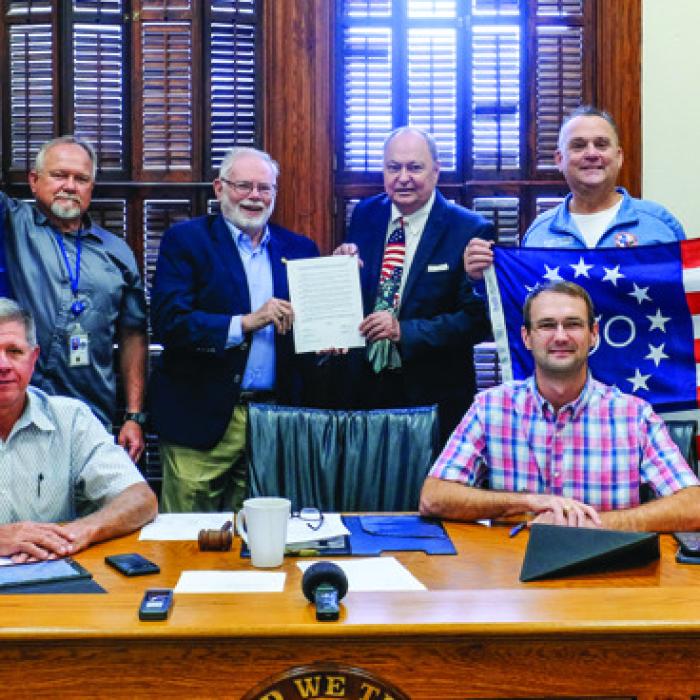

The Fayette County Commissioners Court signed a resolution on Monday officially establishing the Fayette County Semiquincentennial Commission.
The Commission is charged with organizing and promoting commemorative events, educational programs and celebrations within Fayette County to celebrate the 250th Anniversary of the United States.
Larry Jackson, the retired publisher of the Fayette County Record, will serve as chairman of the Commission’s executive committee. The resolution approved on Monday states that Jackson along with County Judge Dan Mueller shall appoint other County residents representing various veterans organizations, historical societies, educational institutions and civic groups to serve on the Commission. The resolution also states that the Commission and its activities shall be funded solely through donations. The Commission will dissolve on Dec. 31, 2026.
At Monday’s meeting Jackson said he has already It’s onion planting time.
You could wait as late as February to plant onions and still get a decent crop. But for the biggest bulbs, now is the time to plant.
Onion varieties come in three basic groups: long-day, intermediate-day, and shortday. This refers to the daylegnth required for the onions to start making bulbs. Northern latitudes receive more hours of daylight than regions closer to the equator. Onions, depending on variety, begin to bulb when the days reach a certain length.
Here in Texas, we are limited to growing short-day onions. Knowing the difference in varieties is critical if you want to grow onions from seed. Most garden centers and feed stores sell onion “sets” – young onion sprouts that can be transplanted. You can be assured that onion sets sold locally are short-day onions.
I picked up a couple bunches of onion sets from CHB Market and Ranch Services, located on the Bluff off FM 155 just outside La Grange. The ones they have for sale right now look great – fresh and bright green.
You might ask, “Why grow onions when they’re so cheap at the grocery store?” If you’re asking that question, you’ve probably never grown onions yourself before. Like most vegetables, they taste so much better when you grow them yourself, especially the “granex” varieties known for their sweetness. In addition, under the right conditions, you can grow much larger bulbs than the ones found in grocery store.
It’s pretty easy to plant onions. I like to grow them in “double” rows. Make two furrows down a row spaced about 12 inches apart. Plant the onion sets an inch or two deep and about four to six inches apart down the furrows. If you use drip irrigation, place the drip tape in between the two furrows. Even if you’re not using drip tape, I find the double rows allow me to plant more onions in a given space. And it makes it a little easier to weed.
Each “leaf” of the onion makes one layer in the onion bulb. The more leaves the plant has, the more layers there will be in the onion. Apply fertilizers that are high in nitrogen to grow leafier and bigger onions. Blood meal, feather meal or bat guano are good choices for onions.
Onions also need plenty of water. Don’t let them dry out. When the leaf tips turn yellow prematurely, it greatly slows down the growth. So try to keep them moist. They don’t like competition from weeds, either.
When you plant onions this time of year, they’ll seem to grow slowly. They might resemble chives for a few months. But they’ll explode in growth as the spring approaches.
I suggest planting way more onions that you think you’ll need for bulbs, because you’ll end up picking a few for “green” onions before the bulbs appear. You can even plant them closely, two inches apart, and thin out some green onions for salads, soups or baked potatoes through the growing season.