


City of LG’s New Tax Zone Plan Gets an Icy Reception From Fayette Co. Leaders
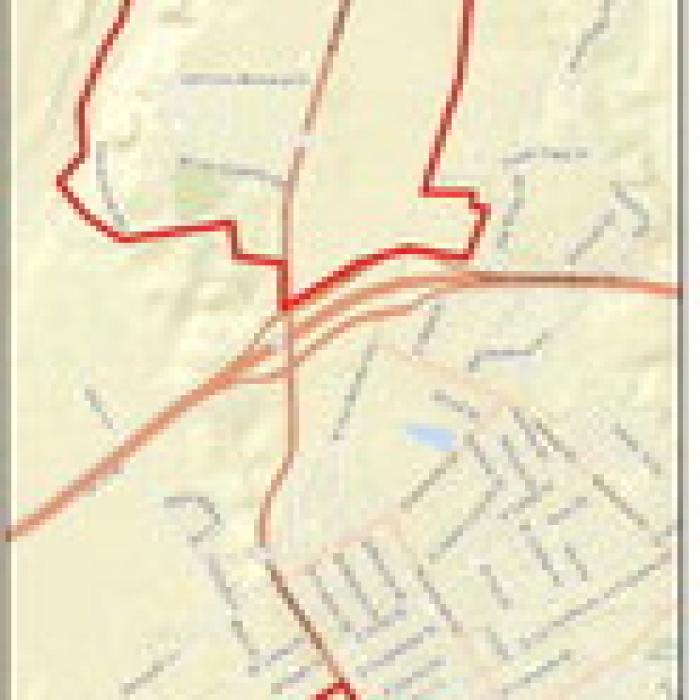
La Grange leaders got a cool reception from the Fayette County Commissioners Court meeting last Thursday when they pitched a plan for a Tax Increment Reinvestment Zone (TIRZ).
The La Grange City Council voted back in March to establish a TIRZ which will take in about 200 acres, mostly on the north side of town encompassing both the Fayette County Fairgrounds and the former St. Mark’s Medical Center. The proposed TIRZ also includes a smaller tract of land centered around downtown La Grange. The move allows the City to engage in Tax Increment Financing, a type of tax funding aimed at attracting development within the TIRZ. The consulting firm Pettit and Ayala of Fort Worth is helping the City set up the TIRZ.
Besides the Hospital and the Fairgrounds, the bulk of the property in the northern tract is owned by a pair of LLCs named “JLH 2215 Property LLC” and “JLH 2560 Property LLC.”
As property values within the zone rise due to appreciation or new construction, the City can allocate a portion of the increased tax revenue to a special TIRZ fund. Developers can request this funding for infrastructure projects such as roads, water, sewer lines, drainage and landscaping. The TIRZ board of directors could require developers in the zone to include certain amenities with their projects, such as parks or trails, in exchange for this funding.
The City of La Grange imposes a relatively low property tax rate – $0.18194 per $100 of property value in 2025. Fayette County, on the other hand, imposes a tax rate more than double that – $0.40984 per $100 in 2025. Accordingly, the TIRZ fund could grow much faster if the County agreed to participate.
At the meeting last Thursday, Natalie Ayala Hall of Pettit and Ayala gave a presentation to the Fayette County Commissioners Court about the TIRZ. Also in attendance were La Grange City Manager Jack Thompson, Mayor Jan Dockery, and staff from the City’s economic development and Main Street offices.
“A TIRZ is not an additional assessment in any way,” Hall said. “There’s not going to be an additional line item on your tax bill because you were included in the TIRZ. What happens is it redirects a portion of your tax increment from new development within the TIRZ to a special fund.”
The City proposed a term of 20 to 30 years. Hall said the City and the County could decide how much of the increment will go into the TIRZ Fund.
“The 2025 tax bill is based on the value of the property on Jan. 1, 2025,” Hall said. “On Jan. 1, 2026, they’re going to again take that snapshot – what was the value of the property on that date. The delta, that’s what you have to play with – how much money we could potentially put into the TIRZ.”
She gave an example of a tax bill going from $1 to $1.50.
“You don’t have to put all 50 cents into the TIRZ,” Hall said. “We’re proposing 75 percent for the City and 75 percent for the County.”
The other 25 percent of the increment would go into the general fund just like normal property tax revenue.
“We really want to focus on the quality of the type of development that comes in, and we want to have a hand in that,” Thompson said. “And so this is one of the ways we’re looking to guide that, while also looking to get more investment in the city.”
Thompson said the land in the northern tract of the proposed TIRZ currently generates about $1,100 in property taxes for the County.
“If we do this deal and we’re able to develop it, the value of that land we’re projecting to be about $85 million in taxable value,” Thompson said.
At the current tax rate, property of that value would generate $348,364 in revenue for the County and $154,649 for the City.At the proposed 75 percent allocation, the TIRZ would get about $377,260 annually. Without the County’s participation, that number would shrink to $115,987.
Pct. 2 Commissioner Clint Sternadel asked if the County could withdraw from the TIRZ before the end of the term. Hall said the County could withdraw as long as there are no outstanding obligations, such as prior agreements to fund developer projects.
Pct. 4 Commissioner Drew Brossmann asked how the TIRZ would be governed. Hall said TIRZ boards typically consist of city council members from the sponsoring city. Hall proposed two seats to represent the County. She said the City and the County could negotiate the number of seats.
“It could be five members of the City Council plus two, it’s really up to you,” Hall said.
“So it’s just a majority vote?” Brossmann asked.
“Yes, it’s just a majority vote,” Hall said.
Brossmann pointed out that the County would be putting more money into the TIRZ than the City.
“That’s unusual because the county has such a high tax rate compared to the city, or I guess I should say the city has a low tax rate,” Hall said.
“So since the county is putting more money into the TIRZ, wouldn’t it be fitting that we would get more of a decision-making power to decide where the money goes?” Brossmann asked.
“Some of that can be negotiated before, when we do the interlocal agreement,” Thompson said.
Thompson said that if the TIRZ board ever “bullied” the County into participating in projects against the will of the Commissioners Court, the County could walk away from the agreement, so long as there are no outstanding obligations.
“So you’re saying (we can walk away if) there’s no debt or obligation,” Brossmann said. “But if we don’t have enough voting power to determine what kind of debt or obligation we want to take on in this TIRZ … if we do say, ‘Hey, we want to go ahead and pull out.’ But we’re not able to because we have this debt obligation because the board agreed to sign off on this, and then we’re hung with it.”
“Theoretically, yeah, you could,” Thompson said.
Brossmann expressed another concern – County voters who don’t like so much development.
“We all know how the County residents and everybody feels about subdivisions coming in and taking over the property and all,” Brossmann said. “I don’t think the County tax dollars need to go toward development. I completely understand bringing in more revenue and the tax base. I completely understand that, but you have to look at it from our side also. I just don’t think that that’s going to be a good feel in the community. I guess we’ll see after they put in the papers and everybody finds out about it. We’ll get plenty of feedback on it.”
Pct. 3 Commissioner Harvey Berckenhoff noted that the County will need to build a new justice center at some point in time, and it might be built inside the proposed TIRZ.
“We got a big issue, and the Sheriff’s Department, they’ve been doing the best they can with it, but we’re gonna have to build a new justice center somewhere,” Berckenhoff said. “And that seems like a pretty nice spot over there. But what’s that gonna do to development around it? I think it would kill it.”
Thompson said a justice center might not necessarily drive away development. On the other hand, he said, TIRZ funds could be used for public facilities, including the Courthouse and the Jail.
Sternadel said developers in his precinct, which encompasses the rapidly developing Round Top area, don’t seem to need any assistance from the County with infrastructure projects.
“The developers have made a very pretty penny off of raw land with no infrastructure,” Sternadel said. “They’ve been responsible for the water, to bring it however far if they can’t provide wells. Those developers have made it work and made it work well for them with no infrastructure.”
Sternadel also questioned the fairness of offering developers deals on infrastructure improvements when other nearby property owners pay greatly for their infrastructure.
“You have the whole Cedar Creek subdivision there that has no wastewater,” Sternadel said. “It’s costing those landowners, just because I’m familiar with that area, they might be paying $15,000 to $20,000 to put a new septic system on their property. But we’re going to sweeten the deal for the development next door.”
The discussion lasted about an hour and 15 minutes. There was an item on the agenda for Court to possibly authorize participation in the TIRZ. The Commissioners took no action on that item.