


Cauliflower as Big as Your Head

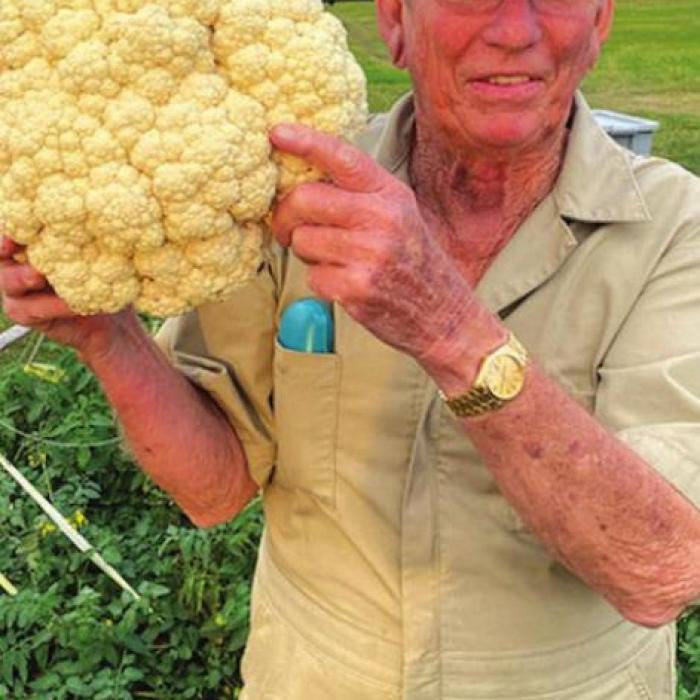

Back in September I wrote about Phil Stein of Fayetteville, who grew an incredible crop of vegetables during the heat of summer with the help of a drip irrigation system.
Readers may recall that Stein takes a conventional approach to gardening. He uses synthetic fertilizer, mostly triple 13, but he stays away from harmful pesticides. Stein was somewhat skeptical of full-on organic gardening when I spoke to him back in the summer. I could understand why – he’s been growing bountiful crops for years using conventional methods.
If it ain’t broke, don’t fix it.
Stein cares deeply about bees and other pollinators, so he rejects the most harmful conventional practices – chemical pesticide use. I whole-heartedly agree with that.
Stein called me this Wednesday to give me an update on his fall garden. After I spoke with him in September, Stein said he decided to try some of Microlife’s multi-purpose organic fertilizer, available in 40 lb. sacks at Sutherland’s in La Grange. Stein’s crops had already
Stein’s crops had already received a dose of triple 13 conventional fertilizer. He sidedressed his rows with Microlife fertilizer after they were up and growing.
The results were spectacular. This week, Stein said he picked the biggest heads of broccoli and cauliflower that he has ever grown.
“I grew broccoli and cauliflower that were bigger than my head,” he said. “I guess you can say I’m a half-a** organic gardener now.”
Microlife’s 6-2-4 multi-purpose organic fertilizer contains much more than the six parts nitrogen (N), two parts phosphorus (P) and four parts potassium (K) listed on the governmentmandated label. The product actually contains more than 100 organic plant nutrients including “minerals, vitamins, natural plant hormones, natural plant stimulators, essential sugars/ amino acids/carbon and protein plus billions of beneficial microorganisms per bag including Endo & Ecto Mycorrhizal Fungi,” according to the product’s specification sheets.
Microlife fertilizer gets those nutrients from natural ingredients including fish, kelp, molasses, emery humates, yucca, rock phosphate, wheat middlings, soy meal, cottonseed meal, alfalfa, corn meal and bone meal.
Triple 13 only gives you NPK, which comes in the form of soluble chemical salts that kill beneficial microorganisms. I can’t stress this enough: plants need more than NPK. They certainly don’t need chemical salts. Conventional fertilizers like triple 13 will work for a while, but farmers and gardeners who use them year after year will notice they need more and more fertilizer to get the same yield.
Malcolm Beck, a Bastrop County native and legendary Texas organic gardener who died in 2018, once explained it this way: “Modern chemical fertilizers contain no energy. The microbial life needed to process the chemicals into proper plant foods have to draw their energy from the soil organic matter and humus reserves. When the soil organic content runs low, the soluble fertilizer is not properly processed. The plants pick up the food in unbalanced ratios, causing them to become stressed, which in turn, invites pest insects and diseases to attack the plants.”
I think Stein’s application of Microlife fertilizer was just what his garden needed.
I encourage everyone to give it a try.