


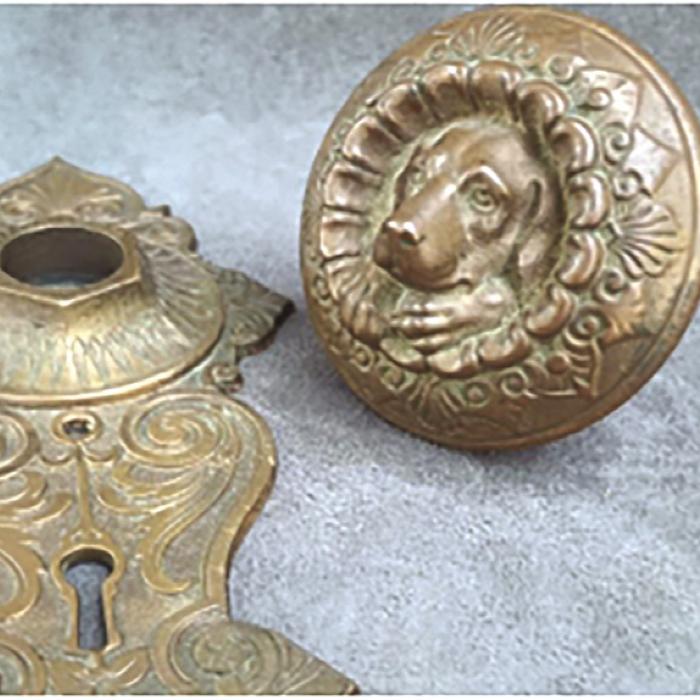
Antique Adventures: The $3,900 Doggie Doorknob (Part 1)

This is the second installment of our new antiques column.
Putting dollar numbers on an antique is mostly an exercise in ego, as will be discussed in detail in future columns. But for this story we are just going to crassly grab your attention.
Because $3,900 is only a fraction of the actual numbers— both up and down— that attach to this great collector grade doorknob.
…In the beginning… there was no Internet, no cell phones, no online marketplace for anything, and everyone buying and selling antiques was clueless as to how much supply of any item was actually out there. We all knew that if something brought a strong price, the search would be on for other examples, and then the price would drop, but such news only travelled by print and rumor, so actual price discovery was limited.
Internet auctions were a fantasy back in the early 1990s, but if you wanted to do the hard work, you could run a nationwide auction using landline telephones and a fax machine.
We’re an easy mark for the appeal of “hard work,” but we also knew that an auction does make a lot of stuff go away, not to mention generating a nice pay day, so about 1995 we said …”let’s give it a shot…” We had always been attracted to architectural antiques. In fact, that’s what brought us together when we met at Brimfield in the 1980s. Then, along the way, we had become interested in antique doorknobs and other items classified as “builders’ hardware.” In fact, the interest was so strong that we were looking at a pile of knobs, plates, doorbells, sash locks, handles, and mortise locks that was going to take forever to sell one at a time.
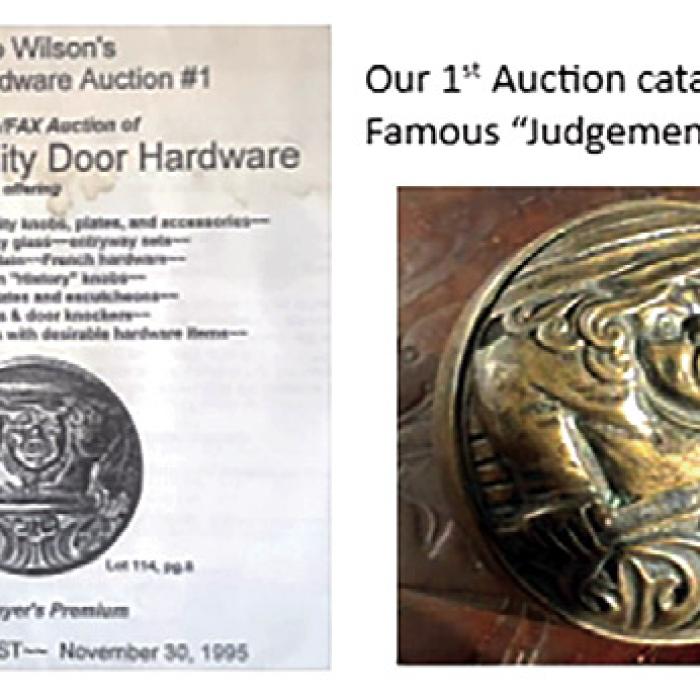
So, we put together a black & white print catalog (using a film camera where you had to wait a week for the images to be processed) and sent it off to a mailing list of doorknob collectors. The response was strong, and the rest is history.
The top seller in that sale was a knob Jill found at Brimfield for $50. We christened it “Judgement” and people began paying attention when it was knocked down for $850 plus a 10% buyer’s premium. That brought us lot of publicity in the trade papers, and a good buzz from folks who had never seen a quality doorknob.
It sort of surprised us as well.
Looking at that catalog now, much of what we offered was pretty mundane. But the market really had no idea what was available in aggregate, and we were the first real source for a vetted supply, so bidding was strong for what was being offered. It was a nice foundation upon which to build our auction program.
Several months later we built our second auction catalog. This time we stepped up our game but could only afford to print color on one side of each double sheet. We took the glossy photo prints, hand cut the images, pasted up the catalog pages with pictures and copy, and took everything to a photocopy shop for “printing.”
The top lot in that sale was a knob with a parrot, along with a very decorative door plate. It brought $750 and more nice press feedback. Well, the doorknob market is a bit “thin” to say the least, and we couldn’t just pump out more stuff, and besides we had other things to do. So, we moved on with our broader antiques interests, basically waiting until the bell rang for the next auction inspiration.
And that arrived in the form a phone call.
“Hello, Mr. Wilson?” “Yes, that’s me,” I answered, with encouragement.
“Well I saw your last auction and the bird knob that brought $750. And I have something that is way better than that.”
At which point I’m holding the phone with an iron grip and giving thanks that this guy can’t see my face, because I know exactly where he was headed: “I have a bunch of knobs here that have dog heads on ‘em” Part 2 retells how we bought those knobs, and sold them, and what happened next. Part 3 shares the followon realities of watching a market price go up and down.
Web & Jill Wilson live in Rutersville & love a good antiques story. Email them at hww@webwilson.com or text or call (401) 339-5522.