


The Amazing Tale of How Fayette Co. Discovered Its Connection to a Revolutionary War Veteran
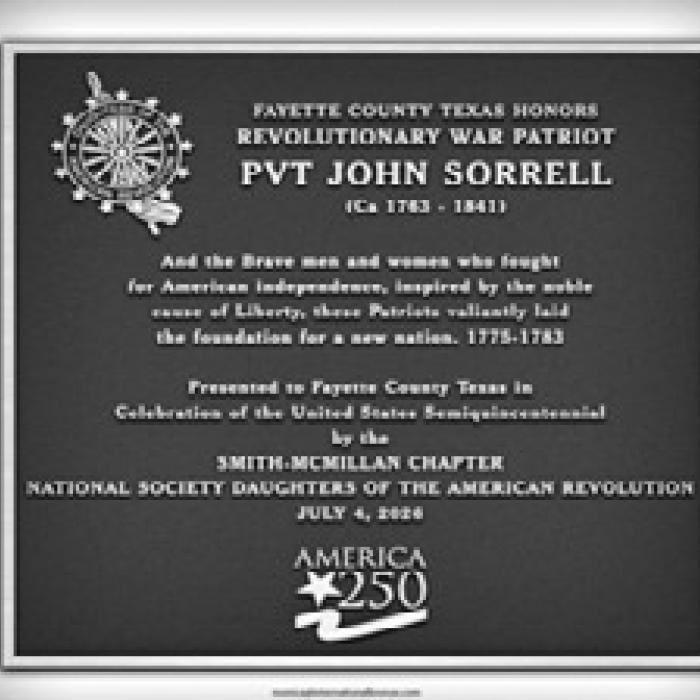
How exciting to learn several years ago when I was reviewing the Revolutionary Soldiers that were buried in Texas to find one in Fayette County.
One of the objectives of the Daughters of the American Revolution is to protect historical locations and erect monuments to preserve American history for future generations.
There are 45 known American Revolutionary War Patriots buried in Texas. Since 1908, the Texas Society DAR (Daughters of the American Revolution) has worked diligently to document all Revolutionary War Patriots who died in Texas. Daughters of the American Revolution in 1936 published a book featuring markers placed by DAR at historical sites in Texas.
In 2006, the TXDAR Patriot Monument was erected by the Texas Society DAR at the Texas State Cemetery in Austin. The Texas Society of the Daughters of the American Revolution Patriot Monument was originally dedicated on March 16, 2009, to honor 32 men with Texas ties who participated in the American Revolution. Names have since been added to honor both Spanish citizens and Anglo colonists who contributed to the war effort. Some men were soldiers who fought the British and others contributed to the war effort by herding cattle and horses from Spanish Mexico to reinforce the American Revolutionary Army.
A Children of the American Revolution (CAR) bench Monument was added to the site in 2017. In anticipation of the 250th Anniversary of the founding of the United States in 2026, a back piece was also added to the site at the 2023 re-dedication.
Smith-McMillan Chapter NSDAR decided a couple of years ago to pursue information about our Fayette County Revolutionary Soldier. First we found that it was not clear just where he was buried, but West Point and Plum were mentioned, as well as an unknown grave. Likely, the Church yard since 1831 has changed since this is a rural area. We inquired with the Fayette Museum Archives in La Grange and were told they needed more information because they had no information. Little did we know at the time there are multiple spellings of our Patriot John Sorrell. Spellings are all over the place depending which branch of the family you are following. The common name associated with the French-professed side of the family is SoRelle. Those who claim more British loyalties are Sorrell. DAR notes our Patriot as John Sorrell as do the Sons of the American Revolution (SAR).
The clock moved forward and the Smith-McMillan Chapter decided to go full on with celebrating our Nations 250th anniversary. Our theme statement determined by a small committee moving forward is “Freedom Then, Freedom Now, Freedom Tomorrow.” One more attempt at locating John Sorrell within the Fayette Museum and Archives was made, and Voila! In the Archives resides a folder approximately an inch thick of information compiled about John Sorrell. In the file the name is spelled several ways. John Sorrell served in the Continental Army with Captain John Harding’s company in North Carolina before moving to Georgia and later to Texas.
It names John SoRelle as a Civil Engineer who died 27 September 1841.
Briefly looking at the archive documents it is clear the John Sorrell had plantations in Alabama, Georgia and Mississippi. He moved to Texas in the 1830s and became a notable land speculator in Fayette and Travis counties. He brought with him 10 or more slaves to clear survey lines. He purchased a half-league for just one penny an acre.
A bit of history about John Sorrell: he married Mary Watts (Polly) and they had 12 children in Georgia. His probate decree in Georgia, dated April 2 1850, granted his 12 children equal shares of his estate. At the time of his death, he held 1,239 2/3 acres on the west side of the Colorado River with 122 2/3 acres adjoining in Fayette county and many more acres in Colorado, Travis and Gillespie Counties.
One son of his 12 children named Seaborn Jones Sorrell (1805-1852) had a son named George Morgan Lafayette (G M Lafayette) SoRelle born ca 1828, he was a prominent lawyer did work in Fayette County, which was a major legal center in mid-19th century Texas. G. M. L. SoRelle served as a delegate to the Texas Constitutional Convention of 1868–1869, representing the electoral district comprising Limestone, Navarro, and Hill counties.
During the convention, he participated in drafting the Texas Constitution of 1869, a pivotal document that reshaped the state’s legal and judicial framework after the Civil War. He passed away in 1870 in Groesbeck, Limestone County, Texas.
Seaborn Jones’ brothers included Wiley Jones, John Melton, James Madison, and Thomas Benton Sorrell. How appropriate for Seaborn Jones Sorrell to name his son after Lafayette as he was born a short time after Revolutionary Hero Marquis de Lafayette’s return farewell tour (1824-25) and height of his popularity in the United States.
Very recently we have been trying to find descendents of John Sorrell. We have found a few descendents of his daughter Margaret, one in particular, Ted Pylant (deceased), documented Margaret and her Father John Sorrell in his researched genealogy. There are descendents in Texas. Another daughter of John’s, Celia Sorrell, married Charles Cooper. Her Great, Great, Great Grandson has contacted us. He, it appears, has researched the family and knows that Celia and husband Charles came with John Sorrell to buy Texas veterans land rights. This descendent states that John contracted Yellow fever and died here. The Smith-McMillan Chapter of the Daughters of the American Revolution, as part of their America250 Celebration, are going to place a Patriot Marker on the La Grange County Courthouse grounds dedicated to the Veterans of the County, on July 4th, 2026. Patriot markers are recorded and approved by DAR. The La Grange Fayette County Commissioners Court approved the erection of the Marker to the Veterans Memorial on Courthouse grounds. Unveiling of the Marker will take place at the Countywide Celebration of America250 at the Courthouse, La Grange, scheduled this time at 5 p.m. July 4. The Chapter is grateful to grants that supported the purchase of the marker from LCRA as well as a DAR.
We are hoping that some of John Sorrell’s descendents can help us celebrate this Marker dedication.