


50 Years After It Was Fighting for Its Life, Muster Oak Thriving
When Jimmy Dwigans opened up his copy of The Fayette County Record on Aug. 8 he couldn’t help but smile.
In our “50 Years Ago” feature in the newspaper that day we detailed the preservation effort that saved La Grange’s Muster Oak, the massive live oak at the corner of Washington and Colorado streets.
That effort was headed up by the late Clarence Bubela, a man who Dwigans said taught him everything he knows about tree care.
“He was like a dad to me,” Dwigans said. “He took care of me. He trained me. He passed away in 2006. I miss him every day.”
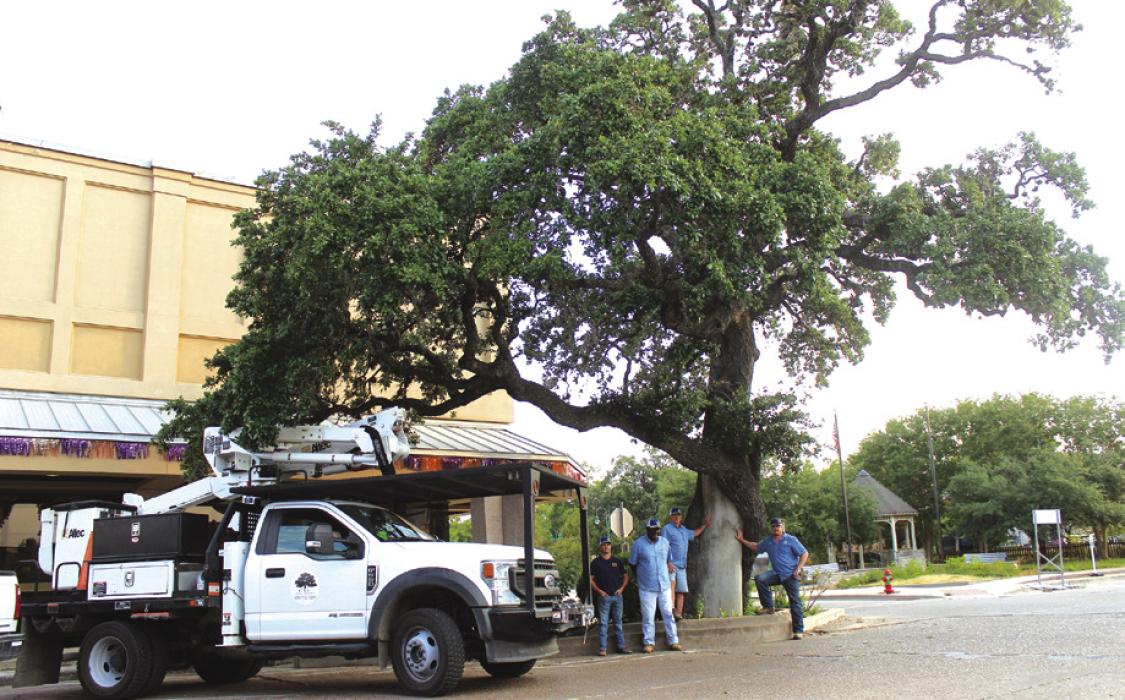
Dwigans now owns his own tree company, CTL Tree Service – which, in full-circle fashion, has twice done ball moss spraying on the tree his father-in-law saved.
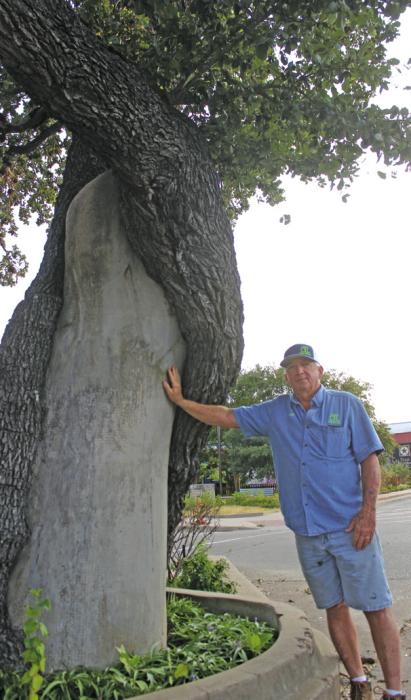
Last week Dwigans visited the Muster Oak to inspect Bubela’s work of 50 years ago.
Because of its position on the town square, the Muster Oak has been a rallying point for locals for generations. Famously, groups of local soldiers would gather at the tree before going off to war.
The first such documented mustering under the oak was on September 15, 1842, Nicholas Mosby Dawson organized his ill-fated company that planned to come to the aid of San Antonio by repelling an invasion by Mexico. Three days later, in a fight out- side San Antonio near Salado Creek, Dawson and thirty-five of his men were killed and later returned to La Grange and buried at Monument Hill.
The tree survived several instances of being struck by vehicles (because of its position near a busy intersection) and even a lightning strike.
Back in 1973 the trunk of the tree was deteriorating and it was in real danger.
Bubela formulated a plan to build a concrete interior trunk that a half century later is still doing its job.
“He was a very smart man, he knew horticulture and trees and knew how to preserve trees and keep them healthy,” Dwigans said. “This concrete was formed out with plywood first and then he put the mesh in there to hold the concrete in. I’m just amazed it hasn’t cracked. It still looks like they just did it.”
Bubela did lots of other things to fortify the tree 50 years ago, via trimming and filling in other cavities and sterilizing dying areas. Now Dwigans said the old tree, which he estimates is over 250 years old, still “looks really healthy.”
“It’s got a lot of dirt around it for the oxygen and water to get in,” he said. “And these holes out here (cut into the paved street) they provide oxygen and water as well.”
Hopefully, thanks to the work of Bubela, and now the continuing care of Dwigans, the Muster Oak will continue to be a local landmark for generations to come.
“Oh if this tree could talk, what it would tell us,” Dwigans said.