


South Texas Monkey Business

News broke this week about some monkeys that got loose in Mississippi after the truck transporting them crashed. It reminded me about a monkey story I learned from my wife and her family, who are from South Texas.
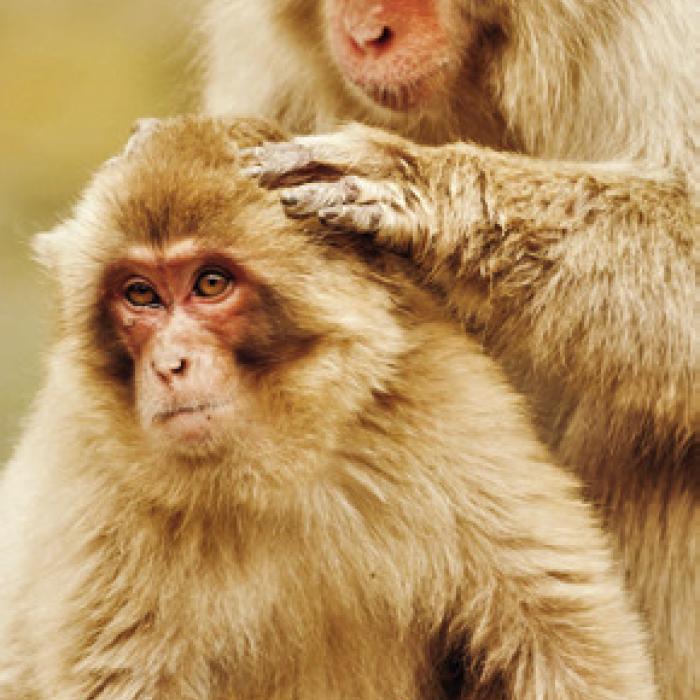
I’ve heard several variations of this story, all involving Japanese Snow Monkeys. These are the blonde-haired monkeys with red faces.
According to one tale, a carnival train derailed somewhere near the Frio River in South Texas. A bunch of these snow monkeys got loose, and some of them became feral. They lived in the river bottom for years.
When my wife, Janessa, and her siblings were little, my father-in-law John Sample would tell them this fantastic story about their origin: Instead of being delivered by a stork like normal kids, John said he went down to the Frio River and caught three of those snow monkeys. He cut their tails off, shaved them, and brought them home to their new momma, my mother-inlaw Gail. She put diapers on them and eventually got them house-broke. Janessa said she and her siblings believed this story until they got off the ranch and started school.
But there most certainly are Japanese Snow Monkeys living in South Texas to this day. How they got here is a fascinating story.
Back in the early 1970s, a troupe of these monkeys living near the ancient imperial capital of Kyoto, Japan, experienced a population explosion. They were invading the temples and stealing fruit from gardeners. The locals wanted them gone.
Somehow or another, a South Texas rancher named Edward Dryden heard about the plight of these monkeys, and about 150 of them ended up at his place in Encinal. Dryden apparently had the idea of selling them for medical research, but he died before realizing any profit. By that time, many of the monkeys succumbed to the South Texas heat. But some survived.
There are quite a few “deer stand stories” from hunters in Dilley, Cotulla and Tilden who say they’ve seen monkeys in the brush.
The Texas-based writer Sarah Bird, while a student-writer for the Daily Texan, documented a monkey-roundup in Laredo in 1975. She has written about how the monkeys adapted to life in South Texas.
“In place of the piney, snow-capped retreats where they’d foraged for nuts, wild plants, and mushrooms, they now faced a hostile landscape weaponized with thorny mesquite, prickly cactus, and coyotillo, the last defended with both sword barbs and poisonous berries,” Bird writes. “Back in Japan, they might have encountered the rare wolf or feral dog. Out on the lone prairie, the monkeys now had to confront mobs of predators: bobcats, coyotes, hawks, owls, rattlesnakes, and screwworms.”
Bird documented how the monkeys had developed a special warning call for rattlesnakes – a threat they never encountered in Japan. They learned to scrub the spikes off cactus pads. They adapted to the heat by cooling off in stock ponds.
Today, the Japanese Snow Monkeys live in Dilley at the Born Free USA Primate Sanctuary in Dilley. You can read more about their efforts at https://www.bornfreeusa.org/ primate-sanctuary/.