


America 250 Locally – Rising Curtains on the American Revolution: Washington & Lafayette
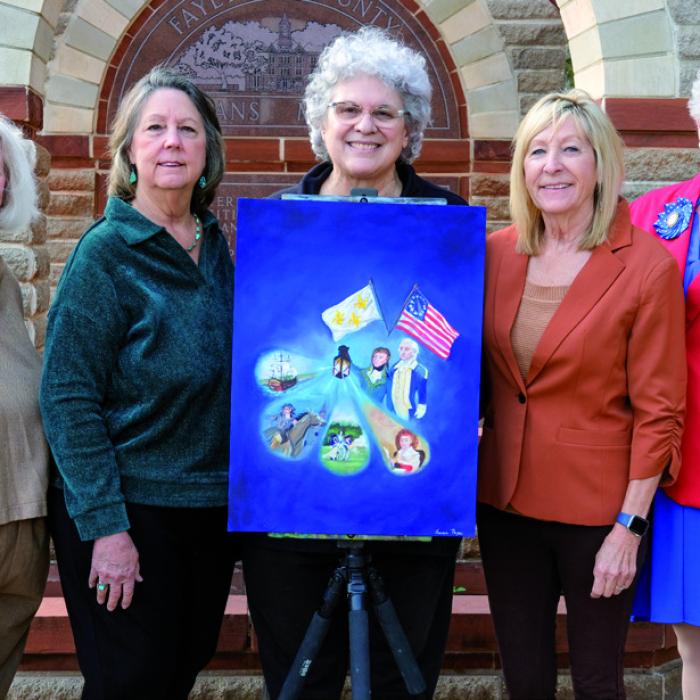
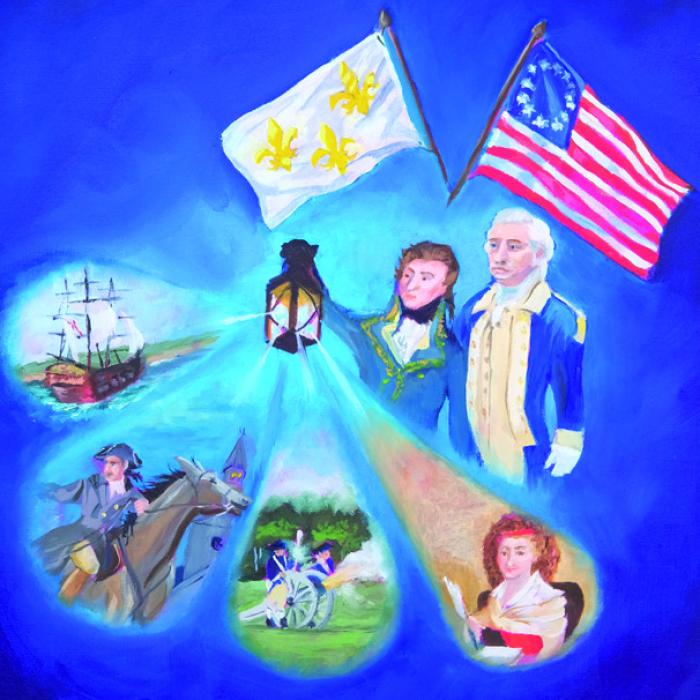
Members of the America 250 Committee, Smith-McMillan Chapter, National Society Daughters of the American Revolution or NSDAR, met at the Veterans Memorial on the grounds of the Fayette County Courthouse at 10 a.m. on January 5, to receive the commissioned oil painting from our member, Susan Pape that will be the branding for the Playbill and advertisements regarding the upcoming “Rhapsody of Freedom” Play. The Smith-McMillan Chapter also commissioned noted playwright and actor, Mary Margaret Mann to write the Play, and she will work and act with the La Grange High School Drama Club in the 7 p.m. performance on Feb. 12 at the Performing Arts Center in La Grange. Pictured are America 250 Committee Members and Founding Co-Chairs surrounding chapter member and artist, Susan Pape: (from left) Sarah Mabry, Cathleen Tutt, Pape, Jackie Head and Sherry Hebert, Media Chair. Founding Co-Chairs not pictured include Sally Reynolds and Carolyn Caflisch, Regent. Photos by Andy Behlen A close-up photo of the oil painting by Susan Pape.
The Smith-McMillan Chapter, National Society Daughters of the American Revolution, is celebrating America’s 250th birthday with events scheduled for Fayette County this Spring and Summer of 2026, the first focusing on the Marquis de Lafayette.
Of note, December 14, 1837, upon petition of citizens, the Congress of the Republic of Texas established the county of Fayette, named in honor of the Marquis de Lafayette. The Marquis’ retirement chateau near Paris, La Grange, was selected as Fayette’s county seat’s name.
Mary Margaret Mann, noted playwright and actress, was commissioned by this DAR Chapter to create a Play reflecting the close relationship and its historical significance of the two Revolutionary Patriots of America—General George Washington and the Marquis de Lafayette. “Rhapsody of Freedom” will be presented on February 1112 by the La Grange High School Drama Club under the playwright, Mary Margaret Mann’s guidance, and she will be an actor in it. The Smith-McMillan Chapter hopes that this background article “fills in the blanks” of the fatherly and son-like relationship between the two men whose paths crossed and affected the outcome of the American Revolution and even the French Revolution. Watch the area news media for dates and details!
“One need not travel far in America to find a namesake of the Marquis de Lafayette. From monuments to municipalities and beyond, sites nationwide honor the Frenchman whom George Washington deemed “an essential friend to America”— and without whose efforts the United States might never have been born.”
From Jeff Walter’s “Marquis to the Revolution: Lafayette’s Clarion Call for Freedom and Equality Still Reverberates” The Marquis de Lafayette’s life-long companion and mother of his children, Adrienne, were married by arrangement when he was sixteen years old. By the age of nineteen, Lafayette was one of the richest young men in France. It was the death of his father when he was only two years old that later filled him with the desire to fight against the British in the American Revolution. His father, also known as the Marquis de Lafayette, died while fighting the British in 1759. On March 25, 1777, the young Marquis left his home country to spend some time in America. The tragic loss of his father shaped Lafayette to despise the British and to revere his father and other military forbearers.
Going against the wishes of the king of France and of his father-in-law, young, wealthy Lafayette purchased his own ship for the voyage naming it the Victoire. After fifty-six days at sea, the ship landed off the coast of Georgetown, South Carolina on June 13, 1777. Lafayette and the other French officers on board then rode to Philadelphia to volunteer for the Continental Army. The nineteen-year-old received his Major General’s sash on July 31 and, five days later, he met General George Washington who travelled to Philadelphia to brief members of Congress on the precarious state of military affairs at a dinner. The British were on the move toward the city.
The young Marquis de Lafayette and General George Washington bonded at once as the forty-fiveyear- old Washington, who had no biological children of his own, was amazed by the young man’s profound dedication to the American cause. Likewise, Lafayette admired the American commander-inchief. After dinner Washington asked the young Frenchman to accompany him on an inspection of Philadelphia’s defenses and welcomed him to the cause. The General invited him to take quarters in his house and on his staff, and from that moment he looked upon the young man as if he were his own son. It was with such simplicity that two friends were united whose attachment and confidence were cemented by the greatest of causes.”
Lafayette served the cause without pay and actually paid the equivalent of more than $200,000 of his own money for the salaries and uniforms and other expenses for his staff, aides, and junior officers. He first saw action on September 11, 1777, at the Battle of Brandywine. Although Washington did not wish the young Frenchman to be exposed to harm, Lafayette pushed hard to be involved in the fight, and when things were not going well on the right flank, Washington sent him into battle under the command of Major General John Sullivan.
Lafayette fought fearlessly, was wounded in the leg but continued to fight and did not seek treatment until after the Continental Army’s orderly retreat. Impressed, General Washington cited Lafayette for his courage under fire and recommended him for divisional command. After his recovery, Lafayette took over Major General Adam Stephen’s division and fought in New Jersey under Major General Nathanael Greene.
The more impressed Washington grew with the young Frenchman the closer the two became. In a letter to his wife while stationed in Valley Forge in January 1778, Lafayette noticed Washington’s honesty and deep trust in him as a confidante. Washington talked at length with him daily or consulted with him in long letters of most interesting points.
In May 1778, General Washington sent Lafayette to lead battles against the British and later Washington agreed to his petition to allow him to return to France to try to smooth out recently strained relations between the two nations. Lafayette carried out that mission while wearing his Continental Army uniform in Paris.
In 1779, he convinced the King to send the French fleet north from the Caribbean to fight the British, as well as sending additional troops to America. In his report to Congress, General Washington lauded Lafayette for these efforts during the time he was in France zealously obtaining support for our affairs as an essential friend to America.
Lafayette brilliantly conducted hit-and-run guerilla operations against forces led by the then British-aligned Benedict Arnold when sent to Virginia in 1781 by Washington. Later shadowing the army of Cornwallis, the young French general played a crucial role in the Siege of Yorktown and was present at the British surrender effectively ending the war and brought independence to the rebellious colonies. Lafayette and Washington remained close friends after the war and Lafayette named his only son George Washington Lafayette. When the Marquis came back to the United States in August 1784, he visited Washington in retirement at Mount Vernon where the two men had an emotional reunion, and he stayed with the Washington family at Mount Vernon for ten days.
Lafayette returned to his wife and family in France and, in July 1789, shortly after the start of the French Revolution and named Commander of the French National Guard. One of his first acts with a crew of 1,000 workers was to demolish the Bastille, a symbol of the French monarchy’s excesses after it was stormed by French Revolutionaries.After doing so, he sent the key to the Bastille’s west portal to George Washington; that key today still hangs in the hallway at the Mount Vernon mansion. As political tensions mounted in France leading to Lafayette’s imprisonment, he sent his son to America to remain in the care of the Washingtons until it was safe for him to return home to France. On his tour of America from 1824 to 1825, Lafayette and his son visited Mount Vernon and paid respects to a man they considered a father figure.
Washington and Lafayette corresponded regularly until Washington’s death in 1799. When word of Lafayette’s death reached America in 1834, segments of the nation went into mourning. President Andrew Jackson ordered that the French Marquis receive the same funeral honors that President John Adams had ordered for George Washington in 1799. As explained by John Quincy Adams during a threehour eulogy in Congress, “The name of Lafayette shall stand enrolled upon the annals of our race high on the list of the pure and disinterested benefactors of mankind.”