


Adventures in Cross-Fencing for Cattle

David Will occasionally writes a column for the Record about regenerative ranching. It’s the idea of using nature to improve the soil and grow better pastures for our livestock to graze. At the same time, these methods can increase profits by relying less on costly inputs like fertilizer and hay.
Rotational grazing is one of the most important topics that Will talks about. If you allow livestock to graze your whole place at once, the grass never gets a chance to rest and regrow. Livestock deposit their manure haphazardly across the whole place, allow-ing fly larvae and parasites to thrive.
Instead, if you divide your place into smaller pastures and rotate the livestock around, you can grow much more forage, and even stockpile forage for winter feeding, so you can rely less on hay. In addition, by confining livestock to smaller pastures and moving them around, you can break the lifecycle of fly larvae and parasites that grow from the manure. With proper management, you can move the livestock off the pasture before those larvae mature and need a host, and rely less on fly control and dewormer products.
In addition, with dense stocking rates, you can increase the amount of manure in smaller areas. Livestock stomp it into the soil. Then you move the livestock, and dung beetles go to work breaking down the manure and burying it in the soil. This can increase soil nutrients and lessen the need for fertilizer.
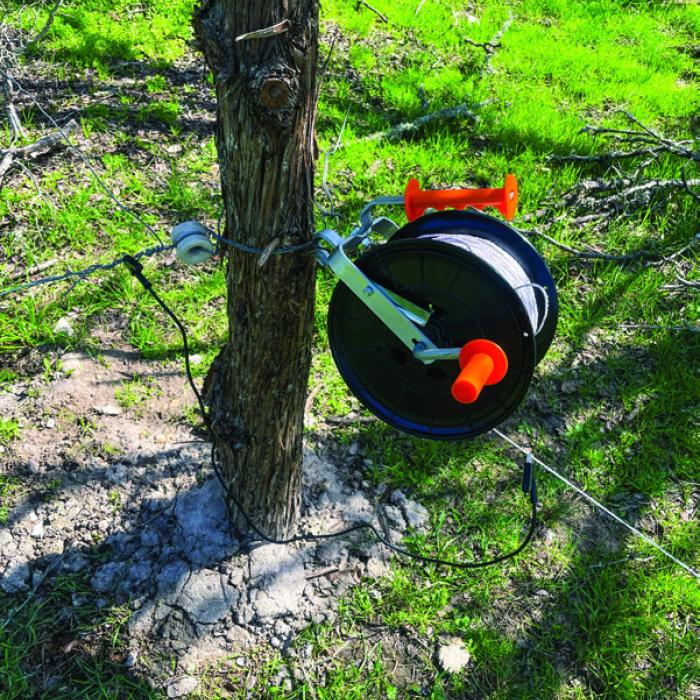
As you can see, all of this requires cross-fencing. Electric fencing provides the easiest and quickest solution. I’m very fortunate to have Milton Urban as a neighbor. He owns Texas Fence Llc., and he’s a retailer for Gallagher electric fence products. A few weeks ago I was talking with his son Joseph across the fence, and he convinced me to try out a few products that were new to me - polywire on a handheld reel and heavy duty fiberglass fence posts.
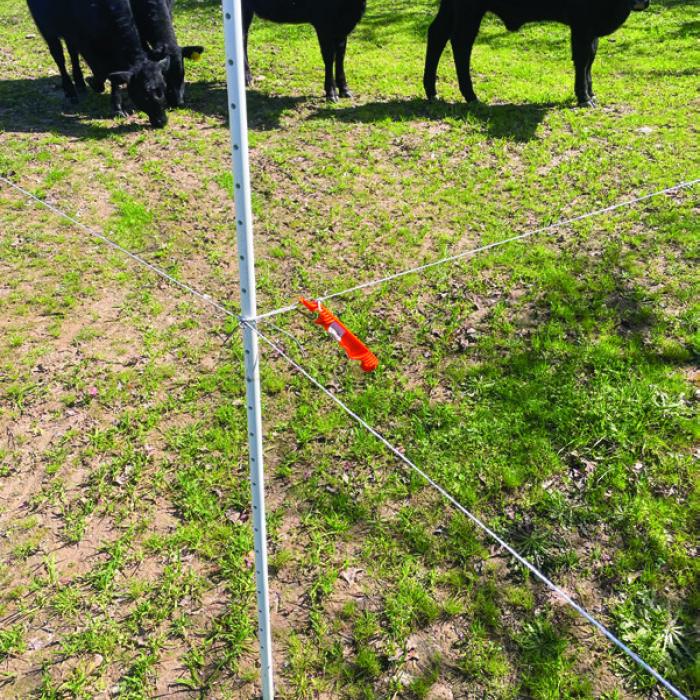
These fiberglass fence posts are tough as a nail. You can drive them into the ground with a t-post driver. They also make a special driver for them. They’re much easier to drive than a t-post. They have a series of holes drilled through them. Since the post is fiberglass, it requires no insulated connectors for the electric wire. You can attach the wire to the post with a long, thin cotter pin through one of the holes, or just stick a nail through one of the holes and wrap the wire around it a few times.
When using polywire, you can pull the line tight and the post stays firmly straight in the ground. I use the fiberglass posts wherever I need to put tension on the line, like at the corners of a fence. In between the corners, I use the cheaper plastic push-in style posts to hold up the line.
In a couple of hours one evening, I was able to hook onto my existing electric perimeter fence and split a five-acre field into three new pastures. It would have taken me days to set a bunch of new corner posts and stretch up a metal wire fence.
It’s been a game-changer. I want to eventually create enough pastures so that I can give each one a 45-day rest as I rotate cattle around the place. I thought it would take me a year’s worth of weekends to accomplish this goal. Instead, I might have it done this weekend.