


Adventures in Catching, Cooking a Stingray
Itry to eat all the strange fish I catch. Sometimes that results in a pleasant surprise. Other times, not so much.
Take for instance the ladyfish, also known as skip jack. They’re famous as excellent cut bait for red drum. But they’re actually quite tasty as well. You just have to know how to clean them - fillet them with the skin and scales on, then use the back of a spoon to scrape the soft meat away from the fine bones. Make them into fish balls and fry them. Try it – the next time you catch one, I bet you’ll have a tough time deciding whether to use it for bait.
Last Saturday, Janessa and I went to Matagorda on a whim. We fished the north jetty at the Colorado River all morning without much luck. I caught one good-sized whiting that we kept for supper. Janessa hooked a speckled trout, but it got off the line just as she reeled it to the rocks.
A few other folks were fishing the jetty that morning. One fellow we spoke with said he got there around 5 a.m. with a couple of friends. According to him, they caught a 40-inch bull redfish before daylight. He also caught quite a few mangrove snappers. I had really hoped to catch some of these myself. They’re quite tasty and there is no limit on them in state waters. Alas, I settled for the one whiting.
From there we drove down Gulf Rd. along the intercoastal. I tried catching some crabs in a hoop net and some chicken necks. No luck. We spent about an hour fishing there. The ground was muddy with litter scattered everywhere. I wish people would pick up after themselves. This is why so many fishing spots on the side of the road end up barricaded.
Finally, we went to the beach. We probably should have started here. The waves were pretty intense. I heard the calm green water was all the way to the shore just a few days prior to our arrival. Just our luck: winds in the Gulf picked up and turned the beach into a washing machine.
The weather was nice, though: partly cloudy with a breeze.
We drove down about five or six miles and set up our fish camp. When one finds himself fishing in the surf, especially in the late afternoon, the thought might occur to partake in a beverage. Now, when you’re managing two or more poles, this becomes tricky. You see a flutter at the tip. The tailgate of the truck lies too far ashore. Quickly analyzing the wave patterns and tides, you set your drink down, on what appears to be dry sand. You check the pole. Maybe it was a crab. Just as you reach for the drink, the gulf sends a wave. Your goblet crashes down, its contents mixing with the sea.
No fish, no beverage. Maybe this is why someone invented the beer helmet.
After an hour or so, some guy drove by in a pickup that apparently lost its four-wheel drive. For the unfamiliar, 4x4 is mandatory on the Matagorda beach. Do not even attempt to drive on it otherwise. This fellow got stuck about 50 yard past us on the beach. I watched him dig himself deeper and deeper. He came over to ask if we had a tow strap. I forgot to bring one and was no help for this unlucky soul. Eventually a few other vehicles arrived and helped him get out.
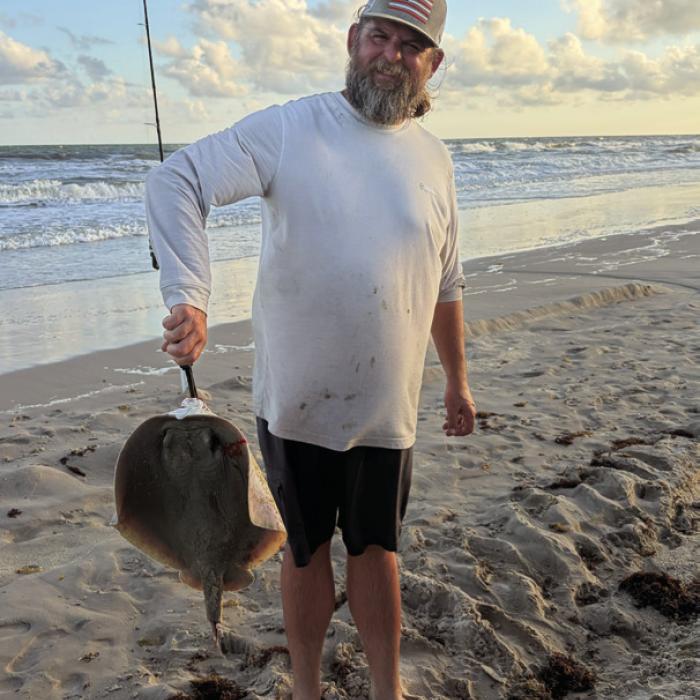
One of those folks, it turned out, was a fellow I know from La Grange. It seems like we run into someone from La Grange every time we go to Matagorda. I suppose it is the closest beach to us. He hung out with us for a while and watched me catch a stingray.
I’ve caught stingrays before and have always used them for bait. Sharks seem to really like them, for some reason, which is interesting, because stingrays and sharks are related to each other. Like sharks, stingrays do not have any bones. Their skeletal system is made of cartilage.
I’ve heard stories about folks cleaning and eating stingrays. Some folks refer to them as “poor man’s scallop.” I decided to give it a try.
They’re built sort of like flounder. You can get four fillets out of one. There are two thicker slabs of meat on the top of the wings, and two thinner slabs on the bottom. I dispatched the ray, chopped its stinger off (and threw it in the dunes), filleted it the best I could and threw it on ice. We saved the carcass for bait and fished until dark without any further success.
Back home the next day, I found an Italian recipe for skate, a fish related to stingrays but native to the Mediterranean. It called for the fillets to be simply breaded with seasoned flour and pan-fried, accompanied by a Putanseca sauce. I like to think of Putanesca as an Italian version of pico de gallo. It’s made with chopped tomatoes, olives, capers, anchovies and garlic. I added some pickled hot peppers and fresh sweet peppers from my garden.
Janessa enjoyed the Putanesca. She said I could have served it with shoe leather and it would have been good. The fried ray?
At first, I thought it tasted pleasantly briny like the sea. Then Janessa mentioned that she thought it tasted the way leather smells. The moment she said that, it suddenly overcame me. I couldn’t get it out of my head. All I could taste was tanned leather. And not so much leather itself, but rather the tanning chemicals. Janessa speculated that it could be the ammonia in the fish. Like sharks, stingrays store urea in the bodies, and this can turn into ammonia.
I thought cleaning the stingray immediately on the beach would lessen this problem. However, I did not skin the fillets immediately. I left the skin on until I got home. Maybe that caused the ammonia smell.
After we ate, neither of us could get the taste or smell out of our mouth until the next day.
I don’t think I’ll try stingray again.