


Round Top Native Gustav von Rosenberg Dies Young After Pursuing Border Trade Career
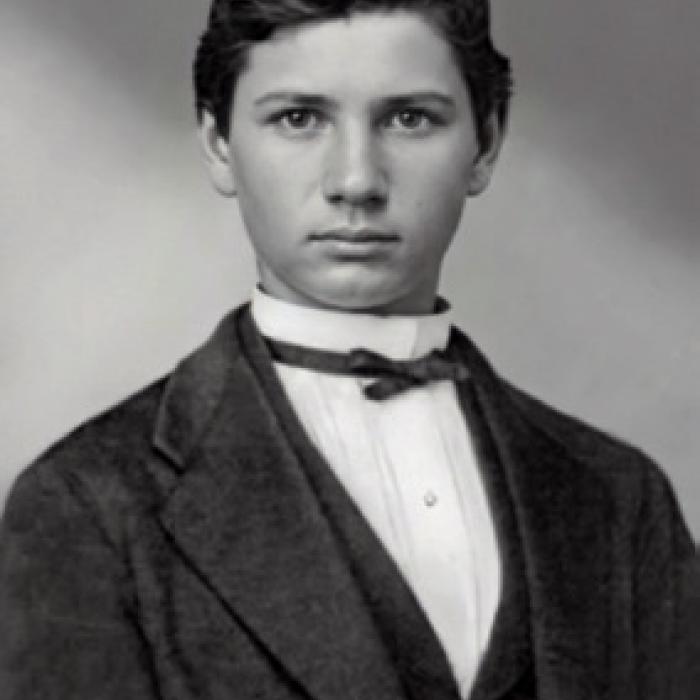
Gustav Adolph von Rosenberg, who was the third child of Johannes Carl von Rosenberg and Julie Wilhelmine Groos, was born on January 15, 1855 on a farm in the Evergreen community of Washington County, Texas. Shortly after the end of the American Civil War, he moved with his family at the age of eleven years to Round Top on Cummins Creek located in adjacent Fayette County about 21 miles to the south southwest. He attended school both in Evergreen and Round Top and probably studied under the direction of his uncle and teacher Hermann Hellmuth. He was christened in 1857 at the age of two years during Easter Day services held in the Fayette County home of his Grandfather Carl Wilhelm Apollo Groos. Pastor Otto Haun, a traveling Lutheran minister, performed the services.
According to family members, Gustav was an intelligent young man, who showed much promise with mercantile matters. He bore a strong resemblance to the Groos side of the family and was especially admired by his uncles for his abilities and appearance. He was undeniably handsome with tall features and dark colored eyes but also noted to be quiet and reserved, which was a sign of respectability.
Gustav’s father Johannes purchased the General Store and Hotel in Round Top from his brother-in-law Arthur Meerscheidt in 1866. The purchase included most of the land block, which faced the town square along Washington Street (now Hwy 237). The two-story Saddlery store, which mimicked the architectural style of the adjacent General Store and Hotel, was probably built by Johannes during the Reconstruction era following the end of the American Civil War. Gustav developed his keen sense of business acumen by working for his father in the General Store and Hotel and perhaps as well in the next door and more recently completed Saddlery.
Gustav von Rosenberg was ambitious and looked to three of his uncles, Friedrich, Carl and Gustav Groos, who were enterprising and financially successful brothers to his mother Julie, for employment within the burgeoning cotton and cattle trade along the Mexican border and more particularly, in the town of Eagle Pass, Texas, a gateway into Mexico where his uncles were engaged as a part of the F. Groos and Company. These uncles solicited his parents’ approval, which was finally granted, and Gustav von Rosenberg was off during the summer of 1873 to Eagle Pass to learn the cotton trade as an intern within the F. Gross and Company.
When Gustav arrived in Eagle Pass, Texas, F. Groos and Company was already a prominent Texas mercantile firm founded nineteen years earlier in 1854 by his three uncles, Friedrich W. Groos, Carl W. A. Groos, and Gustav Groos. It was already in transition to become a banking institution the following year. The company originally hauled supplies to Fort Duncan at Eagle Pass and then later evolved into a general merchandized business after the American Civil War when it relocated its headquarters to San Antonio in 1866. In San Antonio, F. Groos and Company began to focus on banking and established this financial institution during the 1870s with a building location at the corner of Commerce and Navarro Streets. The bank was a key private institution which catered to the Texas-Mexico trade and German immigrant communities. Carl Groos served as the bank’s first President when the company reorganized in 1874. It became a national bank in 1912 and remained under family management for several decades. The company and bank existed for 128 years before being purchased and dissolved in August 1982.
Noteworthy in San Antonio is the Carl Wilhelm August Groos House, which was completed in 1880 by the architect Alfred Giles. This Victorian Gothic Revival limestone mansion continues to exist and is a recorded Texas historic landmark and a part of the famed King William District. Also, noteworthy is the Gustav Groos House located at 231 Washington Street in the King William District. This home remained in the family until 1979 and was built between 1895 and 1896. It is a five-bedroom mansion located on an approximate one-half acre plot near the San Antonio River. It features Victorian architecture, quatrefoil and trefoil porch detailing, intricate millwork and high ceilings.
Unfortunately, Gustav von Rosenberg was in Eagle Pass for only a few short months when he contracted typhoid fever. He died from complications on September 6, 1873. He was buried before news of his passing could reach his parents and siblings back in Round Top, which apparently lacked telegram service. Delivery was probably delayed by a day or two. This was a great shock to his family and brought much sorrow and possibly guilt to his parents Johannes and Julie von Rosenberg for permitting their gifted young son Gustav to leave the safety of his Round Top home for Eagle Pass and the Mexican border, which was known at the time for rampant lawlessness and border violence.
Sources: The von Rosenberg Family of Texas by Alma von Rosenberg-Tomlinson 1949, The San Antonio Registry, AI Historical References