

Reminiscing at the O’Quinn Old Settlers Reunion
Footprints
Part I of II
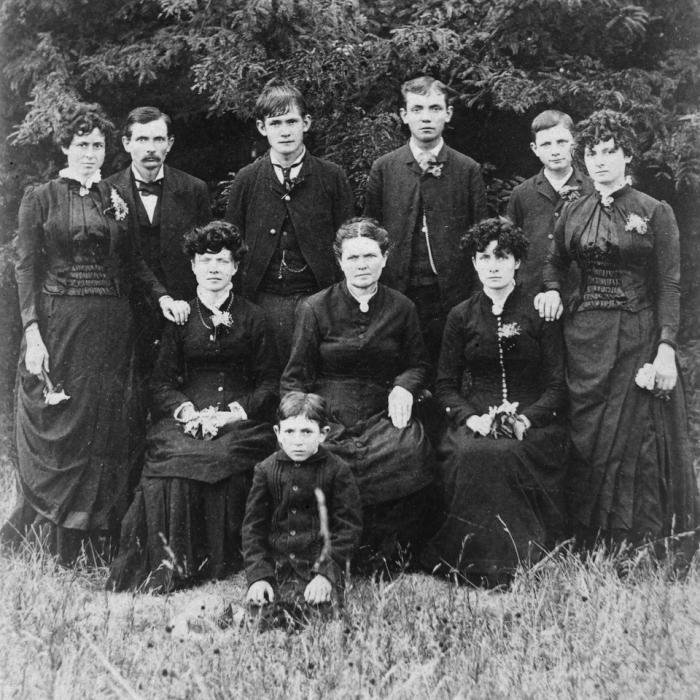
Charles P. Luck grew up at O’Quinn in the 1870s and 80s. In September 1941, he spoke about the early days in O’Quinn for an “Old Settlers Reunion” held there. Luckily for us, his talk was reprinted in its entirety in the November 12, 1942 issue of The La Grange Journal. After opening with a story about time his grandfather, Johann Philipp Luck, spent in New Braunfels before moving to Fayette County, he continued: “My father and mother [Louis Luck and Mary Loessin] were married here. Father engaged in the general merchandising business, he handled nearly everything in dry goods, groceries, hardware, confectionery, toys, liquor, medicines; doctored people with patent medicines, as there were no doctors here at that time; he had the post office which was known as Black Jack Springs post office. Father’s store was headquarters at that time for all business of the Settlement, and was the voting place. Uncle Charles Luck was the law of this settlement, he was elected justice of the peace, they called [him] ‘Squire Luck.’ His old home place is still known as the ‘Squire Luck place.’
“I shall now pass from the Luck family to the Loessin family. The Loessin family built the first cotton gin in this settlement. I was told when this gin was completed, people came for many miles to see the gin. They ground corn into meal, also ran a saw mill and sawed most of the lumber out of which many of the old houses were built; you can still see many cedar floors in houses here, the boards of which were sawed in this saw mill.
“The cotton, when it was ginned, came out of the gin stand from the second floor into the press room at the ceiling, it came humming into the press and looked like snow falling. The first cotton press was run by horse power.
“I was told when my parents settled here, that my father shot a deer from the back door of our home. Hogs, cattle and donkeys were running wild here at that time, father would mark wild hogs and cattle on Sundays. As I stated before, father was engaged in the general merchandise business. The first store he built was about 20X40 feet; his business increased and soon he built a larger one. Business kept on increasing, so he had to build a still larger one. This time he built it two-stories, and used the upstairs for a dance hall; he gave a dance one a month. The young ladies would come in low-neck silk evening dresses and beautiful gold necklaces, brooches, bracelets and rings.
“The men were dressed in black suits with white stiff bosom shirts, paper colors [sic.] and black ties; some wore shoes with big silver buckles, others wore boots with fancy tops, some red, blue, green, bronze and different colors. The scene was very pretty when they all danced a grand march, square dance, Virginia reel or round dances.
“At that time there were no railroads in this section of Texas, so father had to do all his own freighting. He bought all kinds of country produce, cotton, hides; he would have his men hauling country produce by wagon to Houston, Galveston and Mexico and bring back loads of merchandise; he had his wagons going back and forth all the time. There were no bridges and they had to cross the rivers on ferry boats.
“I remember the first time mother took me along to La Grange; when we crossed the river on a ferry boat I thought it was wonderful to haul a team of horses and a wagon on a boat across the river. Folks would drive great herds of Texas longhorn cattle, about 1,000 to 2,000 head in a herd to Kansas City from Southwest Texas, and would usually stop over night on the Bill Berry pasture, which was close to our store, and rest their cattle. The cowboys would come to our store, buy their provisions, whiskey and tobacco, and write letters. They would buy eggs and bacon, cut the bacon in small cubes, break the eggs in a skillet, scramble the eggs and bacon together, eat this with crackers or corn dodgers [a small, hard fried or baked cornmeal cake].
“Sometimes the cowboys galloped by our house on their horses and would shoot into the roof of our house, they called this a friendly salute, but we could not see it that way. Sometimes they would drive great herds of horses through, to sell along the road. Remember, Texas was young at that time. I was only a child. I am now 69 years of age. So, if you could go back 69 years, Texas would also look entirely different to you than it does now.
“As many as ten different covered wagons would drive by our store every day, carrying families that came from other States to locate in Texas—the wonder land. They usually had one or two dogs tied to the back of their wagon, one or two cows, and also hogs and chickens and their earthly belongings with them. They were happy, they were going to a new land.
“At that time Texas was the wonder land; cotton fields were all white with cotton, corn fields were full of corn, grain fields were full of grain; in the fruit orchard the trees were so full that the weight of the fruit would break limbs off the trees; gardens were full of vegetables. This sounds like a fairy tale, but it is the truth.
“We would go out into the woods and sometimes come to large beds of wild phlox, in beautiful colors, wild violets and many other wild flowers.”
Luck’s talk then moved on to his rural school and classmates, which will appear next week.
Of Fayette
Fayette County is one of the most historic counties in Texas. In this weekly feature from the County Historical Commission, a rotating group of writers looks back at local history.