


Psencik Cemetery Historical Marker Dedicated
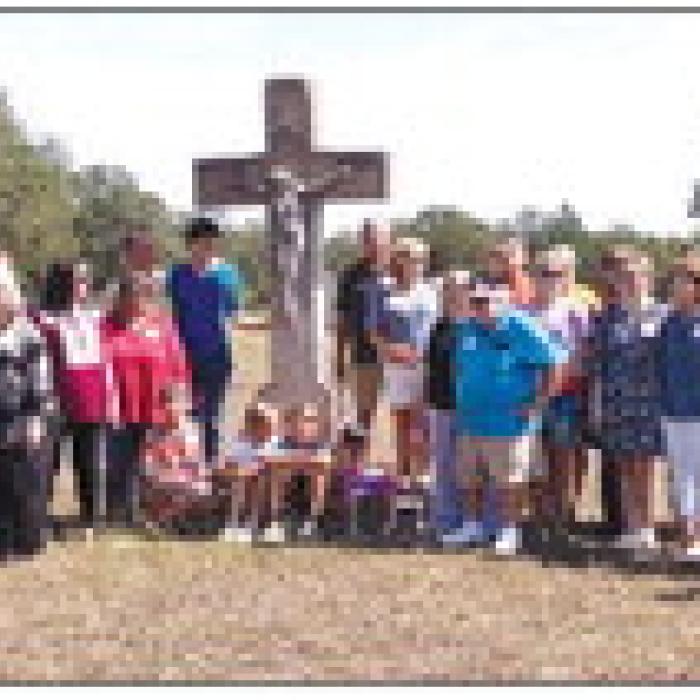
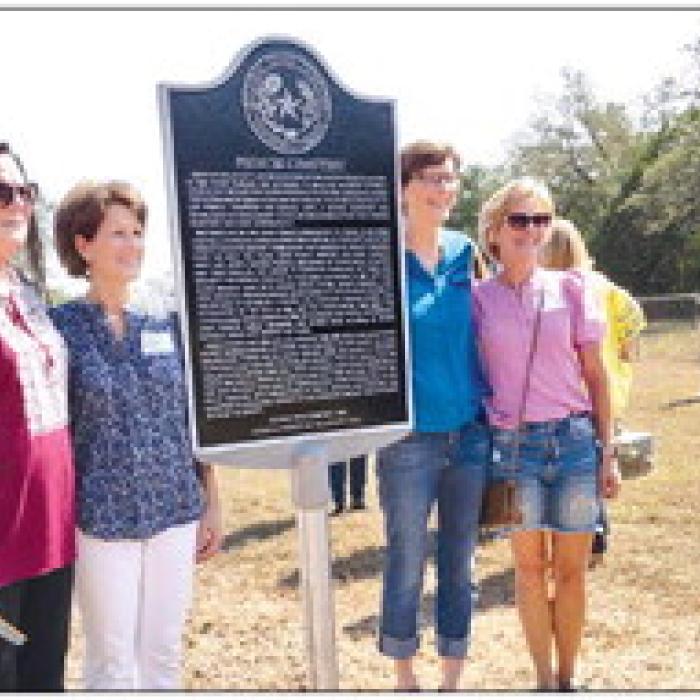
Fayette County and the Psencik Family descendants celebrated the latest Historic Cemetery and Historical Marker for the Psencik Cemetery this last Sunday, Oct. 9 at the Saints Cyril and Methodius Catholic Church in Cistern.
The dedication service was attended by approximately 100 descendants of Josef and Josefa Psencik and their nine children. Two brothers, Anton and John, immigrated to Texas in 1873 and were later followed by their parents, Josef and Josepha, and the rest of the family members, some with families of their own. They all settled in the area around Cistern after working as laborers in Industry.
Once their family homesteads were established, the Psenciks turned their attention to addressing their spiritual needs and providing an education for their children. There was no Catholic Church to hold services nor a rectory to house a resident priest. On May 22, 1886 Joseph II and Anna (Dolezal) Psencik deeded 7 acres of their land to the Catholic Diocese of San Antonio for the purpose of building a Catholic church. In 1888, the Psencik School was built on the 7 acre tract, where children living in the area attended school. Joseph II served as one of the first trustees, and he and his father, Joseph Sr., taught school there. The schoolhouse served multiple purposes for the community. Once a month, visiting priests from nearby parishes, mostly Praha and String Prairie, would come on horseback to celebrate Mass there. It was also used as a hall for dances and social gatherings. According to Fayette County School Records, the Psencik School existed through 1895, but it is not known what year the school was dissolved or what eventually became of the schoolhouse. The school’s exact location on the seven acres is also not known. Although the site was originally intended for the church, the pastor from nearby Praha, Father Francis Shea (Zak), encouraged the people to build the church in Cistern. In 1890, the settlers erected Saints Cyril and Methodius Catholic Church in town off the square under the supervision of Father Joseph Mack.
The Psencik Cemetery, which was also established on the seven acre tract, contains the graves of the earliest Catholic Czech and German immigrants who settled in the Cistern area. There are 82 graves. The earliest marked graves are those of Maria Stasny (1887-1888) and Julia Stasny (1888-1889), most likely sisters as they share the same tombstone. It is believed they were the young daughters of Frances (Psencik) and John Stasney. Given their young age, one can surmise their deaths were probably caused by illness. There are twenty-five graves of which the remains are not known. Any one of them could have been the first grave.At one time they were probably marked with wooden crosses, but today, have a small metal funeral home marker only. The last burial in the cemetery took place in 1964 for Mollie Ziegelbauer (1889-1964), who is buried next to her parents Josef and Marie (Psencik) Ziegelbauer. Mollie never married and died of heart failure in a Flatonia nursing home at the age of 75. Many members of the Psencik family are buried in the cemetery, including Josef and Josefa, the patriarch and matriarch of the family. Five of their children (Anton, Frank, Ferdinand, Anna, and Marie) and their spouses are interred here as are several of their young grandchildren whose lives were cut short by illness or tragic accidents. The many immigrant settlers buried here worked hard to sustain their farms, provide for their families, and develop and improve their community. Many of the men were members of the fraternal organization, Katolicka Jednota Texaska (KJT), formed in 1889, which provided insurance and financial assistance to Catholic Czechs in need. Joseph II, Frank, Anton, and Ferdinand Psencik were among the KJT’s charter members, and Joseph II served as its first president. Many of the women were members of its sister organization Katolicka Jednota Rodin Texaskych (KJZT). These organizations continue to exist today as The Catholic Union of Texas (KJT) and Catholic Family Fraternal of Texas (KJZT) and have chapters throughout the state of Texas. In addition to being a farmer, Anton Psencik also owned and ran a cotton gin where other farmers brought their cotton to have it ginned. Interestingly, Joseph II, who originally deeded the land for the church, is not buried here as he and his family moved to Plum, Texas, near La Grange in 1890. There, he worked to start another church and school and became involved in county politics. Joseph J. Machann (1870-1918), an enterprising businessman who owned general merchandise stores in the towns of Cistern, Smithville, and Schulenburg is also laid to rest here. He and his family immigrated to Texas in 1873 from Lippa, Moravia. In 1899, he married Amelia Psencik, the oldest daughter of Anton and Marie Psencik. While living in Cistern, he served as postmaster from 19011911. He was also a photographer as evidenced by the many “cabinet card” style portraits he created of family members and others. His name and gallery locations are featured on the cards below the photos. It seems photography may have been a side line business, as the 1900 and 1910 census records list his occupation as Merchant rather than Photographer. In 1911, he sold the Cistern store to his nephew Frank Anton Psencik Jr. and moved to Rosenberg to conduct business there.
He died in 1918 at the age of 48 after battling “brights disease” for several years. Unfortunately, the actual site of his grave is unknown. Two other noteworthy burials are of World War I veterans who died of complications from influenza (Spanish Flu) in 1918. Neither actually fought in the “War to end all wars” as both perished of bronchial pneumonia while training at U.S. camps. Their places of death are inscribed on their tombstones. Private Anton Brdecko, (1889-1918) born in Kobyli, Moravia, enlisted in Company E of the 54th Field Artillery. He fell ill at Camp Travis, Texas and died at the age of 26. Private Benno (Benard) Michalski (1896-1918), born in Cistern, enlisted in Company M of the 136th Infantry. He died at Camp Dix, New Jersey at the age 22. These veterans have identical tombstones, and both graves are adorned with US American Legion medallions. Anton Brdecko’s grave also has a Veteran of Foreign Wars emblem. The Psencik Cemetery rests on roughly one third acre of the original seven acre tract. It is rectangular in shape, 109 feet by 139 feet, and is enclosed by a chain-link fence with the entrance gate on the west side. Located in the center of the cemetery is a large crucifix with the dates 1888-1943 etched in its base. A brick walkway leads from the gate to the crucifix, but is currently not visible as it is completely overgrown with grass. Other than the walkway, there are no other landscaping features. On the north side, the tombstones face south toward the central crucifix. Those on the south side face north. Four tombstones are oriented toward the west. The tombstones are of various shapes and sizes, some very plain and others of a more ornate design. They consist of materials such as marble, granite, and concrete. Their features reveal the cultural, religious, and historic influences of that time. Many of the earliest graves are marked with tall, slender pillars commonly used in the late 19th and early 20th centuries. A number of the tombstones contain inscriptions and memorial messages in Czech; others are in English and a few in German. Engraved on several tombstones are the Czech villages where the deceased persons were born, providing a permanent record from whence they came. Most tombstones are adorned with crosses, reflecting the Christian heritage of the early pioneers. One grave with a small tombstone contains a cross fashioned from barb wire. Other physical features include concrete and brick curbing which line the graves of several individuals and families. Also featured are footstones engraved with deceased persons’ initials. In past years, Sts. Cyril and Methodius Church was responsible for the care and maintenance of the Psencik Cemetery. Today, the church is a mission church of Sacred Heart in Flatonia. Sacred Heart Church is now responsible for maintenance and has contracted with local church members to provide that service. Both churches are under the authority of the Victoria Diocese. On October 11, 2000, the Victoria Diocese sold the 6.5 acre portion of land surrounding the Psencik Cemetery but retained ownership of the cemetery. Suzanne Harris, Laverne Wilhelm, Bill and Edna Psencik along with the help of many family, friends, and staff of Fayette County worked very hard to obtain the designation of a Texas Historic Cemetery and the historical Marker that designates the spot and gives the history of the cemetery and area. The dedication was followed by a family reunion and dinner at the fellowship hall of the church.
Fayette County is one of the most historic counties in Texas. In this weekly feature from the County Historical Commission, a rotating group of writers looks back at local history.