


Navigating the Storm’s Aftermath
Hurricane Harvey: 5 Years Later
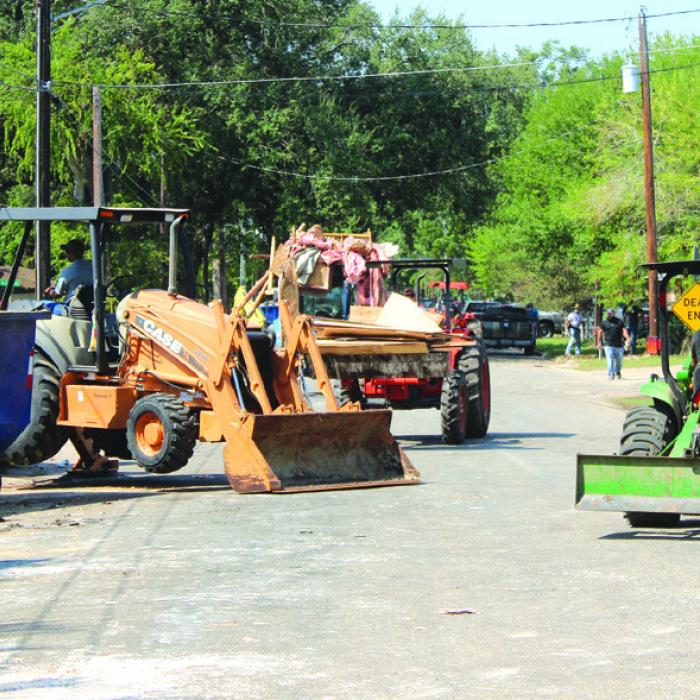
Not everyone whose home flooded after Hurricane Harvey five years ago qualified for assistance. Many government relief programs were based on income, family size, whether or not the victims had insurance, and other socio economic factors. Such was the case for John Castaneda, whose manufactured home was destroyed by the flood in 2017.
“It seemed like the people who had no insurance fared better than the people who did,” Castaneda said. “That is what was disheartening about the government assistance. We knew of people who used that money for other things. That rubbed us the wrong way.”
Castaneda said he and his family applied for assistance from the Federal Emergency Management Agency (FEMA) immediately after the flood. He said FEMA awarded his family $500
“That helped us, for sure,” he said. “But to see other people get thousands and thousands of dollars, we were like, ‘Wow!’ Don’t get me wrong, any assistance that was available to us, we applied. We went to all the Red Cross things. If it was there for us and we needed it, I tried to get it
“I’m a very hard worker, and everything we worked for may not have been much, but this is what I built and I worked my butt off for it,” he added. “For it to be taken away in 24 hours was heartbreaking.”
When asked what he learned from the flood, Castaneda said, “Insurance, more insurance.”
“(The flood) makes me value our home a lot more,” he said. “Material things don’t matter, for sure, because everything is replaceable. I’m just happy I have my family.”
After the flood wiped out their manufactured home, Castaneda and his family bought a traditionally-framed home on a concrete foundation in the Sunset Ridge neighborhood of La Grange. Since then, his family has grown and they are now looking for a bigger home.
We even threw the idea around of a manufactured home, because they are affordable,” he said
La Grange’s zoning ordinances, like many cities, limit where manufactured homes can be located. Manufactured homes, with few exceptions, must be located within a manufactured home park. Most of those in La Grange are located in the flood-prone areas near the Colorado River
The City’s building codes and zoning ordinances limit affordable housing in other ways. For example, lot sizes in La Grange must be at least 7,000 sq. ft. and at least 70 feet wide. The ordinances require all homes to have a front yard at least 20 feet from the house to the street, while homes can be built as close as five feet from side boundaries. Corner lots must have even more expansive yards – 20 feet from both streets.
These rules protect property values of existing owners while limiting density and affordability of new construction
Is it time for cities like La Grange to reconsider these regulations?
“I think we should always look for ways to better our community, whatever the solution ends up being,” said Kenny Couch, Executive Director of Fayette County Habitat for Humanity. “If you wake up in the morning and think everything is OK and nothing needs to change, then you’re out of tune with reality. I don’t see a reason to say, ‘Well, it’s been done for 60 years that way so lets keep it that way.’ If we do that, we’d still be riding horses. If you can’t stop progress, you should be aware of it, be in tune with it, and try to understand it
“With regulations, I don’t know the answer, but I know part of the solution is talking about it,” he added. “I think most people know someone in their family who works their butt off and still can’t afford a house.