


Louis Melcher, Photographer and Entrepreneur
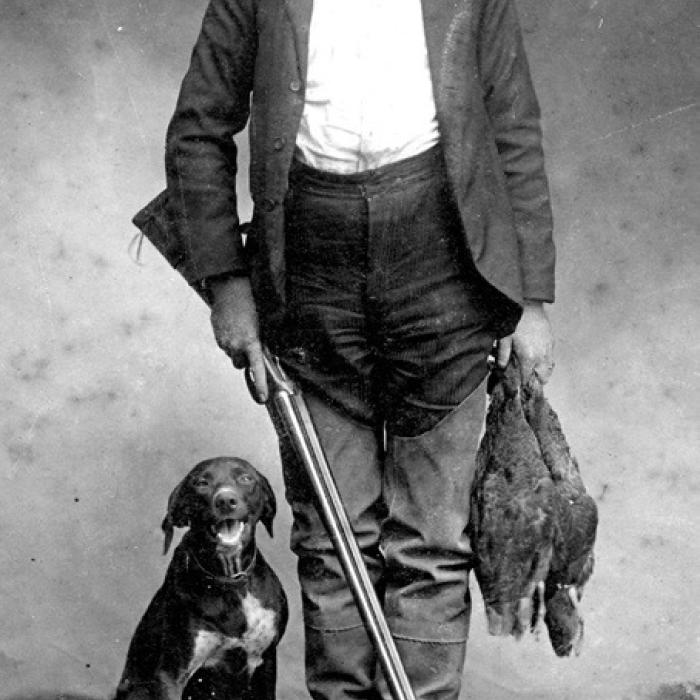
Louis Melcher’s beautiful landscape photography has ensured his place of prominence in Fayette County’s history. Whereas many early photographers satisfied their creative energy with portrait photography, Melcher was prolific in documenting everyday life in the late nineteenth and early twentieth centuries in a manner that is both creative and instructive. Louis Melcher was born on July 15, 1870, the eldest of ten children born to parents, John Carl “J. C.” and Wilhelmine (Gebert) Melcher of the O’Quinn community, both of German ancestry. His father farmed, owned a general mercantile store, and dabbled with inventions—he had seven patents—and other entrepreneurial activities.
On October 22, 1891, Louis married Marie “Ida” Loessin, who grew up in the neighboring Black Jack Springs community. Early photos of the interior of their home, which had belonged to his Melcher grandparents, show that it was full of horn novelties—chairs and settees, and also accessories, like coat racks and mirrors, decorated with cow horns and deer antlers by Louis Melcher himself and offered for sale. Louis and Ida had three children, Erna, born in 1892, Viola, born in 1894 and Edwin, born in 1896. Unfortunately, Viola died at age nine and little Edwin died when he was only four years old.
The April 28, 1892 issue of The La Grange Journal reported, “Mr. J. C. Melcher at O’Quinn south of Cedar is building an addition to his store which his son, Louis, will occupy for a photograph gallery.” Many of Melcher’s photographs of O’Quinn, Black Jack Springs, and Cedar were taken over the next few years.
Throughout his career, Louis Melcher produced the usual studio portraits, but his lens also captured wagons of cotton lined up at a gin, farmers baling hay, a baseball game, the rock quarry at Muldoon, road builders, and the popular pastime of fish picnics, among many other community gatherings and scenes. The clarity of these snapshots in time are the reason his work is so important to us today.
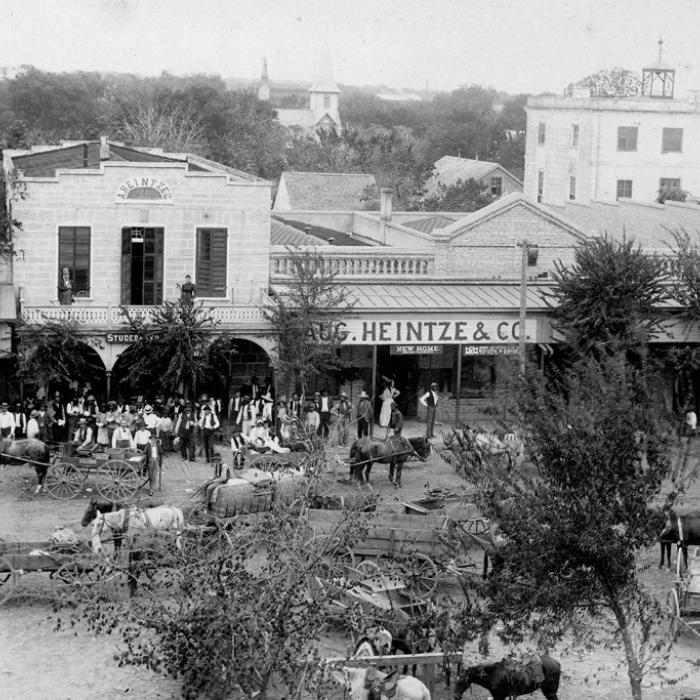
In a short-lived partnership with Charles Meyer, the two produced work as Melcher & Meyer TravelingArtists. TheAugust 1, 1895 issue of The Journal advertised cabinet cards for $1.50 per dozen from their “photograph gallery on wheels.” The following week’s issue reported that Melcher and Meyer had acquired a building on the square in La Grange and were fitting it up as a photograph gallery. It was probably during this period, that Louis Melcher climbed to the bell tower of the new courthouse with his large box camera and captured his iconic street scenes of La Grange. Melcher also served a brief stint as county surveyor from January through November 1899.
Melcher had moved his family to the fledgling community of Engle in 1899, where he operated both a photograph gallery and saloon. On March 2, 1902 a fire nearly destroyed the town. Louis Melcher’s saloon, the I. J. Gallia store, and three houses, including the Melcher home, were all that were left standing. Engel never recovered and Melcher declared bankruptcy in late 1902. The family soon relocated to El Campo, where he was able to erect a studio in April 1903. His sister, Mrs. Fritz Otell, and brother, Tom Melcher, also lived at El Campo. Unfortunately, Melcher’s studio was destroyed by fire in February 1906. In 1907, newspapers reported that Louis Melcher was completing a large two-story building, the upper part of which would be used as an opera house. Lectures were presented in the hall, but it also became a place to see the new motion pictures. During their time in El Campo, Ida also owned and managed a millinery shop.
Many of the photos attributed to Melcher during this period have an agricultural theme. It was also during this time that Melcher began putting captions directly on his glass negatives. He, or perhaps Ida, wrote backwards in pencil on the emulsion side--with a backhanded slant from right to left--in order to have white captions appear correctly when printed.
In September 1913, Louis Melcher sold his El Campo photograph studio and, by March 1914, opened a new studio in the old Svoboda building on Travis Street in La Grange. The Melcher’s daughter, Erna, had married Herman John Falke and moved to Houston by this time.
At some point Louis Melcher began selling albums of his scenic photographs. Each Melcher album contained many of the same series of prints—most approximately 8 inches wide and 5 inches high. However, before approaching a prospective buyer or perhaps making them to order, Melcher personalized the album by adding a few photos of specific interest to the customer. Enticing images of their family home or business were typical of those included. While most of the photos depicted Fayette County sights and people, some images from the area around El Campo were often included. The Fayette Heritage Museum and Archives in La Grange is fortunate to have three of these albums and the Dolph Briscoe Center for American History at the University of Texas has a fourth. There are probably others just waiting to be discovered.
Fayette County is one of the most historic counties in Texas. In this weekly feature from the County Historical Commission, a rotating group of writers looks back at local history.