


La Grange’s Black High School Flourished Under Randolph, Collins
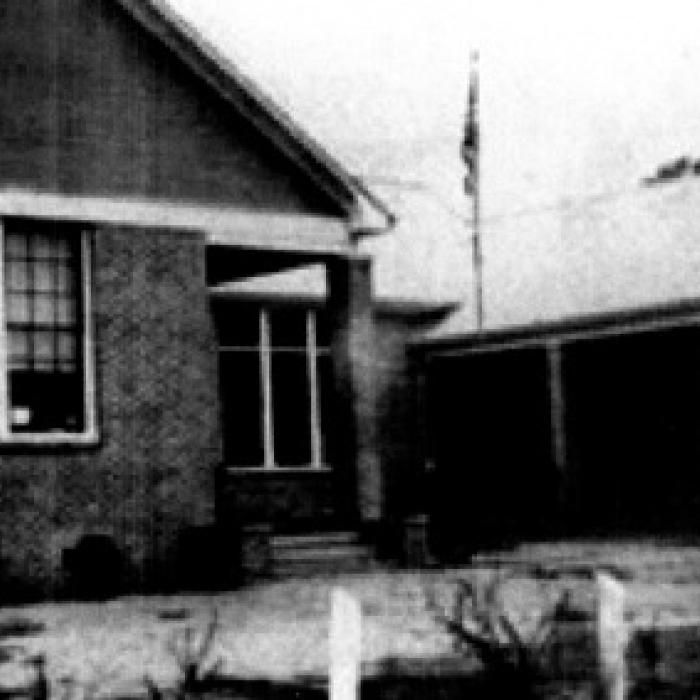
The Footprints of Fayette article that follows is an abbreviated form of the narrative that accompanied the application for the Randolph School historical marker, which will be dedicated next month. The full narrative with footnotes can be found at the Fayette Heritage Museum and Archives.
On Monday, Feb. 6, 1934, contractors began the work of razing the two-story woodframe school on East Pearl Street that had served African American students for thirty years. During construction of its replacement, pupils completed the school term in the nearby parsonage and the Knights of Pythias Hall located just west of the school.
Local architect Edwin Pohl was construction foreman for the new brick building holding five “recitation rooms,” a library and an auditorium. The new school was built in front of the former school’s footprint to give a larger, safer space away from the street for the students to play.
The new La Grange Negro High School building was dedicated on Friday evening October 26, 1934. The local newspaper noted that it was erected at a cost of $18,000, completed with the aid of government funds, and made possible to build because of a Civil Works Administration loan.
The new school opened earlier that fall with five teachers, four of whom had baccalaureate degrees from Prairie View State Normal and Industrial College. G. A. Randolph was the principal, and the other teachers were G. P. Steward, Mary Hayes, Mary Kirby, and Louise (Schermack) Moore.
Giles A. Randolph, circa 1874 – November 1, 1945, was born at Wharton, attended Hearne Academy, and received his baccalaureate degree from Prairie View State Normal School before coming to Fayette County, where he taught first in the rural Colony community from 1902 to 1909. He later wrote: “When I accepted the principalship of the La Grange Negro High School there were only three teachers employed, including the principal. The monthly salary ranged from $35 to $50 paid the principal. The scholastic population was then about 130.” By the time the new school was built in 1934, the scholastic population had doubled, the number of teachers had doubled and the salary had doubled.
From the beginning, the new school enhanced the lives of not only children, but all La Grange’s African American population. That first year free night classes designed to teach adults how to read, write, and do simple arithmetic were taught there. The three nightschool teachers, who were on the county relief roll, were paid out of special State fund set up for that purpose.
Randolph is credited with expanding the curriculum, adding extracurricular activities, and pushing to have the school designated as a training school which increased enrollment and resulted in a Class B rating for the school. The new “training school” designation meant that the school’s course of study had been revised to meet the suggestions of the Texas Department of Education. A school baseball team was formed under his leadership. He also worked to instill pride in his students with library books about black history and pictures of outstanding African Americans.
When Randolph retired in July 1941, William M. Collins was hired as principal and vocational agriculture instructor. Collins, 1908 - February 25, 1991, also made significant contributions to the school. A product of both Prairie View State Normal and Industrial College’s undergraduate and graduate programs, Collins established the school’s first true agriculture program, which included the formation of a La Grange Chapter of the New Farmers of America (NFA) on September 13, 1941. Within two years a blacksmith shop was built and more than $450 worth of tools were purchased through the National Defense Program. The boys worked on agricultural and construction projects throughout the community. The NFA chapter sponsored its first District Fat Stock Show on January 1, 1942 and that became an annual event. The chapter also participated in contests of various skills at Prairie View University. The Randolph NFA Chapter’s accomplishments were documented in local newspapers throughout the school’s history.
Collins immediately organized the school’s first football team, band, and pep squad. The team, known as the Lions, won their first game playing in ragged pants and tennis shoes in Giddings. Collins bought used pants and jerseys from college teams and gradually upgraded them. By October 1941, the Lions were given permission to play on the lighted football field next to the white high school. The newspaper reported: “Last Wednesday’s negro football game at Leopard Field didn’t turn out to suit the local colored Lions. The Giddings Tigers defeated them 19 to 6, in a game which was well attended. What the players lacked, if anything, was made up by the pep squads. The local negro high school had a 5-piece swing band which ground out the latest numbers to the thorough enjoyment of spectators. The girls in their black and white uniforms attracted considerable attention.”
Meanwhile, students were excelling in other sports. ln 1942 the school won the state Class B boys track and field meet. There were also a girls’ track and field team and both boys’ and girls’ basketball teams. Collins and his faculty also organized an annual queen’s contest that helped pay for uniforms, band instruments, typewriters, mimeograph machines, and other office equipment not provided by the school board.
Mr. Collins left the school in November 1943 to take a position at Prairie View College training teachers of farm shops. In that capacity he supervised agriculture shops across Texas, including the La Grange school. Lee Goree Jolley replaced him as principal. However, nine months later Collins was back as principal for the 1944 fall term.
To be continued. Sources: Various issues of the La Grange Journal, Fayette County Record, and N. F. A. News Randolph School Reunion booklet, 1988
Of Fayette
Fayette County is one of the most historic counties in Texas. In this weekly feature from the County Historical Commission, a rotating group of writers looks back at local history.