


How Ray Thurman Constructed a Tireless Career
Armchair Chats
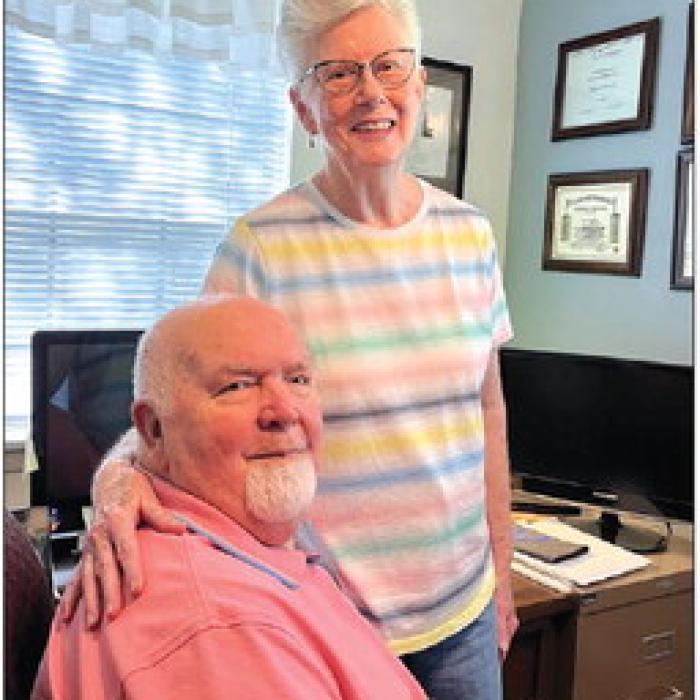
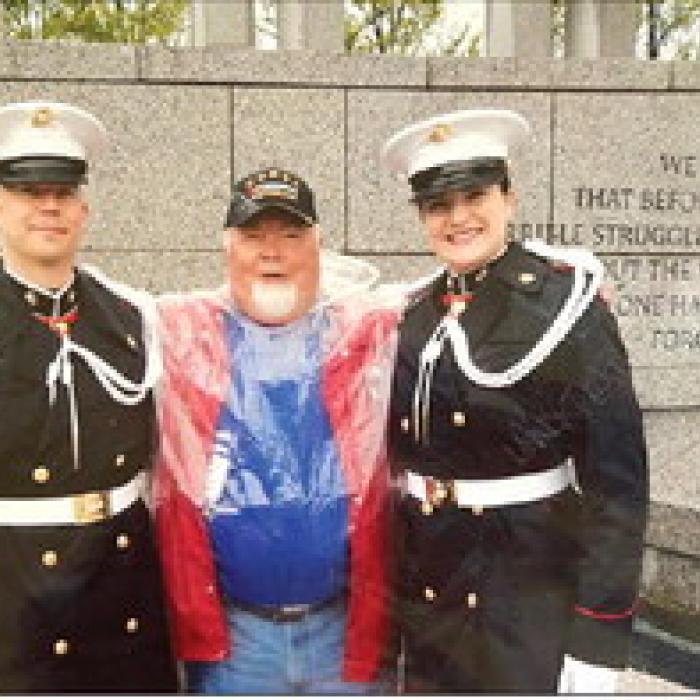

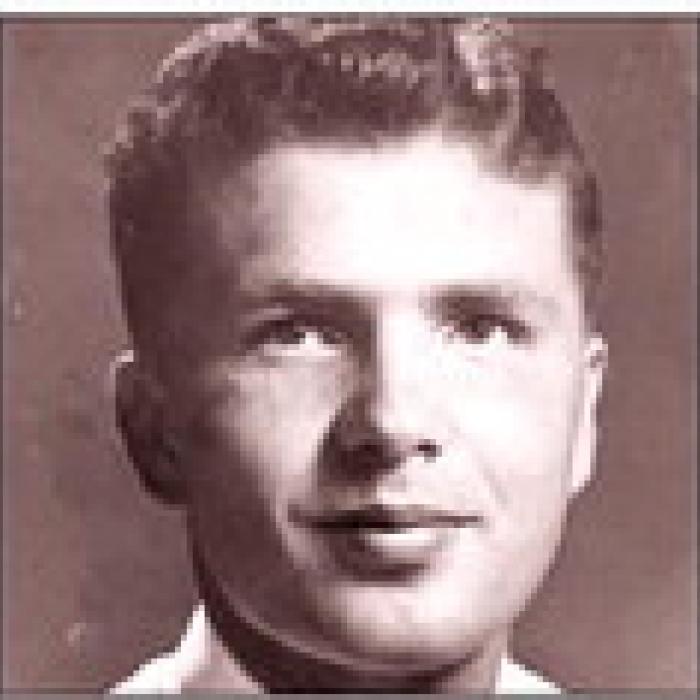
In 2005, Ray was proud to accompany a group of veterans to Washington, D.C., on an Honor Flight tour. He was among the first group from La Grange to make that trip. Ray served four years in the U.S. Air Force during the Korean War and is an active La Grange Legion and VFW member.
A Monthly Feature by ELAINE THOMAS
Fayette Co. native Ray Thurman has poked around corners of the world that few of us could locate on a globe
The day Ray Thurman graduated from La Grange High School in 1953, his stepfather took him aside and told the 17-year-old to find his own life. Ray could no longer live at home. The decree came as a shock, even though the two had never gotten along. Ray left and went to stay with a friend.
“By that time, I had saved up enough money by shining shoes and working at Western Auto, the Cozy Theatre and a grocery store to buy an old 1929 Model A. It burned oil like crazy. At night, I would go to Petzold’s Gulf Station downtown at the corner of Hwy.71 and Hwy. 77, where my friend, Floyd von Minden, worked. He would give me the used oil drained from oil changes,” Ray says.
Ray Hits the Road
“In those days, it was customary to give every customer full service. One night, when a big black Chrysler pulled in and a man got out, my friend started gassing up the car. I opened the doors, swept the floorboards, pulled the hood and checked the radiator. I was hustling in the hope I’d earn a tip. Before pulling out, the man gave me his card and said if I was ever looking for a job to come to Houston and call him. His card said he was an officer with a seismic company,” Ray says.
Several days later, Ray did just that. He was hired on the spot and received $200 for expenses, a map and the key to a Willis jeep the next morning. Like those used in World War II, the jeep had no top. Ray’s mission was to drive the fourcylinder vehicle approximately 1,660 miles to Wolf Point, Montana, to join the seismic crew waiting for the delivery.
That was early June, but by November, when cold weather set in, Ray caught a passenger train to Chicago, transferred to the Santa Fe line and returned to La Grange. Ray’s pals warned him that since he’d recently turned 18, his name was on the draft list maintained by Mrs. Dolores G. Oder in the local Selective Service Office.
“I wasn’t going to be a foot soldier in the Korean War, so I joined the Air Force real fast. I went through basic training at Lackland Air Force Base, then to Keesler Air Force Base in Biloxi, Mississippi, for radar maintenance school, and finally McGuire Air Force Base in Trenton, New Jersey. These were all abbreviated schools because the war was still hot,” Ray recalls.
He studied the operation of an airborne radar set found in a radar reconnaissance aircraft called the Ferret that was built to extend radar coverage outside of the continental U.S. Ray’s entire wing, consisting of about 10 aircraft, was sent to Korea to track North Korean and Chinese air traffic. Since these U.S. planes were unarmed, a few months later it was decided their operation was too dangerous and the group was sent back to McGuire Air Force Base.
After he and a pal made the grievous mistake of returning late from leave, Ray was shipped to Morocco, where there were no Ferret aircraft. So Ray ran the airman’s club, the post office and the PX. A year later, he was transferred to Stead Air Force Base in Reno, Nevada, where he once again operated the post office and the PX. With time on his hands, he also worked as a bartender in a casino. Upon discharge with four years of service, Ray had an E4 rank.
“That’s airman first class, three stripes. I would have had more if I hadn’t gotten into that trouble in New Jersey,” he adds.
Steady Work
By this time, it was 1957, and Ray needed to transition to a productive civilian life. With help from his grandmother, Bertha Otilia Richter, he bought a 1953 Chevrolet and accepted her invitation to stay in her spare bedroom in Houston. Then Ray went looking for a job.
The personnel manager at United Gas Pipeline Company thought he’d heard every conceivable line from job seekers. That is, until he happened to catch the conversation between his secretary, who sat at a desk outside his sixth-floor office in the downtown Houston Pennzoil Building, and a bold young applicant.
The secretary asked the young man what he could do.
“Almost anything!” Ray blurted out.
The personnel manager felt compelled to size up this enthusiastic candidate and stepped out of his office. “Where are you from, boy?” he asked.
“La Grange in Fayette County, sir,” Ray replied.
That did it. The personnel manager’s frosty manner thawed; he told Ray to get a physical exam at a clinic on North Main at the company’s expense. Ray was back within a couple of hours with the required paperwork. After a brief interview, the personnel manager hired Ray.
“I was completely green and had no idea how to look for a job,” Ray recalls of that fateful encounter that set the groundwork for a rewarding career far exceeding the 22-year-old’s expectations.
“The personnel manager later told me he had hired a lot of people from Fayette County because they knew how to work.”
United Gas Pipeline assigned Ray to a civil engineering survey party. After about three years, he was promoted to draftsman in the Houston office and later transferred to the distribution division. About that time, Ray met Twila Vick, whose sister also worked for United Gas Pipeline. Ray and Twila were married several years later. In the old part of Humble, north of downtown Houston, the couple found a home on three lots that needed extensive work. It was just down the street from the home of her mother and stepfather. That suited Ray because he never backed away from a challenge. If he didn’t know how to make a repair, Ray figured it out. By 1973, Ray had 16 years of service and was the assistant chief draftsman in United Gas Pipeline’s Houston office. That’s when the break of a lifetime presented itself.
His Forever Job
“A man I used to work with called and asked if he could pick me up for lunch. I said sure and went downstairs. He drove up and honked and I jumped in the car. We went out to Look’s Sir-Loin Inn, a famous Houston restaurant near the Astrodome, where he bought me a steak. Then he asked me how much I made.
“I told him, and he said, ‘If you’ll come to work for Brown & Root, I’ll get you a dollar an hour more.’That was big money, a big raise. Brown & Root was one of the major engineering construction companies in the world with a lot of business.”
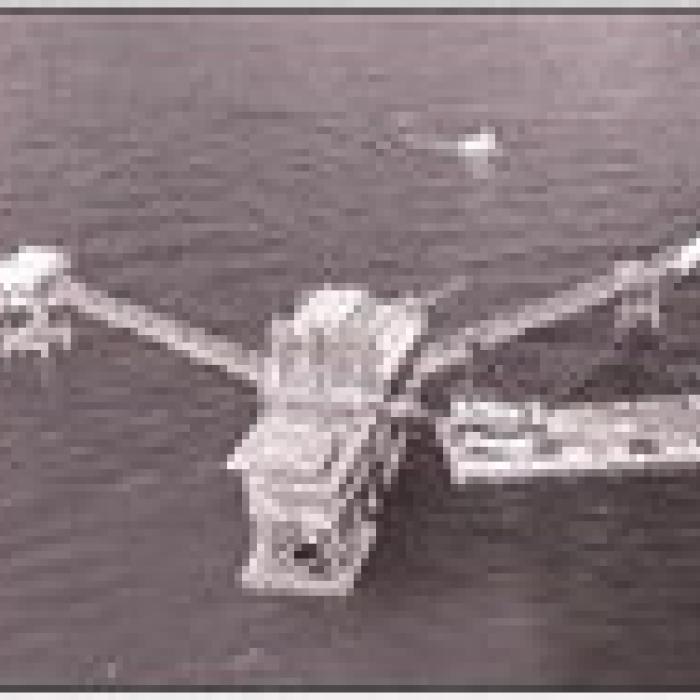
Brown & Root, Inc. hired Ray as a junior draftsman and immediately assigned him to an offshore project – a large compressor station in the Gulf of Mexico. After the engineering was completed, he was sent to the Houston Ship Channel fabrication yard to facilitate the piping and valving work on the mammoth structure. He stayed with the project through the final installation, learning critical hands-on lessons about offshore pipe design and construction every step of the way.
As time passed, Ray was earning what he considered to be good money, so he and Twila built a new house behind the old one. By then, Ray and Twila were the parents of three girls: Shannon, Shea and Lori. Tragically, Shannon, who was born with Cerebral palsy, died in 1992 at 23 years of age.
“Then things started to go bad in the old part of Humble. Even though we had a nice home surrounded by live oaks, pines, pecans and a hickory so large that three men couldn’t reach around it, the neighborhood had deteriorated. We understood there were a lot of drugs in the schools, so we had to move,” Ray remembers.
The family drove out to Fayette County to visit Ray’s aunt and uncle, Roy and Stella Weige. He had been born in their house in Schulenburg. Roy had run a shoe store there before joining the staff of Lauterstein’s in La Grange.
The Thurmans felt at home in Fayette County, so Ray called his old pal, Jack Cernosek, to ask if he would sell a couple of acres down on the Colorado River. Jack agreed but asked Ray and Twila to look at a home a local bank had acquired in a foreclosure on FM 155. It wasn’t long until the Thurman family sold their home in Humble and moved to La Grange. The only downside was Ray couldn’t begin to replicate his Brown & Root salary and benefits with a local job. There was only one thing to do; for the next 18 years, Ray commuted to and from Houston weekly. He also traveled a lot.
“During my 27 years with Brown & Root, I made more than 150 trips offshore in helicopters and a few more in boats. I was away from my wife and kids quite a bit. The kids would cry every time I had to leave. That was the downside of my Brown & Root career,” he explains.
Ray Frequents
Kazakhstan
The single largest project of Ray’s career kicked off in the early 1990s after Kazakhstan became independent from the Soviet Union. Kazakhstan was oil-rich with some of the largest, most prolific wells in the world.
“When the Soviets moved out, the Kazaks didn’t have the expertise to maximize oil production, so they contracted with Chevron. Right away, Chevron wanted to expand a refinery and an oil treating plant. They hired Brown & Root to design and build the projects. Brown & Root assigned me to the project as a piping engineer during the fabrication of some of the modules in Houston,” Ray says.
Pieces of this huge international project were being built around the world: pressure vessels in Italy, pipe racks in Belgium and electrical components from Germany.
A week after starting his assignment, Ray joined contractors from all over Europe at a teambuilding session in Bath, England. When the session ended, he was informed that he would be staying in England to critique the engineering being done in Brown & Root’s London office. Ray attempted to beg off by saying he had no clean clothes, but the excuse didn’t work. He was instructed to buy several suits and whatever else he would need for the next three months. One of the project’s biggest hurdles was getting all the pieces of the puzzle to Tengiz, Kazakhstan. How was Ray going to accomplish that?
“We set up a schedule. At Brown & Root’s Greens Bayou, 16 process modules with pumps and controls had been fabricated that measured 20 feet wide and 60 to 80 feet long. We put them on a ship that sailed across the Atlantic Ocean and up the Adriatic Sea, past Istanbul and into the Black Sea. We offloaded them on barges and shipped them up the Volga-Don Canal to Volgograd, Russia. From there, they traveled down the Volga River and into the Caspian Sea to Aktau, Kazakhstan. They were offloaded there onto railroad cars for the 400-mile journey to Tengiz, Kazakhstan. That took about 30 days.”
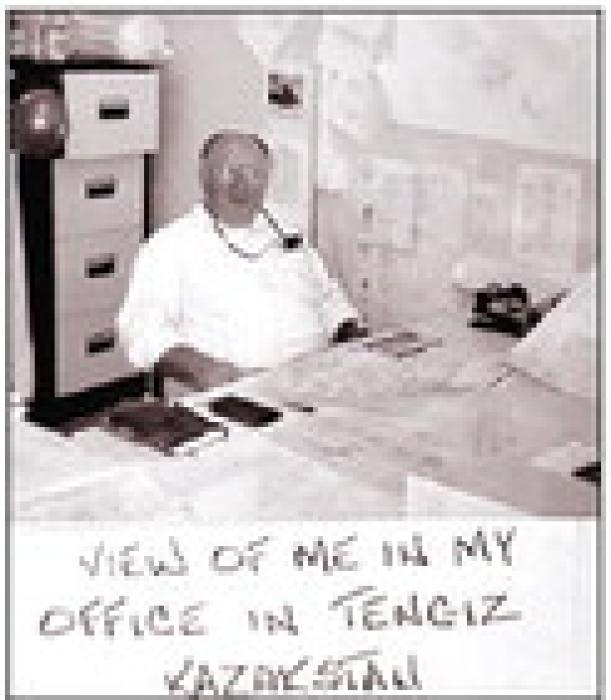
Reporting for work at Tengiz was almost as involved for Ray. The one-way commute was about 40 hours. Onsite, he was housed and fed in Chevron’s portable city for nearly a year. Although he could call Twila anytime through the project’s satellite communications, he had to remember the 10-hour time difference.
Other global projects challenged Ray’s acumen, particularly in relation to piping, support and valve materials. However, in 2000, he decided to retire to La Grange after a career of 16 years with United Gas Pipeline and 27 years with Brown & Root.
Pondering the Past
With work-related deadlines and demands no longer occupying his mind, Ray spends a little time revisiting his early memories.
“My dad, Gilbert Thurman Sr., was a railroader, a telegrapher back in the heyday of railroads. He was the only person I ever knew who could type incoming Morse code messages and read a newspaper at the same time. He moved around quite a bit, relieving other station agents who took vacation or were sick or for some other reason. When he was sent to New Ulm, Texas, he met my mother when she was 16. He went to my grandma’s house and told her he would wait awhile, because he was quite a bit older, but he was going to marry that girl, Virginia Richter. He did, and my parents had my brother, Jan Karl and me. We continued to move around a lot because of my dad’s work,” Ray says.
During World War II, he remembers the family lived in Bastrop with his Aunt Estella. It was there that both Ray and his brother got pneumonia. If the local doctor had not gotten penicillin from Camp Swift where his aunt worked, Jan would have died.
Ray recalls that in the later stages of World War II troop trains came through La Grange on their way to Bastrop. A high-ranking officer, a brigadier general, stepped off one of those trains. Ray and a pal playing army around the depot were shocked when the officer handed Ray his steel helmet with one star on it.
Snyder’s Cafe in La Grange contracted with the Army to feed the troops, so dozens of young men would get off a train and march in formation downtown to be fed. At the time, Ray’s Grandma Richter, with whom he later lived in Houston, worked in a downtown Bastrop jewelry store. A number of German prisoners housed at nearby Camp Swift would come by to see her when they were allowed to visit the town because she spoke German.
Today, Ray Thurman is a humble, contented man.
“Just being the head of this household and seeing my family flourish continues to bring me much happiness,” he says.