


Randolph High School: A Legacy of Education, Dignity And Perseverance
Part II of II
Giles A. Randolph, the retired principal of the La Grange Negro High School, passed away on November 1, 1945. Six months later, in May 1946, the La Grange I. S. D. School Board renamed the school in his memory, honoring Randolph’s thirty-one influential years at the school’s helm. In the 1940s many rural schools were consolidated and closed, resulting in students being bussed to Randolph from all over the county. In 1941, Principal William M. Collins was hired as part of a sixmember faculty. However, attendance grew so much that by May 1946 the school had fourteen faculty members. Randolph High School’s agriculture program was impressive enough that in 1947 five Prairie View University seniors received practice teaching in La Grange under W. M. Collins. The school’s band won second place and a handsome trophy in Class A in the state Interscholastic League contest held at Prairie View in March 1947.
However, in October 1947 Collins’tenure in La Grange abruptly ended. Two Randolph High School teachers were discharged by the white Superintendent for driving buses at excessive speeds. Incensed, the Randolph students staged a walk-out protest, leaving only the faculty and six students showing up for class. The walkout lasted three days and only ended when it became known that the other black teachers had lost their pay for those days because an insufficient number of students had attended classes.
In the end, the two discharged teachers were not re-instated and Principal Collins was fired for failure to prevent or terminate the walk-out. However, this was hardly the end of his career as an educator. Collins went on to receive a Doctorate of Education from Cornell University and teach at Huston-Tillotson College and St. Edward’s University in Austin, Southern University in Baton Rouge, Louisiana, Langston University at Langston, Oklahoma and several other colleges.
Since most of the rural schools had consolidated, local newspapers reported that the number of African American students at Randolph High School had risen from 115 students in 1923 to 253 students in 1947. The white school had seen similar growth, with crowded conditions forcing the School Board to build new classrooms and other facilities at both schools. The land adjacent to Randolph High School that held the two-story, wood-frame Calanthe Lodge building (formerly the Knights of Pythias Hall) was purchased and six new classrooms were planned for the school.
On April 23, 1948, before construction could begin, Julius Brown filed a lawsuit in Federal court at Houston to require the La Grange I. S. D. to provide school facilities for black students equal to those for white students. Brown filed the lawsuit on behalf of himself, as a taxpayer, and his 16-year-old daughter, Vivian Alpha Brown, a Randolph student, based on the May 18, 1896, Supreme Court decision, Plessy v. Ferguson, which introduced the doctrine of “separate but equal.” His petition charged that the school facilities maintained for African American students at La Grange were inadequate, unsanitary, and inferior to those provided white students of the district.
School Superintendent Charles A. Lemmons countered that some of the conditions mentioned also existed in the white school and that land for new classrooms had already been purchased and plans for the building were being prepared by an architect. The petition was withdrawn, but a similar petition was soon filed.
The case went to trial in December 1949. The following February Federal District Judge Kennerly found the suit in the school district’s favor. Judge Kennerly said the building at the Randolph School compared favorably with the buildings at the white schools in the La Grange school district. By the time the appeal was heard and dismissed in January 1951, students had been using the enlarged facility for more than a year.
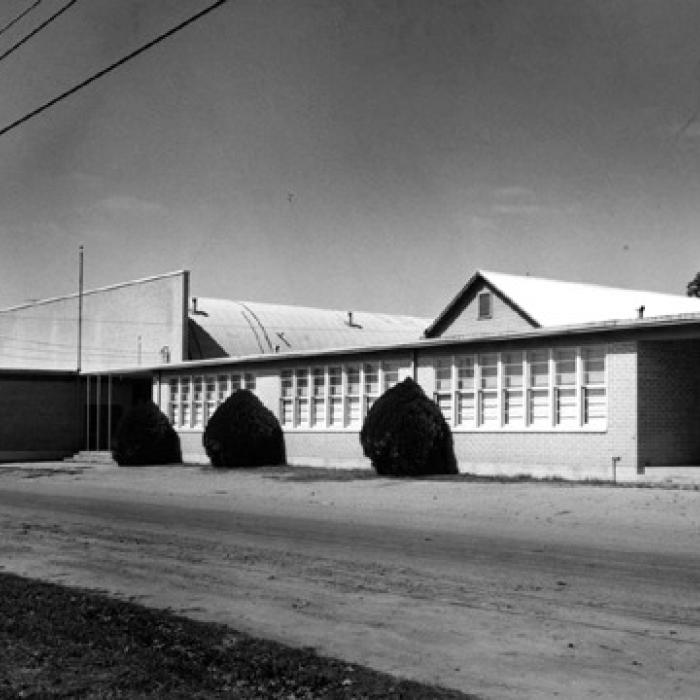
The architects placed the new gymnasium/ auditorium building to the west of the existing H-shaped building. A kitchen was located on its west wall. A stage on the north wall separated girls’ and boys’ dressing rooms and restrooms. Some of the original rooms were reconfigured and four new classrooms were built along Pearl Street in front of the original H-shaped building. The former auditorium was reworked into a study hall and separate science lab. Construction was complete when Randolph High School opened for the 1949 fall term with Shellie L. Hatch as the school’s new principal. (William M. Farris had served as principal for the 19481949 school year.) Because of student absences due to a late cotton crop that year, the Randolph School was closed for two weeks, which postponed the dedication of the new buildings until October 6th.
On May 17, 1954, La Grange’s well-established system of separate schools for black and white students again became the subject of scrutiny. On that day the U. S. Supreme Court handed down a unanimous decision in Brown v. Board of Education which overruled the “separate but equal” doctrine introduced by the decision in the Plessy v. Ferguson case. “Separate but equal educational facilities for racial minorities is inherently unequal, violating the Equal Protection Clause of the Fourteenth Amendment.”
Locally a bi-racial group was appointed by the La Grange I. S. D. on August 9, 1955, to make recommendations for “a systematic and effective method of integrating schools of the district.” However, resistance from white residents, aided by opinions from influential State Officials, meant that La Grange schools would remain segregated for another decade.
Meanwhile, the baby boom caused attendance in both schools to grow rapidly. Additionally, teen-aged black students from Flatonia, Round Top-Carmine and Fayetteville were all being bused into La Grange for high school. A school bond election passed in March 1956 and, the following January, footings and piers were completed for a 21 by 83-foot addition to the Randolph School that would include two equal-sized home economics and vocational agriculture classrooms. The construction of that addition, completed in May 1957, gave Randolph High School its current footprint.
Lorenza Crosby was hired as a vocational agriculture teacher at Randolph in 1959. He had just graduated from Prairie View A&M College and was eager to begin teaching agricultural mechanics, a skill he felt his students could use for the rest of their lives. His students learned how to repair tractors, fix engines, mend screens, pour concrete, and build steps, among other skills. The last building permit for Randolph High School was in 1964 for a vocational agriculture shop building, a rigid frame sheet metal building 36 feet by 40 feet in size, with 12-foot eaves that was to be completed by the fall term.
That summer, on July 2, 1964, President Lyndon Johnson signed The Civil Rights Act. This landmark legislation prohibited discrimination in public places, provided for the integration of schools and other public facilities, and made employment discrimination illegal. However, Randolph High School was still a segregated school when it opened on August 31, 1964, with 234 African American students. The status quo would remain until the La Grange I. S. D. Board of Trustees met on Wednesday, May 5, 1965 and passed an order that integration of La Grange schools would take place for the 1965-1966 school year in order to comply with Title VI of the Civil Rights Act, which prohibited the extension of Federal financial assistance to any dual or segregated system of schools based on race. At a PTA meeting later that month, Supt. C. A. Lemmons announced that the Randolph School would be renovated and opened in the fall as the La Grange Junior High School.
The final Randolph High School graduation and eighth-grade promotional exercises were held at Leopard Field on May 27, 1965. The names of all thirty-three high school graduates and thirty-two junior high graduates appeared in the local newspaper.
Randolph School principal Shellie Hatch was reassigned as a La Grange High School general science and biology teacher. Four other Randolph teachers, including Lorenza Crosby, were reassigned to the high school, but others were not offered local jobs. At least one of the passed over teachers, Myrtle Crosby, was finally rehired the following year.
On September 13, 1965, the former Randolph High School reopened as the La Grange Junior High School made up of seventh and eighth graders. However, there was no cafeteria and all junior high school students were bused to the Hermes cafeteria on the main campus for their noonday meals. The former kitchen area had been remodeled as a boys’ dressing room for physical education. The girls’ dressing room was on the opposite side of the gym. The school district also provided transportation between the main campus and the junior high campus for rural bus riders and any other students who lived closer to the main campus. Seventh and eighth graders from Sacred Heart Catholic School, just a block to the west on Pearl Street, joined the other junior high students for physical education classes. This continued only until 1970 when the junior high students were moved to the senior high school complex on Travis Street.
For a short while part of the building wase leased to the American Milk Producers Institute for temporary terminal facilities until the AMPI constructed a new plant. In 1972 students in vocational classes began converting the Randolph building into suitable classrooms for cosmetology and small engines and machinery repair courses. The buildings became known as the school’s Pearl Street Annex and by the late 1970s the classrooms were also used for the basic skills program taught by the high school’s Coordinated Vocational-Academic Education (CVAE) teacher.
After 1970 the school district never utilized the entire building. Besides classrooms, the building was also used by the Fayette County Appraisal Office in the 1980s before being completely shuttered. In 2004 the city of La Grange reopened the gymnasium as the Randolph Recreation Center. In May 2013 the Randolph Recreation-Activity Center complex opened its doors, offering recreation, exercise with fitness machines, meeting rooms, and rooms for activities such as arts and crafts, games, and quilting.
Since 1934 the brick school buildings that became known as Randolph High School in 1946 have served the community of La Grange. While originally built to serve African American children, the school also became the meeting place for organizations and services for the local black community. Its proud history as the Randolph School came to an end with school desegregation in 1965. However, G. A. Randolph’s legacy is still remembered as the Randolph Recreation-Activity Center continues to benefit the entire community.
Sources: Various issues of the La Grange Journal, Fayette County Record, N. F. A. News, and Austin American-Statesman Page, Southerland and Page blueprints for Randolph High School, 1948, Fayette Heritage Museum & Archives Master Plan for the Randolph School, FHMA
Footprints Of Fayette
Fayette County is one of the most historic counties in Texas. In this weekly feature from the County Historical Commission, a rotating group of writers looks back at local history.