


House Candidates Differ on Approach to River Hearing
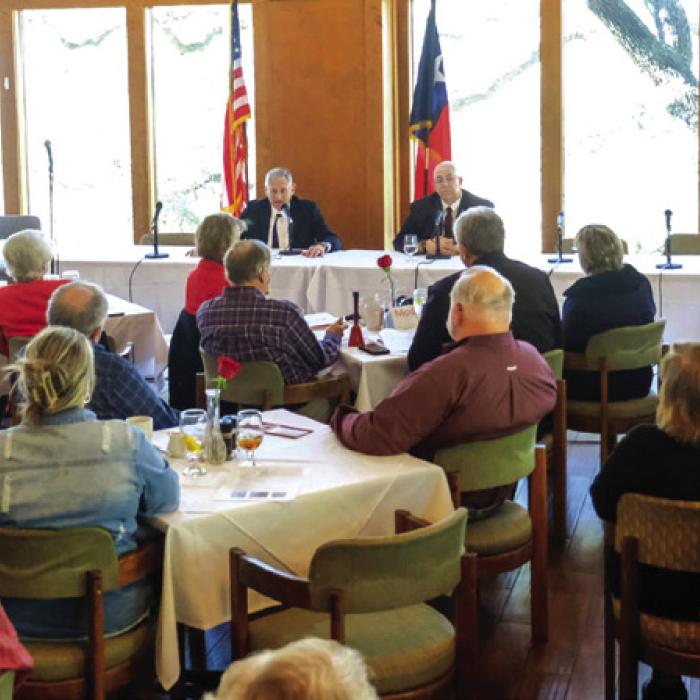
Fayette County’s relationship with the Lower Colorado River Authority (LCRA) was once again a topic of discussion at the latest local election forum.
At the Fayette County Republican Party forum in Ellinger two weeks ago, the County Judge candidates were asked about LCRA’s recent application to relax pollution reporting requirements at the Fayette Power Project. Last Saturday during the second forum at Frisch Auf Country Club, the two Republican candidates for Texas House District 85 fielded a similar question.
Moderator Ken Dernehl asked the incumbent, State Rep. Stan Kitzman, and his challenger, Dennis Geesaman from Flatonia, the following questions: “What is your position on the issue of the Lower Colorado River Authority wanting to release more toxins into the Colorado River? Are you in support of a public meeting being held in Fayette County to address the concerns of the community?”
Before getting to their responses, here is some backstory.
In July of last year, LCRA published a public notice about an application to amend its wastewater discharge permit with the Texas Commission on Environmental Quality (TCEQ). Among the changes, LCRA wants to relax discharge limits for certain pollutants, including selenium.
Selenium can be toxic to aquatic life and humans. Runoff from the plant enters Cedar Creek and its various tributaries before eventually discharging into the Colorado River below La Grange. LCRA requested the same changes back in 2022. At that time, then-County Judge Joe Weber called for LCRA and TCEQ to hold a public hearing in Fayette County. Weber wanted LCRA and TCEQ to ensure citizens that the changes would not negatively affect the local environment. LCRA later withdrew the permit application.
Similarly, after LCRA resubmitted the application last July, County Judge Dan Mueller wrote a letter to TCEQ, and he sent copies to State Senator Lois Kolkhorst and Rep. Kitzman. In the letter dated Sept. 16, 2025, Mueller asked state officials to schedule a public hearing so that experts can explain to the citizens of Fayette County that no harm will come from these changes.
On Oct. 14, Kitzman sent his own letter to TCEQ requesting a hearing.
“As the State Representative for House District 85, which includes constituents directly affected by the Fayette Power Project and its surrounding communities, I am writing to formally request that the Texas Commission on Environment Quality hold a public hearing regarding the proposed environmental quality changes related to the facility,” Kitzman wrote in his Oct. 14 letter.
“My constituents have expressed deep concern and a strong desire for transparency and public engagement in the decision-making process,” the letter went on to say. “A public hearing would provide an essential opportunity for residents, local officials, and stakeholders to review the proposed changes, ask questions, and share their perspectives before any final decisions are made. It is crucial that this process be conducted with full public input to ensure confidence in TCEQ’s mission to protect human and natural resources consistent with sustainable economic development.”
Kitzman reversed course two weeks later. On Oct. 30, one of his staffers sent a one-sentence email to TCEQ withdrawing his request for a hearing. The Record called Rep. Kitzman’s office in early December to ask why he withdrew the request. He never responded to our inquiry.
When the question came up during the forum at Frisch Auf on Saturday, Geesaman responded first and said he wants a public hearing on the matter.
“I’ve actually requested – I don’t have any authority to have that happen – but I requested to have a public hearing,” Geesaman said. “Of course, I don’t want any increased toxins, if that causes any kind of a problem, released into the Colorado River from the plant. But the idea that we didn’t even get a public hearing and my opponent here withdrew the request for a public hearing, that’s very disconcerting.”
When it was Kitzman’s See time to speak, he denied that LCRA wants to release more toxins into the Colorado River. Kitzman suggested that the limits on selenium were never appropriate for the power plant. Furthermore, Kitzman said he withdrew his request because he didn’t want a public hearing to “become a show for the far left.”
“Well, first, the Lower Colorado River Authority is not trying to release more toxins into the Colorado River,” Kitzman said. “Now, if we’re talking about the permit for the power plant in Fayetteville, that part of the original permit was not appropriate to the permit, and so that’s why it was removed from this application for renewal. There are public comment periods. All that goes through the normal process with TCEQ, which is a state agency that oversees those things. The idea that the LCRA would want to poison the people of Fayette County is pretty far-fetched. But we do need the power. And so where I stand is we need every kilowatt that we can get.”
Kitzman went on to say: “What happens is these applications are exploited by the radical leftists and environmentalists to try to at least inhibit or make it cost prohibitive for the permits or cost the taxpayers even more money, or if they got their real wish, it would shut down the whole plant. That’s not what I’m about. That’s why we withdrew that application. We didn’t want that to become a show for the far left. But the LCRA is going to continue to provide power for us and provide the tax base for us and do what we need to do to take care of the citizens of Fayette County.”